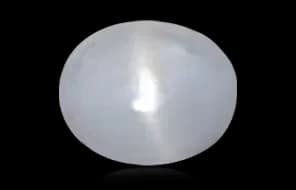
White Moonstone
White Moonstone is prized for its soft body color and luminous adularescence, a floating sheen that gives the gemstone its distinctive moonlit character in jewelry.
White Moonstone is a gem-quality feldspar known for its characteristic adularescence, the soft glow that appears to move across the surface as the stone is viewed from different angles. Moonstone is commonly associated with the feldspar mineral orthoclase, with its optical appearance developing from microscopic intergrowths between feldspar components. Its standard gemological chemistry is commonly represented as KAlSi3O8. Moonstone has a Mohs hardness of 6.0 to 6.5, a refractive index of approximately 1.518 to 1.526, and a specific gravity around 2.58. It has two directions of cleavage and relatively poor toughness, so its durability should be considered when choosing jewelry. White Moonstone ranges from nearly colorless and transparent to milky white and translucent, with white, silver, or blue adularescence. The finest material is often valued for a clean, glassy body and strong, mobile blue sheen. Moonstone occurs in important gem-producing regions including Sri Lanka and India, as well as Madagascar, Tanzania, Myanmar and Brazil. Sri Lanka is especially notable for its moonstone deposits, including the well-known Meetiyagoda area. Moonstone has a long history in jewelry and decorative arts and was especially popular with Art Nouveau designers such as René Lalique and Louis Comfort Tiffany. Today, White Moonstone is used in rings, pendants, earrings, bracelets and cabochon jewelry, although protected settings are preferable because of its cleavage and modest hardness. Buyers value White Moonstone for its distinctive optical phenomenon, soft neutral appearance, natural variation and ability to complement both contemporary and vintage-inspired designs. As a modern symbolic association, the name and appearance of White Moonstone are often connected with calmness, reflection and new beginnings, but these are cultural or aesthetic meanings rather than scientific properties.
- Mineral Family
- Feldspar
- Chemical Formula
- KAlSi3O8
- Mohs Hardness
- 6.0 - 6.5
- Refractive Index
- 1.518 - 1.526
- Specific Gravity
- 2.58
- Cleavage
- Two directions of cleavage
- Crystal System
- Monoclinic
- Luster
- Pearly
- Color Range
- White, Gray, Yellow, Green, Orange
When buying White Moonstone, focus first on the quality of its adularescence, body color and clarity. Colorless to white material with a strong, attractive blue sheen is generally the most sought after, although attractive white, gray and other body colors can also be desirable. The sheen should appear lively and reasonably broad across the cabochon rather than being visible only from one narrow viewing angle. Clarity is also important: translucent to nearly transparent material with fewer distracting inclusions is generally preferred, although some natural inclusions are normal. Cut should be evaluated for how effectively it displays the optical effect. Smooth domed cabochons are the traditional choice because the curved surface helps concentrate the sheen and makes it easier to observe. Faceted and rose-cut Moonstone are also available, particularly when the material is sufficiently transparent. Carat weight affects price, but quality becomes increasingly important as size increases because fine, clean material is less common in larger sizes. Origin can add interest and provenance, but it should not automatically determine value; appearance and quality are usually more important. Ask whether the stone is natural and whether any treatment has been applied. Moonstone can be encountered with treatments such as fracture filling, so sellers should clearly disclose any treatment. Natural Moonstone should not be confused with glass or other imitations. Rainbow Moonstone also requires special attention: although widely sold under the trade name, it is generally transparent labradorite rather than traditional orthoclase Moonstone. Laboratory-grown or imitation material should be clearly disclosed rather than presented as natural Moonstone. For higher-value stones, an independent gemological report can help document identity, natural status and detectable treatments. Before you buy White Moonstone online, review detailed photographs or video from multiple angles, confirm dimensions and carat weight, ask about treatments and return policies, and purchase from a seller willing to provide transparent product information. Price is influenced by sheen strength, body color, clarity, cut, size, origin, treatment status and overall craftsmanship rather than carat weight alone.
White Moonstone requires more care than harder gemstones because its Mohs hardness is 6.0 to 6.5, it has two cleavage directions and relatively poor toughness. Clean it gently with warm water, mild soap and a soft brush. Rinse thoroughly and dry with a soft cloth. Avoid ultrasonic and steam cleaners, which can damage Moonstone. Protect the gem from hard impacts, especially around its edges and corners, because a strong blow can cause cleavage or fractures. High heat and sudden temperature changes should also be avoided. For everyday wear, pendants, earrings and protected settings are generally safer choices than rings exposed to frequent knocks. If worn in a ring, remove it before sports, heavy manual work, gardening or other activities where impact is likely. Store White Moonstone separately from harder gemstones such as diamond, sapphire and ruby to reduce the risk of scratches. A soft fabric pouch or individual jewelry compartment is ideal. Avoid harsh chemicals and prolonged exposure to unsuitable cleaning agents. With gentle handling and appropriate storage, natural White Moonstone can retain its attractive sheen for many years.
White Moonstone is a gem-quality feldspar known for its characteristic adularescence, the soft glow that appears to move across the surface as the stone is viewed from different angles. Moonstone is commonly associated with the feldspar mineral orthoclase, with its optical appearance developing from microscopic intergrowths between feldspar components. Its standard gemological chemistry is commonly represented as KAlSi3O8. Moonstone has a Mohs hardness of 6.0 to 6.5, a refractive index of approximately 1.518 to 1.526, and a specific gravity around 2.58. It has two directions of cleavage and relatively poor toughness, so its durability should be considered when choosing jewelry. White Moonstone ranges from nearly colorless and transparent to milky white and translucent, with white, silver, or blue adularescence. The finest material is often valued for a clean, glassy body and strong, mobile blue sheen. Moonstone occurs in important gem-producing regions including Sri Lanka and India, as well as Madagascar, Tanzania, Myanmar and Brazil. Sri Lanka is especially notable for its moonstone deposits, including the well-known Meetiyagoda area. Moonstone has a long history in jewelry and decorative arts and was especially popular with Art Nouveau designers such as René Lalique and Louis Comfort Tiffany. Today, White Moonstone is used in rings, pendants, earrings, bracelets and cabochon jewelry, although protected settings are preferable because of its cleavage and modest hardness. Buyers value White Moonstone for its distinctive optical phenomenon, soft neutral appearance, natural variation and ability to complement both contemporary and vintage-inspired designs. As a modern symbolic association, the name and appearance of White Moonstone are often connected with calmness, reflection and new beginnings, but these are cultural or aesthetic meanings rather than scientific properties.
- Mineral Family
- Feldspar
- Chemical Formula
- KAlSi3O8
- Mohs Hardness
- 6.0 - 6.5
- Refractive Index
- 1.518 - 1.526
- Specific Gravity
- 2.58
- Cleavage
- Two directions of cleavage
- Crystal System
- Monoclinic
- Luster
- Pearly
- Color Range
- White, Gray, Yellow, Green, Orange
When buying White Moonstone, focus first on the quality of its adularescence, body color and clarity. Colorless to white material with a strong, attractive blue sheen is generally the most sought after, although attractive white, gray and other body colors can also be desirable. The sheen should appear lively and reasonably broad across the cabochon rather than being visible only from one narrow viewing angle. Clarity is also important: translucent to nearly transparent material with fewer distracting inclusions is generally preferred, although some natural inclusions are normal. Cut should be evaluated for how effectively it displays the optical effect. Smooth domed cabochons are the traditional choice because the curved surface helps concentrate the sheen and makes it easier to observe. Faceted and rose-cut Moonstone are also available, particularly when the material is sufficiently transparent. Carat weight affects price, but quality becomes increasingly important as size increases because fine, clean material is less common in larger sizes. Origin can add interest and provenance, but it should not automatically determine value; appearance and quality are usually more important. Ask whether the stone is natural and whether any treatment has been applied. Moonstone can be encountered with treatments such as fracture filling, so sellers should clearly disclose any treatment. Natural Moonstone should not be confused with glass or other imitations. Rainbow Moonstone also requires special attention: although widely sold under the trade name, it is generally transparent labradorite rather than traditional orthoclase Moonstone. Laboratory-grown or imitation material should be clearly disclosed rather than presented as natural Moonstone. For higher-value stones, an independent gemological report can help document identity, natural status and detectable treatments. Before you buy White Moonstone online, review detailed photographs or video from multiple angles, confirm dimensions and carat weight, ask about treatments and return policies, and purchase from a seller willing to provide transparent product information. Price is influenced by sheen strength, body color, clarity, cut, size, origin, treatment status and overall craftsmanship rather than carat weight alone.
White Moonstone requires more care than harder gemstones because its Mohs hardness is 6.0 to 6.5, it has two cleavage directions and relatively poor toughness. Clean it gently with warm water, mild soap and a soft brush. Rinse thoroughly and dry with a soft cloth. Avoid ultrasonic and steam cleaners, which can damage Moonstone. Protect the gem from hard impacts, especially around its edges and corners, because a strong blow can cause cleavage or fractures. High heat and sudden temperature changes should also be avoided. For everyday wear, pendants, earrings and protected settings are generally safer choices than rings exposed to frequent knocks. If worn in a ring, remove it before sports, heavy manual work, gardening or other activities where impact is likely. Store White Moonstone separately from harder gemstones such as diamond, sapphire and ruby to reduce the risk of scratches. A soft fabric pouch or individual jewelry compartment is ideal. Avoid harsh chemicals and prolonged exposure to unsuitable cleaning agents. With gentle handling and appropriate storage, natural White Moonstone can retain its attractive sheen for many years.
White Moonstone for Sale
No gems found
Try broadening your search or adjusting your filters.
Have a gem of your own? List it free - no fees