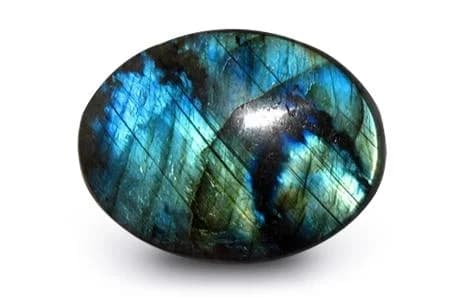
Spectrolite
Spectrolite is a striking variety of labradorite known for vivid, multi-color labradorescence. Its dark body and shifting flashes make it an appealing choice for distinctive jewelry and collectors.
Spectrolite is a trade name traditionally associated with fine-quality Finnish labradorite, a member of the plagioclase feldspar series. It is not a separate mineral species. The name is especially associated with material from the Ylämaa area of southeastern Finland that displays unusually broad and vivid labradorescence, often showing several colors as the stone is moved under light. Labradorite has a calcium-sodium aluminosilicate composition, commonly expressed as (Ca,Na)(Al,Si)4O8, and crystallizes in the triclinic system. It typically has a Mohs hardness of 6 to 6.5, a specific gravity of about 2.68 to 2.72, and refractive indices in the approximate range of 1.554 to 1.573. Its luster is vitreous and can appear pearly on cleavage surfaces, while cleavage is strong in two directions. The body color of Spectrolite is commonly dark gray to black, with labradorescent flashes that may include blue, green, yellow, orange, red and violet-purple tones. Labradorescence is an optical phenomenon produced by light interacting with microscopic internal structures within the feldspar, creating shifting bands of color rather than a uniform surface color. The term Spectrolite has a strong historical connection with Finland. Finnish material became particularly notable after spectacular labradorite was encountered in the Ylämaa region during work associated with the Salpa Line in 1940. Today, the name may be used more broadly in commerce for exceptionally colorful labradorite, so buyers should ask for the precise mineral identification and origin stated by the seller or laboratory. Fine Spectrolite is most commonly fashioned as a cabochon because a curved polished surface can showcase its moving color effect. It is also used for pendants, earrings, statement rings and collector pieces. Because of its moderate hardness and pronounced cleavage, it is better suited to jewelry that receives less impact than everyday hard-wearing stones such as sapphire. Buyers value natural Spectrolite primarily for the intensity, coverage and movement of its labradorescence, attractive dark body color, quality of polish and overall uniqueness.
- Mineral Family
- Feldspar
- Chemical Formula
- (Ca,Na)(Al,Si)4O8
- Mohs Hardness
- 6 - 6.5
- Refractive Index
- 1.554 - 1.573
- Specific Gravity
- 2.68 - 2.72
- Cleavage
- Perfect in two directions
- Crystal System
- Triclinic
- Luster
- Vitreous
- Color Range
- Black, Gray, Blue, Green, Yellow, Orange, Red, Purple
When buying Spectrolite, start with the quality of the labradorescence rather than simply the number of colors listed in a description. Color is usually the most important visual consideration: look for vivid, well-defined flashes with strong contrast against a dark gray or black body. Stones showing blue, green, yellow, orange, red and purple flashes can be especially attractive, but personal preference and pattern are important. Clarity should be judged differently from transparent gemstones. Internal structures, inclusions and lamellae are part of the natural material and can contribute to the optical effect. More important than complete clarity is a sound stone with a smooth polish and no prominent surface-reaching fractures that could weaken it. Cut is commonly a cabochon, and the best orientation is the one that presents the strongest and broadest labradorescence from the intended viewing direction. Oval, round, pear, marquise and freeform shapes are common. Carat weight affects price, but Spectrolite value is not determined by size alone; color quality, pattern, polish, thickness and overall visual impact can be more important. Origin matters because the name Spectrolite has a historical association with Finland, particularly Ylämaa. If a seller claims Finnish origin, ask whether the origin can be documented. Treatments are not normally required to create the natural labradorescent effect, and untreated material is widely available. Any treatment, such as surface enhancement or oiling, should be disclosed before purchase. There is no widely established laboratory-grown equivalent marketed as natural Spectrolite; a buyer should distinguish natural labradorite from simulants or laboratory-created materials. For higher-value purchases, an independent gemological report can help confirm the material as natural labradorite and may document detectable treatments and, where possible, origin. A certificate should not be treated as a substitute for inspecting the stone itself. For authenticity, buy from a reputable seller, request clear photographs or videos showing the color from multiple angles, confirm dimensions and weight, and check whether the description clearly distinguishes Spectrolite as a trade name from the underlying labradorite mineral. Price is influenced by the intensity and coverage of labradorescence, body color, polish, surface condition, size, shape, origin claims, provenance, treatment status and seller reputation. Comparing stones by appearance and documented quality is more meaningful than relying on a fixed price per carat.
Spectrolite can be enjoyed in jewelry, but its 6 to 6.5 Mohs hardness and pronounced cleavage mean it should be treated with care. Clean it with lukewarm water, a small amount of mild soap and a soft cloth or soft brush. Rinse gently and dry thoroughly with a lint-free cloth. Avoid ultrasonic cleaners and steam cleaning because vibration, heat or sudden temperature changes may increase the risk of damage. Keep Spectrolite away from harsh chemicals, abrasive cleaners and prolonged exposure to strong impacts. Remove Spectrolite rings before sports, heavy household work or activities where the stone could strike a hard surface. For storage, keep each piece in a soft pouch or a separate compartment so the gemstone does not rub against harder jewelry. When setting Spectrolite, jewelers should account for its cleavage and avoid excessive pressure during mounting. With sensible handling, a well-polished Spectrolite piece can retain its distinctive color play and luster for many years.
Spectrolite is a trade name traditionally associated with fine-quality Finnish labradorite, a member of the plagioclase feldspar series. It is not a separate mineral species. The name is especially associated with material from the Ylämaa area of southeastern Finland that displays unusually broad and vivid labradorescence, often showing several colors as the stone is moved under light. Labradorite has a calcium-sodium aluminosilicate composition, commonly expressed as (Ca,Na)(Al,Si)4O8, and crystallizes in the triclinic system. It typically has a Mohs hardness of 6 to 6.5, a specific gravity of about 2.68 to 2.72, and refractive indices in the approximate range of 1.554 to 1.573. Its luster is vitreous and can appear pearly on cleavage surfaces, while cleavage is strong in two directions. The body color of Spectrolite is commonly dark gray to black, with labradorescent flashes that may include blue, green, yellow, orange, red and violet-purple tones. Labradorescence is an optical phenomenon produced by light interacting with microscopic internal structures within the feldspar, creating shifting bands of color rather than a uniform surface color. The term Spectrolite has a strong historical connection with Finland. Finnish material became particularly notable after spectacular labradorite was encountered in the Ylämaa region during work associated with the Salpa Line in 1940. Today, the name may be used more broadly in commerce for exceptionally colorful labradorite, so buyers should ask for the precise mineral identification and origin stated by the seller or laboratory. Fine Spectrolite is most commonly fashioned as a cabochon because a curved polished surface can showcase its moving color effect. It is also used for pendants, earrings, statement rings and collector pieces. Because of its moderate hardness and pronounced cleavage, it is better suited to jewelry that receives less impact than everyday hard-wearing stones such as sapphire. Buyers value natural Spectrolite primarily for the intensity, coverage and movement of its labradorescence, attractive dark body color, quality of polish and overall uniqueness.
- Mineral Family
- Feldspar
- Chemical Formula
- (Ca,Na)(Al,Si)4O8
- Mohs Hardness
- 6 - 6.5
- Refractive Index
- 1.554 - 1.573
- Specific Gravity
- 2.68 - 2.72
- Cleavage
- Perfect in two directions
- Crystal System
- Triclinic
- Luster
- Vitreous
- Color Range
- Black, Gray, Blue, Green, Yellow, Orange, Red, Purple
When buying Spectrolite, start with the quality of the labradorescence rather than simply the number of colors listed in a description. Color is usually the most important visual consideration: look for vivid, well-defined flashes with strong contrast against a dark gray or black body. Stones showing blue, green, yellow, orange, red and purple flashes can be especially attractive, but personal preference and pattern are important. Clarity should be judged differently from transparent gemstones. Internal structures, inclusions and lamellae are part of the natural material and can contribute to the optical effect. More important than complete clarity is a sound stone with a smooth polish and no prominent surface-reaching fractures that could weaken it. Cut is commonly a cabochon, and the best orientation is the one that presents the strongest and broadest labradorescence from the intended viewing direction. Oval, round, pear, marquise and freeform shapes are common. Carat weight affects price, but Spectrolite value is not determined by size alone; color quality, pattern, polish, thickness and overall visual impact can be more important. Origin matters because the name Spectrolite has a historical association with Finland, particularly Ylämaa. If a seller claims Finnish origin, ask whether the origin can be documented. Treatments are not normally required to create the natural labradorescent effect, and untreated material is widely available. Any treatment, such as surface enhancement or oiling, should be disclosed before purchase. There is no widely established laboratory-grown equivalent marketed as natural Spectrolite; a buyer should distinguish natural labradorite from simulants or laboratory-created materials. For higher-value purchases, an independent gemological report can help confirm the material as natural labradorite and may document detectable treatments and, where possible, origin. A certificate should not be treated as a substitute for inspecting the stone itself. For authenticity, buy from a reputable seller, request clear photographs or videos showing the color from multiple angles, confirm dimensions and weight, and check whether the description clearly distinguishes Spectrolite as a trade name from the underlying labradorite mineral. Price is influenced by the intensity and coverage of labradorescence, body color, polish, surface condition, size, shape, origin claims, provenance, treatment status and seller reputation. Comparing stones by appearance and documented quality is more meaningful than relying on a fixed price per carat.
Spectrolite can be enjoyed in jewelry, but its 6 to 6.5 Mohs hardness and pronounced cleavage mean it should be treated with care. Clean it with lukewarm water, a small amount of mild soap and a soft cloth or soft brush. Rinse gently and dry thoroughly with a lint-free cloth. Avoid ultrasonic cleaners and steam cleaning because vibration, heat or sudden temperature changes may increase the risk of damage. Keep Spectrolite away from harsh chemicals, abrasive cleaners and prolonged exposure to strong impacts. Remove Spectrolite rings before sports, heavy household work or activities where the stone could strike a hard surface. For storage, keep each piece in a soft pouch or a separate compartment so the gemstone does not rub against harder jewelry. When setting Spectrolite, jewelers should account for its cleavage and avoid excessive pressure during mounting. With sensible handling, a well-polished Spectrolite piece can retain its distinctive color play and luster for many years.
Spectrolite for Sale
No gems found
Try broadening your search or adjusting your filters.
Have a gem of your own? List it free - no fees