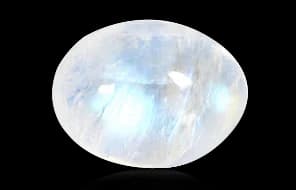
Rainbow Moonstone
Rainbow Moonstone is a luminous labradorite prized for its translucent body and flashes of blue, orange, pink and other colors, making it an enchanting choice for distinctive jewelry.
Rainbow Moonstone is a trade name for a light-colored, often transparent to translucent variety of labradorite, a plagioclase feldspar. Despite its name, it is not technically moonstone: gemological sources identify rainbow moonstone as labradorite displaying attractive iridescence. The feldspar family is one of the most important mineral groups in the Earth's crust, and labradorite is an intermediate member of the albite-anorthite series. Its general chemical formula is (Ca,Na)[Al(Al,Si)Si2O8]. Rainbow Moonstone has a triclinic crystal system, hardness of 6-6.5 on the Mohs scale, refractive indices approximately 1.554-1.573, and specific gravity commonly around 2.68-2.72. Its luster ranges from sub-vitreous to vitreous. Like other feldspars, it has perfect cleavage, so impact resistance is an important consideration when choosing jewelry. The defining visual feature is its multicolored iridescence, often described as labradorescence. Fine material can show blue, orange, pink, yellow, green or multicolor flashes moving across a pale bodycolor as the stone is tilted. GIA research has documented high-quality transparent rainbow moonstone from Madagascar confirmed as labradorite, while earlier gemological literature also records rainbow-moonstone-like labradorite from India. The phenomenon results from internal lamellar structures within the feldspar that interact with light. Historically, labradorite takes its mineral name from Labrador, Canada, where the mineral was first recognized, while rainbow moonstone became established as a jewelry and gem trade name for attractive light-colored labradorite with diffuse multicolor iridescence. Today, Rainbow Moonstone is popular in cabochons, faceted stones, rings, pendants, earrings, bracelets and collector pieces. Cabochons can emphasize broad flashes across the surface, while transparent material may be faceted to showcase internal color. Buyers value Rainbow Moonstone for its distinctive optical character, natural individuality and ability to produce an unusual combination of soft bodycolor and vivid iridescent flashes. Modern gemological references also emphasize that the trade name should not be confused with true moonstone, which is a different feldspar material producing adularescence.
- Mineral Family
- Feldspar
- Chemical Formula
- (Ca,Na)[Al(Al,Si)Si2O8]
- Mohs Hardness
- 6 - 6.5
- Refractive Index
- 1.554 - 1.573
- Specific Gravity
- 2.68 - 2.72
- Cleavage
- Perfect in two directions
- Crystal System
- Triclinic
- Luster
- Vitreous
- Color Range
- White, Gray, Blue, Pink, Orange, Green
When buying Rainbow Moonstone gemstone, evaluate the stone as a combination of bodycolor, transparency, iridescence, clarity, cut and overall visual balance. Color: Pale or near-colorless material with attractive blue, orange, pink, green or multicolor flashes is highly appealing. The most important factor is not simply the number of colors but the strength, distribution and liveliness of the optical effect. Clarity: Transparent to translucent material is generally preferred, particularly when it allows the internal flash to appear clearly. Natural inclusions and fractures can occur, and excessive fractures may reduce durability and visual appeal. Cut: Cabochons remain an effective choice for displaying broad iridescent flashes, while transparent material can be faceted in shapes such as oval, round, cushion, heart and hexagon. The orientation of the cut is important because it determines how the optical effect appears when the stone is viewed. Carat: Rainbow Moonstone is available in a range of sizes. Price does not depend on weight alone; fine color, transparency, strong iridescence and attractive cutting can create substantial premiums. Origin: Madagascar is an important source of notable transparent rainbow moonstone material, while labradorite showing rainbow-moonstone-like appearances has also been documented from other localities. Origin should be treated as one factor rather than a guarantee of quality. Treatments: Buyers should ask whether the stone has been dyed, coated, filled, assembled or otherwise treated. Natural material should be clearly represented, and any treatment should be disclosed. Natural vs lab-grown: Rainbow Moonstone sold as a natural gemstone should be identified as natural labradorite. Do not assume that every stone marketed under the name Rainbow Moonstone is automatically natural; imitations and assembled materials have been documented. Certification: For higher-value stones, an independent gemological report can help confirm the material identity, natural status and any detectable treatments. Authenticity: Visual appearance alone is not sufficient for reliable identification. A qualified gemologist or reputable laboratory can distinguish natural labradorite from moonstone and from imitations. Price factors: Value is influenced primarily by transparency, strength and distribution of iridescence, bodycolor, clarity, cut quality, size, treatment status, origin claims and overall beauty. A strong, well-positioned blue or multicolor flash across a clean, attractive stone can command a premium. When you buy Rainbow Moonstone online, request clear photographs or videos taken from several angles and confirm the seller's disclosure of material, treatments and certification where applicable.
Rainbow Moonstone jewelry should be handled with care because its 6-6.5 Mohs hardness and perfect cleavage make it susceptible to scratching, chipping and breakage from sharp impacts. Clean the gemstone with lukewarm water, mild soap and a soft cloth or soft brush. Avoid ultrasonic and steam cleaners, strong chemicals, hydrofluoric acid and sudden temperature changes. Store each stone separately in a soft pouch or lined compartment so it does not rub against harder gemstones or metal. For everyday wear, pendants and earrings are generally safer choices than rings because they receive fewer impacts. If used in a ring, choose a protective setting and remove the jewelry before sports, heavy work or activities where the stone could be struck. Regularly inspect the setting and mounting for looseness, especially after an impact. These simple precautions help preserve the polish and beautiful iridescent display of natural Rainbow Moonstone.
Rainbow Moonstone is a trade name for a light-colored, often transparent to translucent variety of labradorite, a plagioclase feldspar. Despite its name, it is not technically moonstone: gemological sources identify rainbow moonstone as labradorite displaying attractive iridescence. The feldspar family is one of the most important mineral groups in the Earth's crust, and labradorite is an intermediate member of the albite-anorthite series. Its general chemical formula is (Ca,Na)[Al(Al,Si)Si2O8]. Rainbow Moonstone has a triclinic crystal system, hardness of 6-6.5 on the Mohs scale, refractive indices approximately 1.554-1.573, and specific gravity commonly around 2.68-2.72. Its luster ranges from sub-vitreous to vitreous. Like other feldspars, it has perfect cleavage, so impact resistance is an important consideration when choosing jewelry. The defining visual feature is its multicolored iridescence, often described as labradorescence. Fine material can show blue, orange, pink, yellow, green or multicolor flashes moving across a pale bodycolor as the stone is tilted. GIA research has documented high-quality transparent rainbow moonstone from Madagascar confirmed as labradorite, while earlier gemological literature also records rainbow-moonstone-like labradorite from India. The phenomenon results from internal lamellar structures within the feldspar that interact with light. Historically, labradorite takes its mineral name from Labrador, Canada, where the mineral was first recognized, while rainbow moonstone became established as a jewelry and gem trade name for attractive light-colored labradorite with diffuse multicolor iridescence. Today, Rainbow Moonstone is popular in cabochons, faceted stones, rings, pendants, earrings, bracelets and collector pieces. Cabochons can emphasize broad flashes across the surface, while transparent material may be faceted to showcase internal color. Buyers value Rainbow Moonstone for its distinctive optical character, natural individuality and ability to produce an unusual combination of soft bodycolor and vivid iridescent flashes. Modern gemological references also emphasize that the trade name should not be confused with true moonstone, which is a different feldspar material producing adularescence.
- Mineral Family
- Feldspar
- Chemical Formula
- (Ca,Na)[Al(Al,Si)Si2O8]
- Mohs Hardness
- 6 - 6.5
- Refractive Index
- 1.554 - 1.573
- Specific Gravity
- 2.68 - 2.72
- Cleavage
- Perfect in two directions
- Crystal System
- Triclinic
- Luster
- Vitreous
- Color Range
- White, Gray, Blue, Pink, Orange, Green
When buying Rainbow Moonstone gemstone, evaluate the stone as a combination of bodycolor, transparency, iridescence, clarity, cut and overall visual balance. Color: Pale or near-colorless material with attractive blue, orange, pink, green or multicolor flashes is highly appealing. The most important factor is not simply the number of colors but the strength, distribution and liveliness of the optical effect. Clarity: Transparent to translucent material is generally preferred, particularly when it allows the internal flash to appear clearly. Natural inclusions and fractures can occur, and excessive fractures may reduce durability and visual appeal. Cut: Cabochons remain an effective choice for displaying broad iridescent flashes, while transparent material can be faceted in shapes such as oval, round, cushion, heart and hexagon. The orientation of the cut is important because it determines how the optical effect appears when the stone is viewed. Carat: Rainbow Moonstone is available in a range of sizes. Price does not depend on weight alone; fine color, transparency, strong iridescence and attractive cutting can create substantial premiums. Origin: Madagascar is an important source of notable transparent rainbow moonstone material, while labradorite showing rainbow-moonstone-like appearances has also been documented from other localities. Origin should be treated as one factor rather than a guarantee of quality. Treatments: Buyers should ask whether the stone has been dyed, coated, filled, assembled or otherwise treated. Natural material should be clearly represented, and any treatment should be disclosed. Natural vs lab-grown: Rainbow Moonstone sold as a natural gemstone should be identified as natural labradorite. Do not assume that every stone marketed under the name Rainbow Moonstone is automatically natural; imitations and assembled materials have been documented. Certification: For higher-value stones, an independent gemological report can help confirm the material identity, natural status and any detectable treatments. Authenticity: Visual appearance alone is not sufficient for reliable identification. A qualified gemologist or reputable laboratory can distinguish natural labradorite from moonstone and from imitations. Price factors: Value is influenced primarily by transparency, strength and distribution of iridescence, bodycolor, clarity, cut quality, size, treatment status, origin claims and overall beauty. A strong, well-positioned blue or multicolor flash across a clean, attractive stone can command a premium. When you buy Rainbow Moonstone online, request clear photographs or videos taken from several angles and confirm the seller's disclosure of material, treatments and certification where applicable.
Rainbow Moonstone jewelry should be handled with care because its 6-6.5 Mohs hardness and perfect cleavage make it susceptible to scratching, chipping and breakage from sharp impacts. Clean the gemstone with lukewarm water, mild soap and a soft cloth or soft brush. Avoid ultrasonic and steam cleaners, strong chemicals, hydrofluoric acid and sudden temperature changes. Store each stone separately in a soft pouch or lined compartment so it does not rub against harder gemstones or metal. For everyday wear, pendants and earrings are generally safer choices than rings because they receive fewer impacts. If used in a ring, choose a protective setting and remove the jewelry before sports, heavy work or activities where the stone could be struck. Regularly inspect the setting and mounting for looseness, especially after an impact. These simple precautions help preserve the polish and beautiful iridescent display of natural Rainbow Moonstone.
Rainbow Moonstone for Sale
No gems found
Try broadening your search or adjusting your filters.
Have a gem of your own? List it free - no fees