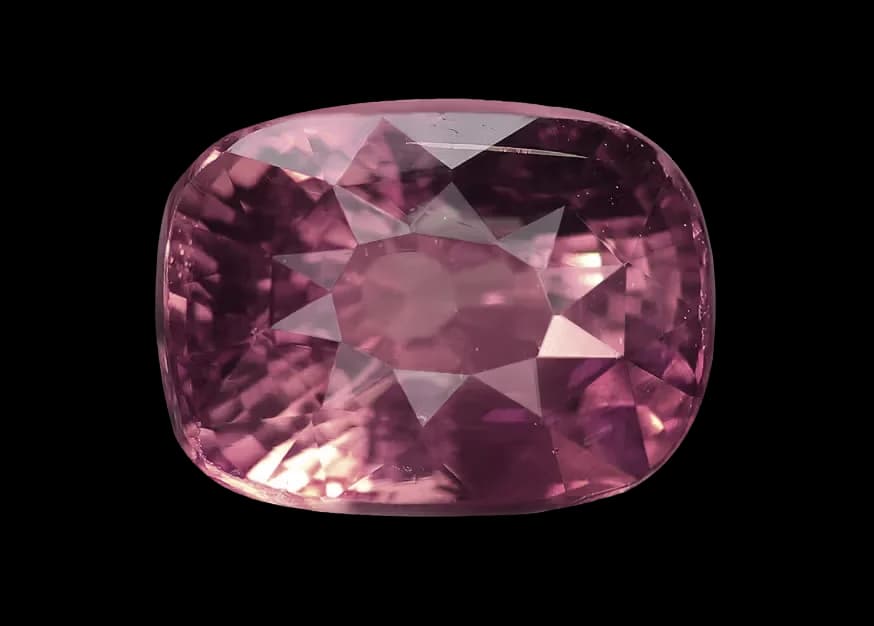
Purple Alexandrite
Purple Alexandrite is a rare color-changing chrysoberyl prized for its vivid green-to-purple-red transformation and exceptional durability in fine jewelry.
Purple Alexandrite is a rare variety of chrysoberyl, a beryllium aluminum oxide mineral prized for its remarkable color-changing effect. Its chemical formula is BeAl₂O₄, with a Mohs hardness of 8.5, refractive index of 1.746-1.755, specific gravity of about 3.73, orthorhombic crystal system, vitreous luster, and no cleavage. The gem is best known for changing from green to bluish green in daylight or fluorescent lighting to red, purplish red, or purple hues under incandescent light. This phenomenon is known as the alexandrite effect and results from the way trace chromium affects light absorption within the crystal. Purple tones may also appear through alexandrite's strong pleochroism. Natural alexandrite forms in geological environments associated with metamorphic rocks and fluid-rich conditions. Major historical and modern sources include Russia's Ural Mountains, Brazil, Sri Lanka, and Tanzania. Alexandrite was first discovered in the Russian Urals in the early 1830s and was named in honor of Alexander II. Today, natural Alexandrite is used in rings, earrings, pendants, and other fine jewelry. Its rarity, dramatic color change, durability, and scarcity in larger fine-quality sizes make it especially attractive to collectors and discerning jewelry buyers. GIA identifies strong color change, attractive green and red-purple hues, good clarity, and well-oriented cutting as important quality considerations.
- Mineral Family
- Chrysoberyl
- Chemical Formula
- BeAl₂O₄
- Mohs Hardness
- 8.5
- Refractive Index
- 1.746 - 1.755
- Specific Gravity
- 3.73
- Cleavage
- None
- Crystal System
- Orthorhombic
- Luster
- Vitreous
- Color Range
- Purple, Red, Green
When buying Purple Alexandrite, evaluate the complete color-change behavior rather than judging the stone under a single light source. Color is the most important quality factor: fine material generally shows a strong transition from bluish green or green in daylight to red or purplish red under incandescent light. Clarity also matters, and fine stones are often eye-clean. Cut should be selected to maximize the visible color change, with cutters carefully orienting the stone because of its pleochroism. Carat weight has a major effect on value because most fashioned alexandrites are below one carat, while larger fine-quality stones are exceptionally scarce. Origin can influence market value and collector interest, particularly for stones with documented Russian, Brazilian, Sri Lankan, or Tanzanian provenance, although origin should be confirmed by a qualified gem laboratory rather than assumed from appearance. Alexandrite is usually not treated, but any treatment or fracture filling should be fully disclosed. Natural Alexandrite and laboratory-grown Alexandrite can have very similar chemical, physical, and optical properties, so laboratory testing is important when natural origin and rarity affect the purchase. For a high-value stone, request an independent gemological report identifying the material as natural Alexandrite and documenting any detectable treatments. Authenticity should be assessed through professional testing, careful examination, and reliable documentation. Price depends primarily on the strength and attractiveness of the color change, color quality, clarity, cut, carat weight, origin, treatment status, and whether the stone is natural or laboratory-grown.
Alexandrite is well suited to jewelry because its 8.5 Mohs hardness, excellent toughness, and lack of cleavage provide good resistance to everyday wear. Clean Alexandrite jewelry with warm, soapy water and a soft brush, then rinse and dry gently with a soft cloth. GIA notes that ultrasonic and steam cleaning are usually safe for untreated Alexandrite, but fracture-filled material should only be cleaned with warm, soapy water. Store each piece separately in a soft-lined compartment to reduce scratching and contact with harder gemstones. Although Alexandrite is stable under normal conditions, avoid unnecessary exposure to harsh chemicals, sudden impacts, and rough activities. Remove Alexandrite jewelry before heavy physical work, sports, or situations where the stone could be struck against a hard surface.
Purple Alexandrite is a rare variety of chrysoberyl, a beryllium aluminum oxide mineral prized for its remarkable color-changing effect. Its chemical formula is BeAl₂O₄, with a Mohs hardness of 8.5, refractive index of 1.746-1.755, specific gravity of about 3.73, orthorhombic crystal system, vitreous luster, and no cleavage. The gem is best known for changing from green to bluish green in daylight or fluorescent lighting to red, purplish red, or purple hues under incandescent light. This phenomenon is known as the alexandrite effect and results from the way trace chromium affects light absorption within the crystal. Purple tones may also appear through alexandrite's strong pleochroism. Natural alexandrite forms in geological environments associated with metamorphic rocks and fluid-rich conditions. Major historical and modern sources include Russia's Ural Mountains, Brazil, Sri Lanka, and Tanzania. Alexandrite was first discovered in the Russian Urals in the early 1830s and was named in honor of Alexander II. Today, natural Alexandrite is used in rings, earrings, pendants, and other fine jewelry. Its rarity, dramatic color change, durability, and scarcity in larger fine-quality sizes make it especially attractive to collectors and discerning jewelry buyers. GIA identifies strong color change, attractive green and red-purple hues, good clarity, and well-oriented cutting as important quality considerations.
- Mineral Family
- Chrysoberyl
- Chemical Formula
- BeAl₂O₄
- Mohs Hardness
- 8.5
- Refractive Index
- 1.746 - 1.755
- Specific Gravity
- 3.73
- Cleavage
- None
- Crystal System
- Orthorhombic
- Luster
- Vitreous
- Color Range
- Purple, Red, Green
When buying Purple Alexandrite, evaluate the complete color-change behavior rather than judging the stone under a single light source. Color is the most important quality factor: fine material generally shows a strong transition from bluish green or green in daylight to red or purplish red under incandescent light. Clarity also matters, and fine stones are often eye-clean. Cut should be selected to maximize the visible color change, with cutters carefully orienting the stone because of its pleochroism. Carat weight has a major effect on value because most fashioned alexandrites are below one carat, while larger fine-quality stones are exceptionally scarce. Origin can influence market value and collector interest, particularly for stones with documented Russian, Brazilian, Sri Lankan, or Tanzanian provenance, although origin should be confirmed by a qualified gem laboratory rather than assumed from appearance. Alexandrite is usually not treated, but any treatment or fracture filling should be fully disclosed. Natural Alexandrite and laboratory-grown Alexandrite can have very similar chemical, physical, and optical properties, so laboratory testing is important when natural origin and rarity affect the purchase. For a high-value stone, request an independent gemological report identifying the material as natural Alexandrite and documenting any detectable treatments. Authenticity should be assessed through professional testing, careful examination, and reliable documentation. Price depends primarily on the strength and attractiveness of the color change, color quality, clarity, cut, carat weight, origin, treatment status, and whether the stone is natural or laboratory-grown.
Alexandrite is well suited to jewelry because its 8.5 Mohs hardness, excellent toughness, and lack of cleavage provide good resistance to everyday wear. Clean Alexandrite jewelry with warm, soapy water and a soft brush, then rinse and dry gently with a soft cloth. GIA notes that ultrasonic and steam cleaning are usually safe for untreated Alexandrite, but fracture-filled material should only be cleaned with warm, soapy water. Store each piece separately in a soft-lined compartment to reduce scratching and contact with harder gemstones. Although Alexandrite is stable under normal conditions, avoid unnecessary exposure to harsh chemicals, sudden impacts, and rough activities. Remove Alexandrite jewelry before heavy physical work, sports, or situations where the stone could be struck against a hard surface.
Purple Alexandrite for Sale
No gems found
Try broadening your search or adjusting your filters.
Have a gem of your own? List it free - no fees