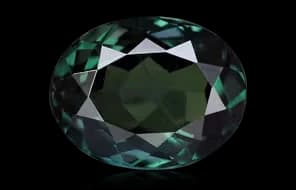
Brazilian Alexandrite
Brazilian Alexandrite is a rare, coveted variety of chrysoberyl prized for its vivid green-to-reddish color change, exceptional durability, and collector appeal.
Brazilian Alexandrite is the chromium-bearing color-change variety of chrysoberyl, a rare beryllium aluminum oxide mineral. It crystallizes in the orthorhombic system and has a vitreous luster, a Mohs hardness of 8.5, a refractive index of 1.746-1.755, and a specific gravity of about 3.73. Its chemical formula is BeAl₂O₄, with chromium responsible for the characteristic color-change phenomenon. The defining feature of natural Alexandrite is its response to different light sources: it can appear green to bluish green in daylight or daylight-equivalent lighting and shift toward red, purplish red, or reddish purple under incandescent illumination. This effect is known as the alexandrite effect and results from the mineral's selective absorption of light. Alexandrite is also strongly pleochroic, although pleochroism itself is distinct from the color-change phenomenon. Brazil became an important source of Alexandrite during the twentieth century, particularly in Minas Gerais. The Malacacheta region produced fine material from the 1970s through the 1980s, while the Lavra de Hematita deposit, discovered in 1987, became one of Brazil's most significant Alexandrite discoveries. Brazilian material from Hematita has produced notable stones with strong color change, good transparency, and impressive sizes. Fine Brazilian Alexandrite remains scarce, particularly when vivid color change, attractive clarity, and larger carat weight occur together. In modern jewelry, Brazilian Alexandrite is used in rings, pendants, earrings, bracelets, and collector-quality custom pieces. Its 8.5 Mohs hardness and excellent toughness make it suitable for many jewelry applications, including everyday-wear settings when properly mounted. Buyers value natural Brazilian Alexandrite for its rarity, documented provenance, dramatic optical character, and the difficulty of finding stones that combine strong color change, pleasing saturation, transparency, and substantial size.
- Mineral Family
- Chrysoberyl
- Chemical Formula
- BeAl₂O₄
- Mohs Hardness
- 8.5
- Refractive Index
- 1.746 - 1.755
- Specific Gravity
- 3.73
- Cleavage
- None
- Crystal System
- Orthorhombic
- Luster
- Vitreous
- Color Range
- Green, Blue, Red, Purple
When buying Brazilian Alexandrite online, evaluate the gemstone as a combination of color change, clarity, cut, carat weight, origin, treatment status, and laboratory documentation. Color is the most important visual factor. Fine Alexandrite generally shows a saturated green to bluish green appearance in daylight and a strong red to purplish-red appearance under incandescent light. A pronounced and attractive change is more desirable than a weak or muddy transition. Clarity should be judged in relation to the stone's size and overall appearance. Natural inclusions are common, and a completely flawless appearance should not automatically be treated as evidence of superior quality. Cut should maximize face-up color, brilliance, transparency, and the visibility of the color change without creating excessive darkness. Oval, cushion, and other mixed or brilliant-style cuts may be encountered, while cabochons can be attractive when inclusions create chatoyancy. Carat weight has a major effect on rarity and price because fine Alexandrite becomes increasingly scarce as size increases. Origin can add value when independently established. Brazilian origin, particularly material associated with important Minas Gerais deposits such as Hematita, should be supported by appropriate laboratory evidence when provenance is being represented as a selling point. Treatments should be disclosed clearly. Alexandrite is usually not treated, although individual stones may have fractures or other characteristics requiring care; fracture-filled material, if encountered, should be identified and cleaned appropriately. Natural Alexandrite and synthetic Alexandrite are different purchasing categories. Synthetic material can share Alexandrite's chemical and optical properties but is laboratory-grown rather than naturally formed, so it should never be presented as natural. Imitations are a separate category and may use unrelated materials to reproduce the appearance. For valuable stones, request an independent report from a respected gemological laboratory confirming species, natural or synthetic status, and any requested origin determination. Authenticity cannot reliably be established from color change alone. Price is driven by the strength and quality of color change, color saturation, clarity, cut, carat weight, natural status, provenance, and laboratory documentation. Exceptionally fine stones can command substantial premiums, so unusually inexpensive claims for supposedly natural Brazilian Alexandrite deserve careful scrutiny.
Brazilian Alexandrite is relatively hard and durable, making it suitable for many jewelry designs. Clean it with warm, soapy water and a soft cloth or gentle brush. Alexandrite is stable under normal wearing conditions and is generally resistant to heat, light, and common chemicals. GIA notes that ultrasonic and steam cleaning are usually safe for untreated Alexandrite, but warm soapy water is the safest broadly applicable option, particularly when a stone has fractures or any treatment that could be affected by cleaning. Remove jewelry before activities that expose it to strong impacts, harsh chemicals, or unnecessary abrasion. Although Alexandrite has a Mohs hardness of 8.5 and excellent toughness, it can still be scratched by harder materials such as diamond. Store each piece separately in a soft-lined compartment or pouch to prevent contact with other jewelry. For valuable Brazilian Alexandrite jewelry, have the setting periodically inspected by a qualified jeweler or gemologist, especially if the stone is worn frequently. If the gemstone has a laboratory report identifying a treatment or special condition, follow the care recommendations associated with that specific stone.
Brazilian Alexandrite is the chromium-bearing color-change variety of chrysoberyl, a rare beryllium aluminum oxide mineral. It crystallizes in the orthorhombic system and has a vitreous luster, a Mohs hardness of 8.5, a refractive index of 1.746-1.755, and a specific gravity of about 3.73. Its chemical formula is BeAl₂O₄, with chromium responsible for the characteristic color-change phenomenon. The defining feature of natural Alexandrite is its response to different light sources: it can appear green to bluish green in daylight or daylight-equivalent lighting and shift toward red, purplish red, or reddish purple under incandescent illumination. This effect is known as the alexandrite effect and results from the mineral's selective absorption of light. Alexandrite is also strongly pleochroic, although pleochroism itself is distinct from the color-change phenomenon. Brazil became an important source of Alexandrite during the twentieth century, particularly in Minas Gerais. The Malacacheta region produced fine material from the 1970s through the 1980s, while the Lavra de Hematita deposit, discovered in 1987, became one of Brazil's most significant Alexandrite discoveries. Brazilian material from Hematita has produced notable stones with strong color change, good transparency, and impressive sizes. Fine Brazilian Alexandrite remains scarce, particularly when vivid color change, attractive clarity, and larger carat weight occur together. In modern jewelry, Brazilian Alexandrite is used in rings, pendants, earrings, bracelets, and collector-quality custom pieces. Its 8.5 Mohs hardness and excellent toughness make it suitable for many jewelry applications, including everyday-wear settings when properly mounted. Buyers value natural Brazilian Alexandrite for its rarity, documented provenance, dramatic optical character, and the difficulty of finding stones that combine strong color change, pleasing saturation, transparency, and substantial size.
- Mineral Family
- Chrysoberyl
- Chemical Formula
- BeAl₂O₄
- Mohs Hardness
- 8.5
- Refractive Index
- 1.746 - 1.755
- Specific Gravity
- 3.73
- Cleavage
- None
- Crystal System
- Orthorhombic
- Luster
- Vitreous
- Color Range
- Green, Blue, Red, Purple
When buying Brazilian Alexandrite online, evaluate the gemstone as a combination of color change, clarity, cut, carat weight, origin, treatment status, and laboratory documentation. Color is the most important visual factor. Fine Alexandrite generally shows a saturated green to bluish green appearance in daylight and a strong red to purplish-red appearance under incandescent light. A pronounced and attractive change is more desirable than a weak or muddy transition. Clarity should be judged in relation to the stone's size and overall appearance. Natural inclusions are common, and a completely flawless appearance should not automatically be treated as evidence of superior quality. Cut should maximize face-up color, brilliance, transparency, and the visibility of the color change without creating excessive darkness. Oval, cushion, and other mixed or brilliant-style cuts may be encountered, while cabochons can be attractive when inclusions create chatoyancy. Carat weight has a major effect on rarity and price because fine Alexandrite becomes increasingly scarce as size increases. Origin can add value when independently established. Brazilian origin, particularly material associated with important Minas Gerais deposits such as Hematita, should be supported by appropriate laboratory evidence when provenance is being represented as a selling point. Treatments should be disclosed clearly. Alexandrite is usually not treated, although individual stones may have fractures or other characteristics requiring care; fracture-filled material, if encountered, should be identified and cleaned appropriately. Natural Alexandrite and synthetic Alexandrite are different purchasing categories. Synthetic material can share Alexandrite's chemical and optical properties but is laboratory-grown rather than naturally formed, so it should never be presented as natural. Imitations are a separate category and may use unrelated materials to reproduce the appearance. For valuable stones, request an independent report from a respected gemological laboratory confirming species, natural or synthetic status, and any requested origin determination. Authenticity cannot reliably be established from color change alone. Price is driven by the strength and quality of color change, color saturation, clarity, cut, carat weight, natural status, provenance, and laboratory documentation. Exceptionally fine stones can command substantial premiums, so unusually inexpensive claims for supposedly natural Brazilian Alexandrite deserve careful scrutiny.
Brazilian Alexandrite is relatively hard and durable, making it suitable for many jewelry designs. Clean it with warm, soapy water and a soft cloth or gentle brush. Alexandrite is stable under normal wearing conditions and is generally resistant to heat, light, and common chemicals. GIA notes that ultrasonic and steam cleaning are usually safe for untreated Alexandrite, but warm soapy water is the safest broadly applicable option, particularly when a stone has fractures or any treatment that could be affected by cleaning. Remove jewelry before activities that expose it to strong impacts, harsh chemicals, or unnecessary abrasion. Although Alexandrite has a Mohs hardness of 8.5 and excellent toughness, it can still be scratched by harder materials such as diamond. Store each piece separately in a soft-lined compartment or pouch to prevent contact with other jewelry. For valuable Brazilian Alexandrite jewelry, have the setting periodically inspected by a qualified jeweler or gemologist, especially if the stone is worn frequently. If the gemstone has a laboratory report identifying a treatment or special condition, follow the care recommendations associated with that specific stone.
Brazilian Alexandrite for Sale
No gems found
Try broadening your search or adjusting your filters.
Have a gem of your own? List it free - no fees