Cats Eye
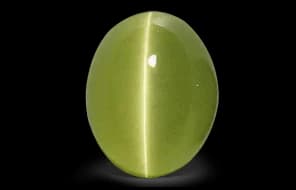
Cat’s Eye is a rare and captivating chrysoberyl gemstone prized for its sharp, luminous chatoyancy—a narrow band of light that glides across its polished surface.
Cat’s Eye gemstone, when used without another mineral name, generally refers to chatoyant chrysoberyl, a valuable member of the chrysoberyl mineral group. Its chemical composition is beryllium aluminum oxide (BeAl₂O₄), and it crystallizes in the orthorhombic system. With a Mohs hardness of 8.5, good toughness, vitreous luster, and a refractive index of approximately 1.744–1.755, chrysoberyl is well suited to fine jewelry. The defining feature of natural Cat’s Eye is chatoyancy: a concentrated band of reflected light created by the alignment of fine, parallel needle-like or fibrous inclusions. The effect is especially striking in well-oriented cabochons and can produce the prized “milk-and-honey” appearance, where one side appears lighter and the other darker. Cat’s Eye chrysoberyl is commonly seen in yellow, golden-yellow, yellow-green, green, brownish, and grayish tones, with vivid body color and a sharp, centered eye generally increasing desirability. Chrysoberyl deposits occur in several gem-producing regions, with Sri Lanka and Brazil among the notable sources of chrysoberyl and cat’s-eye material. Sri Lanka has a long-established reputation for producing fine cat’s-eye chrysoberyl. Cat’s Eye is also related mineralogically to alexandrite because both are varieties of chrysoberyl; rare alexandrite can itself display a cat’s-eye effect when suitable inclusions are present. Today, Cat’s Eye is primarily fashioned as a cabochon for rings, pendants, bracelets, earrings, and collector pieces. Buyers value it for its distinctive optical phenomenon, durability, rarity, and individual character. The quality of the eye is particularly important: a narrow, bright, continuous band that moves cleanly across the dome is generally more desirable than a broad, weak, or broken effect.
- Mineral Family
- Chrysoberyl
- Chemical Formula
- BeAl₂O₄
- Mohs Hardness
- 8.5
- Refractive Index
- 1.744 - 1.755
- Specific Gravity
- 3.70 - 3.78
- Cleavage
- Distinct in one direction, imperfect in others
- Crystal System
- Orthorhombic
- Luster
- Vitreous
- Color Range
- Yellow, Green, Gray, Orange, White
When buying Cat’s Eye gemstone online, focus first on the quality of its chatoyancy and then evaluate color, clarity, cut, carat weight, origin, treatments, and documentation. Color: Attractive golden-yellow, honey, yellow-green, and greenish body colors are widely appreciated, while strong saturation and even color can increase value. Chatoyancy: The eye is the defining quality feature. Look for a sharp, bright, well-centered band that appears to glide across the stone as it is moved under a suitable light source. A strong, continuous eye is generally more valuable than a diffuse or broken one. Clarity: Unlike transparent faceted gemstones, Cat’s Eye chrysoberyl naturally requires aligned inclusions to create its phenomenon. The goal is therefore not an inclusion-free stone, but an attractive balance between transparency, body color, and concentrated silk or needle-like inclusions that produce a strong eye. Cut: Cat’s Eye is normally fashioned as a cabochon. Proper orientation of the internal inclusions is essential for producing a centered, even chatoyant band. Carat: Larger stones with strong color and excellent chatoyancy can be considerably rarer and more valuable, although size should always be assessed alongside optical quality. Origin: Sri Lanka and Brazil are important sources, while material may also come from other gem-producing regions. Origin should be supported by reliable laboratory evidence if an origin premium is being claimed. Treatments: Ask whether the stone has undergone any treatment or enhancement. Natural Cat’s Eye chrysoberyl is valued for its natural appearance, and any disclosed treatment should be considered when comparing stones. Natural vs lab-grown: Natural chrysoberyl should be distinguished from synthetic chrysoberyl and from other natural gemstones that merely display a cat’s-eye effect. A gemstone being chatoyant does not by itself prove that it is chrysoberyl. Certification: For valuable stones, request an independent gemological report identifying the material and, where applicable, documenting whether it is natural and whether treatments are present. Authenticity: Do not rely solely on photographs or the moving-eye effect. Professional identification can distinguish chrysoberyl from quartz, tourmaline, and other chatoyant materials. Price factors: Value is influenced by the sharpness and completeness of the eye, body color, transparency, size, cut quality, origin when reliably established, treatment status, and laboratory documentation. A reputable seller should clearly disclose the gemstone species, natural or synthetic status, treatments, carat weight, and any available laboratory report.
Cat’s Eye chrysoberyl is durable enough for regular jewelry wear, but its directional cleavage means it should still be protected from hard impacts. Clean the gemstone with lukewarm water, mild soap, and a soft cloth or soft brush. Avoid abrasive cleaners, harsh chemicals, ultrasonic or steam cleaning unless a qualified professional has confirmed that the particular stone and setting are suitable. Remove Cat’s Eye jewelry before activities involving heavy impact, household chemicals, or rough work. Store each piece separately in a soft-lined pouch or jewelry compartment to prevent contact with harder gems and metal components. Check ring and pendant settings periodically, especially when the gemstone is worn frequently. For valuable natural Cat’s Eye, professional cleaning and inspection can help preserve both the gemstone and its setting.
Cat’s Eye gemstone, when used without another mineral name, generally refers to chatoyant chrysoberyl, a valuable member of the chrysoberyl mineral group. Its chemical composition is beryllium aluminum oxide (BeAl₂O₄), and it crystallizes in the orthorhombic system. With a Mohs hardness of 8.5, good toughness, vitreous luster, and a refractive index of approximately 1.744–1.755, chrysoberyl is well suited to fine jewelry. The defining feature of natural Cat’s Eye is chatoyancy: a concentrated band of reflected light created by the alignment of fine, parallel needle-like or fibrous inclusions. The effect is especially striking in well-oriented cabochons and can produce the prized “milk-and-honey” appearance, where one side appears lighter and the other darker. Cat’s Eye chrysoberyl is commonly seen in yellow, golden-yellow, yellow-green, green, brownish, and grayish tones, with vivid body color and a sharp, centered eye generally increasing desirability. Chrysoberyl deposits occur in several gem-producing regions, with Sri Lanka and Brazil among the notable sources of chrysoberyl and cat’s-eye material. Sri Lanka has a long-established reputation for producing fine cat’s-eye chrysoberyl. Cat’s Eye is also related mineralogically to alexandrite because both are varieties of chrysoberyl; rare alexandrite can itself display a cat’s-eye effect when suitable inclusions are present. Today, Cat’s Eye is primarily fashioned as a cabochon for rings, pendants, bracelets, earrings, and collector pieces. Buyers value it for its distinctive optical phenomenon, durability, rarity, and individual character. The quality of the eye is particularly important: a narrow, bright, continuous band that moves cleanly across the dome is generally more desirable than a broad, weak, or broken effect.
- Mineral Family
- Chrysoberyl
- Chemical Formula
- BeAl₂O₄
- Mohs Hardness
- 8.5
- Refractive Index
- 1.744 - 1.755
- Specific Gravity
- 3.70 - 3.78
- Cleavage
- Distinct in one direction, imperfect in others
- Crystal System
- Orthorhombic
- Luster
- Vitreous
- Color Range
- Yellow, Green, Gray, Orange, White
When buying Cat’s Eye gemstone online, focus first on the quality of its chatoyancy and then evaluate color, clarity, cut, carat weight, origin, treatments, and documentation. Color: Attractive golden-yellow, honey, yellow-green, and greenish body colors are widely appreciated, while strong saturation and even color can increase value. Chatoyancy: The eye is the defining quality feature. Look for a sharp, bright, well-centered band that appears to glide across the stone as it is moved under a suitable light source. A strong, continuous eye is generally more valuable than a diffuse or broken one. Clarity: Unlike transparent faceted gemstones, Cat’s Eye chrysoberyl naturally requires aligned inclusions to create its phenomenon. The goal is therefore not an inclusion-free stone, but an attractive balance between transparency, body color, and concentrated silk or needle-like inclusions that produce a strong eye. Cut: Cat’s Eye is normally fashioned as a cabochon. Proper orientation of the internal inclusions is essential for producing a centered, even chatoyant band. Carat: Larger stones with strong color and excellent chatoyancy can be considerably rarer and more valuable, although size should always be assessed alongside optical quality. Origin: Sri Lanka and Brazil are important sources, while material may also come from other gem-producing regions. Origin should be supported by reliable laboratory evidence if an origin premium is being claimed. Treatments: Ask whether the stone has undergone any treatment or enhancement. Natural Cat’s Eye chrysoberyl is valued for its natural appearance, and any disclosed treatment should be considered when comparing stones. Natural vs lab-grown: Natural chrysoberyl should be distinguished from synthetic chrysoberyl and from other natural gemstones that merely display a cat’s-eye effect. A gemstone being chatoyant does not by itself prove that it is chrysoberyl. Certification: For valuable stones, request an independent gemological report identifying the material and, where applicable, documenting whether it is natural and whether treatments are present. Authenticity: Do not rely solely on photographs or the moving-eye effect. Professional identification can distinguish chrysoberyl from quartz, tourmaline, and other chatoyant materials. Price factors: Value is influenced by the sharpness and completeness of the eye, body color, transparency, size, cut quality, origin when reliably established, treatment status, and laboratory documentation. A reputable seller should clearly disclose the gemstone species, natural or synthetic status, treatments, carat weight, and any available laboratory report.
Cat’s Eye chrysoberyl is durable enough for regular jewelry wear, but its directional cleavage means it should still be protected from hard impacts. Clean the gemstone with lukewarm water, mild soap, and a soft cloth or soft brush. Avoid abrasive cleaners, harsh chemicals, ultrasonic or steam cleaning unless a qualified professional has confirmed that the particular stone and setting are suitable. Remove Cat’s Eye jewelry before activities involving heavy impact, household chemicals, or rough work. Store each piece separately in a soft-lined pouch or jewelry compartment to prevent contact with harder gems and metal components. Check ring and pendant settings periodically, especially when the gemstone is worn frequently. For valuable natural Cat’s Eye, professional cleaning and inspection can help preserve both the gemstone and its setting.
Cats Eye for Sale
No gems found
Try broadening your search or adjusting your filters.
Have a gem of your own? List it free - no fees