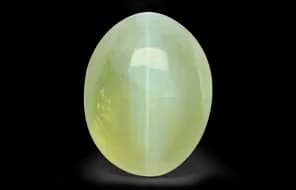
Ceylon Cats Eye
Ceylon Cats Eye is a rare chrysoberyl gemstone from Sri Lanka, prized for its silky body color and distinctive moving band of light known as chatoyancy.
Ceylon Cats Eye refers to chrysoberyl cat's eye associated with Sri Lanka, historically known as Ceylon. It is not a separate mineral species, but a geographic or trade designation for chatoyant chrysoberyl. Chrysoberyl belongs to the oxide mineral group and has the chemical formula BeAl2O4. It crystallizes in the orthorhombic crystal system and has a Mohs hardness of 8.5, making it a durable choice for jewelry.
The defining feature of a natural Ceylon Cats Eye gemstone is chatoyancy: a narrow, bright band that moves across the curved surface as the stone is rotated under a suitable light source. This effect is produced by light reflecting from parallel fibrous, needle-like, or other oriented inclusions within the chrysoberyl. The stone is normally fashioned as a cabochon so the inclusions can create a concentrated eye effect.
Ceylon Cats Eye commonly occurs in yellow, honey-yellow, greenish-yellow, golden, brownish-yellow, and grayish-green appearances. For database classification, these hues can be grouped primarily into yellow, green, and gray. A strong, straight, well-centered, continuous eye is generally more desirable than a weak, diffuse, or broken effect. Attractive body color, good transparency, a pleasing dome, smooth polish, and minimal distracting fractures can further enhance its appeal.
Sri Lanka has a long-established reputation for producing fine gemstones, and chrysoberyl cat's eye is among the notable gem materials associated with the country's gem deposits. Sri Lankan material is particularly valued when it combines attractive body color, good transparency, and strong chatoyancy. Origin alone, however, does not determine quality; the individual stone should always be evaluated on its visible characteristics and laboratory documentation.
Ceylon Cats Eye is especially suited to rings and pendants, while larger cabochons can also be incorporated into statement jewelry, bracelets, brooches, and earrings. Because the cat's-eye effect is the principal visual attraction, simple settings that leave the domed surface visible often work particularly well. Buyers seeking natural Ceylon Cats Eye online should distinguish geographic origin from gemstone identity and confirm that the stone is actually chrysoberyl cat's eye rather than another chatoyant material.
Collectors and jewelry buyers value Ceylon Cats Eye for the combination of rarity, durability, natural inclusions that create its optical phenomenon, and the individuality of each moving eye. The gemstone's appeal is primarily gemological and visual rather than based on healing, astrological, or supernatural claims.
- Mineral Family
- Chrysoberyl
- Chemical Formula
- BeAl2O4
- Mohs Hardness
- 8.5
- Refractive Index
- 1.746 - 1.756
- Specific Gravity
- 3.75
- Cleavage
- Distinct on {110}, imperfect on {010}, poor on {001}
- Crystal System
- Orthorhombic
- Luster
- Vitreous
- Color Range
- Yellow, Green, Gray
When buying Ceylon Cats Eye, evaluate the gemstone as an individual stone rather than relying only on the name Ceylon. The most important factor is the quality of its chatoyancy. Look for a bright, narrow, well-defined band that remains visually strong and moves clearly across the cabochon as the stone is rotated. A centered, continuous eye is generally preferable to a broad, weak, broken, or poorly positioned band.
Color is another important consideration. Natural chrysoberyl cat's eye can occur in yellow, honey, golden, greenish-yellow, brownish-yellow, and grayish-green tones. Attractive, saturated body color can increase desirability, but there is no universal color preference that outweighs the overall quality of the stone.
Clarity should be assessed differently from transparent faceted gemstones because the inclusions responsible for chatoyancy are an essential part of the phenomenon. Fine, appropriately oriented inclusions can create an excellent eye, while excessive fractures, distracting inclusions, or cloudiness can reduce beauty and durability. Transparency should be considered together with the strength and quality of the eye.
Cut is critical. Chrysoberyl cat's eye is generally cut as a cabochon, with the orientation and dome carefully designed to display the chatoyant band. A symmetrical shape, well-proportioned dome, smooth surface, and high-quality polish can significantly improve the appearance. Oval and cushion-shaped cabochons are common, but the best shape depends on the rough material and inclusion orientation.
Carat weight affects price, but larger size alone does not guarantee higher value. A larger stone with a weak eye may be less desirable than a smaller stone with excellent chatoyancy, color, transparency, and polish. Origin can add interest and provenance, particularly when Sri Lankan origin is documented, but origin should be considered alongside the actual quality of the gem.
Treatment information should always be requested from the seller. Buyers should ask whether the stone is natural, whether it has received any treatment, and whether the stated Sri Lankan origin has been independently established. Natural and laboratory-created or synthetic chrysoberyl should not be represented as equivalent when provenance and natural origin are important to the purchase.
For higher-value natural Ceylon Cats Eye, an independent gemological report can help document gemstone identity, natural or synthetic status, detectable treatments, and, where the laboratory offers the service, geographic origin. Certification is especially useful when purchasing a valuable stone online or when a seller makes specific claims about Sri Lankan provenance.
Authenticity should be assessed through a combination of gemological testing, credible documentation, detailed photographs or videos, seller transparency, and consistent product information. Be cautious of unusually inexpensive stones advertised as fine natural Ceylon Cats Eye, especially when the seller provides no laboratory report or meaningful disclosure. Price depends on the strength and quality of chatoyancy, color, transparency, clarity characteristics, cut, polish, carat weight, natural status, treatment, origin documentation, and overall market demand.
Chrysoberyl has a Mohs hardness of 8.5 and is well suited to jewelry, but good care will help preserve the polished surface and the appearance of the chatoyant effect. For routine cleaning, use lukewarm water, a small amount of mild soap, and a soft lint-free cloth or soft brush. Rinse thoroughly and dry gently.
Avoid abrasive cleaners, harsh chemicals, bleach, strong solvents, and rough brushes. Household chemicals and cosmetics can also accumulate on jewelry, so it is best to remove Ceylon Cats Eye jewelry before applying perfumes, hairspray, lotions, or cleaning products.
Although chrysoberyl is hard, avoid unnecessary impacts, especially with rings worn during physically demanding activities. Remove the jewelry before sports, heavy manual work, gardening, or household cleaning to reduce the risk of scratches, chips, or damage to the setting.
Store Ceylon Cats Eye separately from other jewelry in a soft pouch or lined compartment. Its hardness can allow it to scratch softer gemstones, while hard objects can still damage or abrade its polished surface under unfavorable conditions. For valuable pieces, periodic inspection of the setting by a qualified jeweler is also advisable.
Ceylon Cats Eye refers to chrysoberyl cat's eye associated with Sri Lanka, historically known as Ceylon. It is not a separate mineral species, but a geographic or trade designation for chatoyant chrysoberyl. Chrysoberyl belongs to the oxide mineral group and has the chemical formula BeAl2O4. It crystallizes in the orthorhombic crystal system and has a Mohs hardness of 8.5, making it a durable choice for jewelry.
The defining feature of a natural Ceylon Cats Eye gemstone is chatoyancy: a narrow, bright band that moves across the curved surface as the stone is rotated under a suitable light source. This effect is produced by light reflecting from parallel fibrous, needle-like, or other oriented inclusions within the chrysoberyl. The stone is normally fashioned as a cabochon so the inclusions can create a concentrated eye effect.
Ceylon Cats Eye commonly occurs in yellow, honey-yellow, greenish-yellow, golden, brownish-yellow, and grayish-green appearances. For database classification, these hues can be grouped primarily into yellow, green, and gray. A strong, straight, well-centered, continuous eye is generally more desirable than a weak, diffuse, or broken effect. Attractive body color, good transparency, a pleasing dome, smooth polish, and minimal distracting fractures can further enhance its appeal.
Sri Lanka has a long-established reputation for producing fine gemstones, and chrysoberyl cat's eye is among the notable gem materials associated with the country's gem deposits. Sri Lankan material is particularly valued when it combines attractive body color, good transparency, and strong chatoyancy. Origin alone, however, does not determine quality; the individual stone should always be evaluated on its visible characteristics and laboratory documentation.
Ceylon Cats Eye is especially suited to rings and pendants, while larger cabochons can also be incorporated into statement jewelry, bracelets, brooches, and earrings. Because the cat's-eye effect is the principal visual attraction, simple settings that leave the domed surface visible often work particularly well. Buyers seeking natural Ceylon Cats Eye online should distinguish geographic origin from gemstone identity and confirm that the stone is actually chrysoberyl cat's eye rather than another chatoyant material.
Collectors and jewelry buyers value Ceylon Cats Eye for the combination of rarity, durability, natural inclusions that create its optical phenomenon, and the individuality of each moving eye. The gemstone's appeal is primarily gemological and visual rather than based on healing, astrological, or supernatural claims.
- Mineral Family
- Chrysoberyl
- Chemical Formula
- BeAl2O4
- Mohs Hardness
- 8.5
- Refractive Index
- 1.746 - 1.756
- Specific Gravity
- 3.75
- Cleavage
- Distinct on {110}, imperfect on {010}, poor on {001}
- Crystal System
- Orthorhombic
- Luster
- Vitreous
- Color Range
- Yellow, Green, Gray
When buying Ceylon Cats Eye, evaluate the gemstone as an individual stone rather than relying only on the name Ceylon. The most important factor is the quality of its chatoyancy. Look for a bright, narrow, well-defined band that remains visually strong and moves clearly across the cabochon as the stone is rotated. A centered, continuous eye is generally preferable to a broad, weak, broken, or poorly positioned band.
Color is another important consideration. Natural chrysoberyl cat's eye can occur in yellow, honey, golden, greenish-yellow, brownish-yellow, and grayish-green tones. Attractive, saturated body color can increase desirability, but there is no universal color preference that outweighs the overall quality of the stone.
Clarity should be assessed differently from transparent faceted gemstones because the inclusions responsible for chatoyancy are an essential part of the phenomenon. Fine, appropriately oriented inclusions can create an excellent eye, while excessive fractures, distracting inclusions, or cloudiness can reduce beauty and durability. Transparency should be considered together with the strength and quality of the eye.
Cut is critical. Chrysoberyl cat's eye is generally cut as a cabochon, with the orientation and dome carefully designed to display the chatoyant band. A symmetrical shape, well-proportioned dome, smooth surface, and high-quality polish can significantly improve the appearance. Oval and cushion-shaped cabochons are common, but the best shape depends on the rough material and inclusion orientation.
Carat weight affects price, but larger size alone does not guarantee higher value. A larger stone with a weak eye may be less desirable than a smaller stone with excellent chatoyancy, color, transparency, and polish. Origin can add interest and provenance, particularly when Sri Lankan origin is documented, but origin should be considered alongside the actual quality of the gem.
Treatment information should always be requested from the seller. Buyers should ask whether the stone is natural, whether it has received any treatment, and whether the stated Sri Lankan origin has been independently established. Natural and laboratory-created or synthetic chrysoberyl should not be represented as equivalent when provenance and natural origin are important to the purchase.
For higher-value natural Ceylon Cats Eye, an independent gemological report can help document gemstone identity, natural or synthetic status, detectable treatments, and, where the laboratory offers the service, geographic origin. Certification is especially useful when purchasing a valuable stone online or when a seller makes specific claims about Sri Lankan provenance.
Authenticity should be assessed through a combination of gemological testing, credible documentation, detailed photographs or videos, seller transparency, and consistent product information. Be cautious of unusually inexpensive stones advertised as fine natural Ceylon Cats Eye, especially when the seller provides no laboratory report or meaningful disclosure. Price depends on the strength and quality of chatoyancy, color, transparency, clarity characteristics, cut, polish, carat weight, natural status, treatment, origin documentation, and overall market demand.
Chrysoberyl has a Mohs hardness of 8.5 and is well suited to jewelry, but good care will help preserve the polished surface and the appearance of the chatoyant effect. For routine cleaning, use lukewarm water, a small amount of mild soap, and a soft lint-free cloth or soft brush. Rinse thoroughly and dry gently.
Avoid abrasive cleaners, harsh chemicals, bleach, strong solvents, and rough brushes. Household chemicals and cosmetics can also accumulate on jewelry, so it is best to remove Ceylon Cats Eye jewelry before applying perfumes, hairspray, lotions, or cleaning products.
Although chrysoberyl is hard, avoid unnecessary impacts, especially with rings worn during physically demanding activities. Remove the jewelry before sports, heavy manual work, gardening, or household cleaning to reduce the risk of scratches, chips, or damage to the setting.
Store Ceylon Cats Eye separately from other jewelry in a soft pouch or lined compartment. Its hardness can allow it to scratch softer gemstones, while hard objects can still damage or abrade its polished surface under unfavorable conditions. For valuable pieces, periodic inspection of the setting by a qualified jeweler is also advisable.
Ceylon Cats Eye for Sale
No gems found
Try broadening your search or adjusting your filters.
Have a gem of your own? List it free - no fees