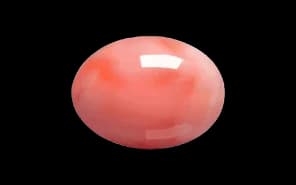
Pink Coral
Pink Coral is a delicate organic gemstone prized for its soft pink hues, polished luster, rarity, and distinctive natural structure. Its elegant color makes it especially appealing for jewelry and collectors.
Pink Coral is a natural organic gem formed from the calcium-carbonate skeletons of colonial marine organisms known as coral polyps. Gem-quality pink coral belongs primarily to precious-coral groups such as Pleurocorallium, with fine flesh-pink material often marketed as Angel Skin Coral. Unlike mineral gemstones that crystallize within rocks, coral develops as branching colonies in marine environments and is later collected, cut, and polished for decorative use. Its composition is predominantly calcium carbonate, occurring mainly as aragonite with an organic matrix. Pink Coral typically has a Mohs hardness of about 3-4, a refractive index around 1.48-1.65, and a specific gravity of approximately 2.60-2.70. It has no cleavage and commonly displays a vitreous to waxy luster after polishing. Colors range from very pale flesh pink and baby pink to stronger rose, salmon, and pink-orange shades. Fine material is valued for even color, smooth surfaces, attractive luster, and minimal pits or fractures. Japan and Taiwan are important sources of fine pink precious coral, while related precious corals have historically been collected in the Mediterranean and other regions. Coral has been used ornamentally for thousands of years and remains popular in necklaces, beads, pendants, earrings, bracelets, rings, carvings, and collector pieces. Because coral is relatively soft and can be brittle, it is better suited to jewelry designs that protect the material from impact and abrasion. Buyers value natural Pink Coral for its organic origin, distinctive appearance, limited availability, and the individuality of its natural growth structure.
- Mineral Family
- Coral
- Chemical Formula
- CaCO3 (calcium carbonate)
- Mohs Hardness
- 3 - 4
- Refractive Index
- 1.48 - 1.65
- Specific Gravity
- 2.60 - 2.70
- Cleavage
- None
- Crystal System
- Amorphous
- Luster
- Vitreous
- Color Range
- Pink, Orange, White, Red
When buying Pink Coral gemstone material, start with color. Attractive pink coral generally has a pleasing, even bodycolor, although subtle natural variation and growth structure can be desirable. Fine Angel Skin material is particularly sought after for balanced flesh-pink tones. Examine clarity as surface quality rather than applying the same clarity standards used for transparent gemstones: pits, cavities, fractures, growth marks, and uneven areas can affect appearance and value. Cut and polish are important because coral is commonly fashioned into cabochons, beads, smooth polished forms, carvings, and other rounded shapes rather than conventional faceted gems. Carat weight matters, but larger pieces with strong color and good surface quality can become increasingly scarce. Origin can influence value and should be supported by reliable documentation rather than assumed from appearance alone. Ask whether the coral is natural and what treatments have been applied. Dyeing, bleaching, waxing, impregnation, stabilization, reconstruction, and other enhancements may be encountered in the coral trade, while glass, plastic, resin, bone, marble, and other materials may be used as imitations. Coral is not generally considered a lab-grown gemstone in the same way as synthetic corundum or synthetic beryl; sellers should clearly distinguish natural coral from reconstructed or imitation material. For valuable Pink Coral, request an independent gemological identification report that states the material and any detectable treatments. Verify the laboratory and report number where possible. Price depends on natural origin, color quality, surface condition, size, shape, polish, rarity, treatment status, provenance, and documentation. A trustworthy seller should disclose treatments and provide clear photographs and accurate measurements before purchase.
Pink Coral is relatively soft and should be treated as a delicate jewelry material. Clean it gently with a soft, damp cloth or mild soapy water, then rinse carefully and pat dry. Avoid ultrasonic cleaners, steam cleaners, strong chemicals, acids, solvents, prolonged heat, and abrasive cleaning products. Perfume, cosmetics, hairspray, and household chemicals should be kept away from the coral. Because its surface can scratch or chip, remove Pink Coral jewelry before activities involving impact, rough surfaces, sports, or heavy manual work. Store each piece separately in a soft pouch or lined compartment so it does not rub against harder gemstones. Avoid prolonged exposure to intense heat or direct sunlight, particularly for treated or dyed material. If a valuable piece needs polishing or repair, have it handled by a jeweler experienced with delicate organic gem materials.
Pink Coral is a natural organic gem formed from the calcium-carbonate skeletons of colonial marine organisms known as coral polyps. Gem-quality pink coral belongs primarily to precious-coral groups such as Pleurocorallium, with fine flesh-pink material often marketed as Angel Skin Coral. Unlike mineral gemstones that crystallize within rocks, coral develops as branching colonies in marine environments and is later collected, cut, and polished for decorative use. Its composition is predominantly calcium carbonate, occurring mainly as aragonite with an organic matrix. Pink Coral typically has a Mohs hardness of about 3-4, a refractive index around 1.48-1.65, and a specific gravity of approximately 2.60-2.70. It has no cleavage and commonly displays a vitreous to waxy luster after polishing. Colors range from very pale flesh pink and baby pink to stronger rose, salmon, and pink-orange shades. Fine material is valued for even color, smooth surfaces, attractive luster, and minimal pits or fractures. Japan and Taiwan are important sources of fine pink precious coral, while related precious corals have historically been collected in the Mediterranean and other regions. Coral has been used ornamentally for thousands of years and remains popular in necklaces, beads, pendants, earrings, bracelets, rings, carvings, and collector pieces. Because coral is relatively soft and can be brittle, it is better suited to jewelry designs that protect the material from impact and abrasion. Buyers value natural Pink Coral for its organic origin, distinctive appearance, limited availability, and the individuality of its natural growth structure.
- Mineral Family
- Coral
- Chemical Formula
- CaCO3 (calcium carbonate)
- Mohs Hardness
- 3 - 4
- Refractive Index
- 1.48 - 1.65
- Specific Gravity
- 2.60 - 2.70
- Cleavage
- None
- Crystal System
- Amorphous
- Luster
- Vitreous
- Color Range
- Pink, Orange, White, Red
When buying Pink Coral gemstone material, start with color. Attractive pink coral generally has a pleasing, even bodycolor, although subtle natural variation and growth structure can be desirable. Fine Angel Skin material is particularly sought after for balanced flesh-pink tones. Examine clarity as surface quality rather than applying the same clarity standards used for transparent gemstones: pits, cavities, fractures, growth marks, and uneven areas can affect appearance and value. Cut and polish are important because coral is commonly fashioned into cabochons, beads, smooth polished forms, carvings, and other rounded shapes rather than conventional faceted gems. Carat weight matters, but larger pieces with strong color and good surface quality can become increasingly scarce. Origin can influence value and should be supported by reliable documentation rather than assumed from appearance alone. Ask whether the coral is natural and what treatments have been applied. Dyeing, bleaching, waxing, impregnation, stabilization, reconstruction, and other enhancements may be encountered in the coral trade, while glass, plastic, resin, bone, marble, and other materials may be used as imitations. Coral is not generally considered a lab-grown gemstone in the same way as synthetic corundum or synthetic beryl; sellers should clearly distinguish natural coral from reconstructed or imitation material. For valuable Pink Coral, request an independent gemological identification report that states the material and any detectable treatments. Verify the laboratory and report number where possible. Price depends on natural origin, color quality, surface condition, size, shape, polish, rarity, treatment status, provenance, and documentation. A trustworthy seller should disclose treatments and provide clear photographs and accurate measurements before purchase.
Pink Coral is relatively soft and should be treated as a delicate jewelry material. Clean it gently with a soft, damp cloth or mild soapy water, then rinse carefully and pat dry. Avoid ultrasonic cleaners, steam cleaners, strong chemicals, acids, solvents, prolonged heat, and abrasive cleaning products. Perfume, cosmetics, hairspray, and household chemicals should be kept away from the coral. Because its surface can scratch or chip, remove Pink Coral jewelry before activities involving impact, rough surfaces, sports, or heavy manual work. Store each piece separately in a soft pouch or lined compartment so it does not rub against harder gemstones. Avoid prolonged exposure to intense heat or direct sunlight, particularly for treated or dyed material. If a valuable piece needs polishing or repair, have it handled by a jeweler experienced with delicate organic gem materials.
Pink Coral for Sale
No gems found
Try broadening your search or adjusting your filters.
Have a gem of your own? List it free - no fees