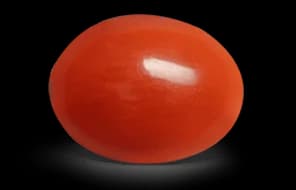
Japanese Red Coral
Japanese Red Coral is prized for its rich red color, organic origin, rarity, and distinctive polished surface, making it a striking choice for fine jewelry and collectors.
Japanese Red Coral is a precious organic gemstone formed by marine coral colonies rather than by geological crystallization like most mineral gems. It is associated with precious Corallium coral from Japanese waters and is particularly valued for saturated red colors, including deep oxblood tones. Its composition is primarily calcium carbonate (CaCO3), with the coral skeleton consisting mainly of aragonite. The aragonite structure is orthorhombic, while the finished material is typically opaque to translucent and has a vitreous to waxy luster. Japanese Red Coral develops slowly in marine environments, where coral colonies grow branches that can eventually be harvested and polished into ornamental material. Important Japanese coral-producing areas have historically included waters around Kochi, Okinawa, Kagoshima, Nagasaki, and the Ogasawara Islands, although availability is limited and harvesting is subject to conservation and trade controls. Colors range from pink and orange-red to vivid and deep red, with evenly saturated red material generally commanding greater interest. Unlike mineral gemstones, natural coral may show growth features, pits, surface irregularities, or subtle banding, which can help reveal its organic origin. Japanese Red Coral has a long history in Japanese decorative arts and jewelry, where it has been carved, polished, and incorporated into beads, pendants, rings, bracelets, and other ornamental pieces. Today, collectors and jewelry buyers value natural Japanese Red Coral for its limited supply, distinctive marine origin, strong color, and individuality. Because it is relatively soft, it is best suited to jewelry designs that provide reasonable protection from impact and abrasion.
- Mineral Family
- Coral
- Chemical Formula
- CaCO3
- Mohs Hardness
- 3 - 4
- Refractive Index
- 1.486 - 1.658
- Specific Gravity
- 2.60 - 2.70
- Cleavage
- None
- Crystal System
- Orthorhombic
- Luster
- Waxy
- Color Range
- Red, Pink, Orange
When buying Japanese Red Coral, start with color. Rich, evenly distributed red is generally the most sought-after appearance, while pink and orange-red material can also be attractive. Clarity is assessed differently from transparent gemstones: natural coral may contain growth structures, tiny pits, pores, lines, or other organic features, and a completely uniform appearance should not automatically be assumed to be natural. Cut and shape should be chosen according to the intended jewelry design. Smooth cabochons, beads, polished branches, and carved forms are common because coral is too soft for many conventional faceting applications. Carat weight matters because large pieces of fine, evenly colored natural coral are less common. Origin can influence desirability, but an origin claim should be supported by appropriate documentation rather than assumed from appearance alone. Treatments are important: coral may be dyed, bleached, impregnated, filled, or reconstituted to improve appearance, and imitation material may be made from plastic, resin, glass, or other substances. Natural Japanese Red Coral should be distinguished from treated coral, reconstructed coral, and imitations. There is no conventional lab-grown equivalent of natural precious coral commonly sold as a gemstone; laboratory-made or synthetic-looking products should not be confused with naturally grown coral. A reputable gemological laboratory report can help identify the material and disclose detectable treatments when available. Authenticity is especially important for high-value pieces, so buyers should purchase from established sellers and request documentation for significant stones. Price is influenced by color saturation, uniformity, size, surface quality, craftsmanship, provenance, treatment status, and overall rarity. Because coral is an organic gem and may be subject to conservation regulations, buyers should also consider legal sourcing and applicable international trade requirements when purchasing natural Japanese Red Coral online.
Japanese Red Coral requires more care than harder gemstones because its Mohs hardness is only about 3-4. Clean it gently with a soft, damp cloth or lukewarm water and mild soap when necessary, then dry it thoroughly with a soft cloth. Avoid ultrasonic cleaners, steam cleaners, abrasive materials, and harsh household chemicals. Perfume, hairspray, cosmetics, strong solvents, acids, and prolonged exposure to heat can damage or alter treated coral and may dull its surface. Store Japanese Red Coral separately from diamonds, sapphires, and other harder gems to prevent scratches. A soft fabric pouch or lined jewelry box is ideal. Avoid wearing coral jewelry during activities involving impact, heavy manual work, swimming, or exposure to chemicals. Periodically inspect settings and polished surfaces, especially for rings and bracelets that receive more contact. With gentle handling and proper storage, natural Japanese Red Coral can retain its distinctive color and polished appearance for many years.
Japanese Red Coral is a precious organic gemstone formed by marine coral colonies rather than by geological crystallization like most mineral gems. It is associated with precious Corallium coral from Japanese waters and is particularly valued for saturated red colors, including deep oxblood tones. Its composition is primarily calcium carbonate (CaCO3), with the coral skeleton consisting mainly of aragonite. The aragonite structure is orthorhombic, while the finished material is typically opaque to translucent and has a vitreous to waxy luster. Japanese Red Coral develops slowly in marine environments, where coral colonies grow branches that can eventually be harvested and polished into ornamental material. Important Japanese coral-producing areas have historically included waters around Kochi, Okinawa, Kagoshima, Nagasaki, and the Ogasawara Islands, although availability is limited and harvesting is subject to conservation and trade controls. Colors range from pink and orange-red to vivid and deep red, with evenly saturated red material generally commanding greater interest. Unlike mineral gemstones, natural coral may show growth features, pits, surface irregularities, or subtle banding, which can help reveal its organic origin. Japanese Red Coral has a long history in Japanese decorative arts and jewelry, where it has been carved, polished, and incorporated into beads, pendants, rings, bracelets, and other ornamental pieces. Today, collectors and jewelry buyers value natural Japanese Red Coral for its limited supply, distinctive marine origin, strong color, and individuality. Because it is relatively soft, it is best suited to jewelry designs that provide reasonable protection from impact and abrasion.
- Mineral Family
- Coral
- Chemical Formula
- CaCO3
- Mohs Hardness
- 3 - 4
- Refractive Index
- 1.486 - 1.658
- Specific Gravity
- 2.60 - 2.70
- Cleavage
- None
- Crystal System
- Orthorhombic
- Luster
- Waxy
- Color Range
- Red, Pink, Orange
When buying Japanese Red Coral, start with color. Rich, evenly distributed red is generally the most sought-after appearance, while pink and orange-red material can also be attractive. Clarity is assessed differently from transparent gemstones: natural coral may contain growth structures, tiny pits, pores, lines, or other organic features, and a completely uniform appearance should not automatically be assumed to be natural. Cut and shape should be chosen according to the intended jewelry design. Smooth cabochons, beads, polished branches, and carved forms are common because coral is too soft for many conventional faceting applications. Carat weight matters because large pieces of fine, evenly colored natural coral are less common. Origin can influence desirability, but an origin claim should be supported by appropriate documentation rather than assumed from appearance alone. Treatments are important: coral may be dyed, bleached, impregnated, filled, or reconstituted to improve appearance, and imitation material may be made from plastic, resin, glass, or other substances. Natural Japanese Red Coral should be distinguished from treated coral, reconstructed coral, and imitations. There is no conventional lab-grown equivalent of natural precious coral commonly sold as a gemstone; laboratory-made or synthetic-looking products should not be confused with naturally grown coral. A reputable gemological laboratory report can help identify the material and disclose detectable treatments when available. Authenticity is especially important for high-value pieces, so buyers should purchase from established sellers and request documentation for significant stones. Price is influenced by color saturation, uniformity, size, surface quality, craftsmanship, provenance, treatment status, and overall rarity. Because coral is an organic gem and may be subject to conservation regulations, buyers should also consider legal sourcing and applicable international trade requirements when purchasing natural Japanese Red Coral online.
Japanese Red Coral requires more care than harder gemstones because its Mohs hardness is only about 3-4. Clean it gently with a soft, damp cloth or lukewarm water and mild soap when necessary, then dry it thoroughly with a soft cloth. Avoid ultrasonic cleaners, steam cleaners, abrasive materials, and harsh household chemicals. Perfume, hairspray, cosmetics, strong solvents, acids, and prolonged exposure to heat can damage or alter treated coral and may dull its surface. Store Japanese Red Coral separately from diamonds, sapphires, and other harder gems to prevent scratches. A soft fabric pouch or lined jewelry box is ideal. Avoid wearing coral jewelry during activities involving impact, heavy manual work, swimming, or exposure to chemicals. Periodically inspect settings and polished surfaces, especially for rings and bracelets that receive more contact. With gentle handling and proper storage, natural Japanese Red Coral can retain its distinctive color and polished appearance for many years.
Japanese Red Coral for Sale
No gems found
Try broadening your search or adjusting your filters.
Have a gem of your own? List it free - no fees