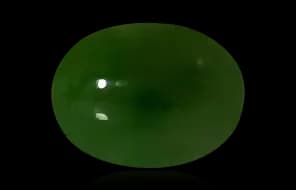
Nephrite
Nephrite is a durable jade gemstone prized for its rich green colors, exceptional toughness, smooth polish and long history in carving and jewelry.
Nephrite is one of the two gem materials traditionally known as jade, the other being jadeite. It belongs to the amphibole group and consists mainly of an extremely fine, interlocking aggregate of tremolite and actinolite. Its chemical composition is represented by Ca2(Mg,Fe)5Si8O22(OH)2, with iron content contributing to many of its deeper colors. Nephrite crystallizes in the monoclinic system, but gem-quality material usually occurs as a compact, fibrous aggregate rather than visible crystals. Its Mohs hardness is about 6-6.5, while its exceptional toughness comes from the tightly interwoven fibrous structure. Refractive index is typically about 1.60-1.63 and specific gravity about 2.90-3.10. The luster ranges from greasy to vitreous after polishing, and cleavage is not normally observed in the compact gem material. Nephrite occurs in green shades ranging from pale green to deep green, as well as white, gray, black and yellowish varieties. White, low-iron material is sometimes described as 'mutton fat' jade. Important sources and historic materials include China, New Zealand, Canada, Russia, Australia, the United States and other regions. Chinese nephrite, particularly material associated with the historic jade-working traditions of Xinjiang, has played an important role in decorative arts and carving. New Zealand's pounamu, or greenstone, is another historically significant nephrite material. Nephrite is widely fashioned into cabochons, beads, bangles, pendants, rings and carved ornaments rather than traditional faceted gems. Buyers value it for its distinctive color, fine texture, polish, toughness and cultural and artistic heritage. When purchasing natural Nephrite gemstone jewelry, identification is important because many green materials are marketed simply as jade.
- Mineral Family
- Jade
- Chemical Formula
- Ca2(Mg,Fe)5Si8O22(OH)2
- Mohs Hardness
- 6 - 6.5
- Refractive Index
- 1.60 - 1.63
- Specific Gravity
- 2.90 - 3.10
- Cleavage
- None
- Crystal System
- Monoclinic
- Luster
- Greasy
- Color Range
- Green, White, Black, Gray, Yellow, Orange
When buying Nephrite gemstone, begin with color and texture. Rich, attractive green material is generally desirable, while fine, even texture and pleasing translucency can add value. White, gray, black and yellowish nephrite can also be collectible when the color and material quality are distinctive. Clarity is assessed differently from transparent faceted gemstones because nephrite is commonly translucent to opaque; an even, compact texture and attractive translucency are important quality considerations. Cut and workmanship are especially significant because nephrite is commonly carved, polished into cabochons, made into beads or shaped as bangles and ornamental objects. For finished jewelry, examine symmetry, polish, surface condition and craftsmanship rather than focusing only on carat weight. Nephrite is often valued by the piece, dimensions, quality and workmanship, so carat weight alone does not determine price. Origin can influence desirability and market value, particularly for documented material from historically important localities, but origin should not be treated as proof of quality. Ask whether the stone is natural and whether it has been dyed, waxed, coated, impregnated or otherwise enhanced. Nephrite is not commonly sold as a laboratory-grown gemstone equivalent, so buyers should be cautious when a seller makes unusual claims about synthetic material. Treatments and imitations should be clearly disclosed. For higher-value pieces, an independent gemological report can help confirm that the material is nephrite and identify detectable treatments. Authenticity should be assessed through professional gemological testing when necessary, because jade terminology is sometimes used loosely for unrelated green stones and simulants. Price depends on color, texture, translucency, size, workmanship, treatment status, provenance and overall rarity. Comparing several authenticated examples is useful before deciding to buy Nephrite online.
Nephrite is tough and suitable for many types of jewelry, but its hardness of 6-6.5 means it can still develop scratches with prolonged contact against harder materials. Clean Nephrite jewelry with lukewarm water, a soft cloth and mild soap when needed, then rinse and dry thoroughly. Avoid harsh chemicals, strong acids, abrasive cleaners and prolonged exposure to high heat. Ultrasonic and steam cleaners are best avoided, particularly when the piece has fractures, coatings, impregnation or other treatments. Store Nephrite separately from harder gemstones such as sapphire, ruby and diamond to reduce scratching. Keep bangles, carved pieces and other valuable items protected from hard impacts even though nephrite has excellent toughness. For treated or antique pieces, follow any care instructions supplied with the item and consider professional cleaning when the treatment history is uncertain.
Nephrite is one of the two gem materials traditionally known as jade, the other being jadeite. It belongs to the amphibole group and consists mainly of an extremely fine, interlocking aggregate of tremolite and actinolite. Its chemical composition is represented by Ca2(Mg,Fe)5Si8O22(OH)2, with iron content contributing to many of its deeper colors. Nephrite crystallizes in the monoclinic system, but gem-quality material usually occurs as a compact, fibrous aggregate rather than visible crystals. Its Mohs hardness is about 6-6.5, while its exceptional toughness comes from the tightly interwoven fibrous structure. Refractive index is typically about 1.60-1.63 and specific gravity about 2.90-3.10. The luster ranges from greasy to vitreous after polishing, and cleavage is not normally observed in the compact gem material. Nephrite occurs in green shades ranging from pale green to deep green, as well as white, gray, black and yellowish varieties. White, low-iron material is sometimes described as 'mutton fat' jade. Important sources and historic materials include China, New Zealand, Canada, Russia, Australia, the United States and other regions. Chinese nephrite, particularly material associated with the historic jade-working traditions of Xinjiang, has played an important role in decorative arts and carving. New Zealand's pounamu, or greenstone, is another historically significant nephrite material. Nephrite is widely fashioned into cabochons, beads, bangles, pendants, rings and carved ornaments rather than traditional faceted gems. Buyers value it for its distinctive color, fine texture, polish, toughness and cultural and artistic heritage. When purchasing natural Nephrite gemstone jewelry, identification is important because many green materials are marketed simply as jade.
- Mineral Family
- Jade
- Chemical Formula
- Ca2(Mg,Fe)5Si8O22(OH)2
- Mohs Hardness
- 6 - 6.5
- Refractive Index
- 1.60 - 1.63
- Specific Gravity
- 2.90 - 3.10
- Cleavage
- None
- Crystal System
- Monoclinic
- Luster
- Greasy
- Color Range
- Green, White, Black, Gray, Yellow, Orange
When buying Nephrite gemstone, begin with color and texture. Rich, attractive green material is generally desirable, while fine, even texture and pleasing translucency can add value. White, gray, black and yellowish nephrite can also be collectible when the color and material quality are distinctive. Clarity is assessed differently from transparent faceted gemstones because nephrite is commonly translucent to opaque; an even, compact texture and attractive translucency are important quality considerations. Cut and workmanship are especially significant because nephrite is commonly carved, polished into cabochons, made into beads or shaped as bangles and ornamental objects. For finished jewelry, examine symmetry, polish, surface condition and craftsmanship rather than focusing only on carat weight. Nephrite is often valued by the piece, dimensions, quality and workmanship, so carat weight alone does not determine price. Origin can influence desirability and market value, particularly for documented material from historically important localities, but origin should not be treated as proof of quality. Ask whether the stone is natural and whether it has been dyed, waxed, coated, impregnated or otherwise enhanced. Nephrite is not commonly sold as a laboratory-grown gemstone equivalent, so buyers should be cautious when a seller makes unusual claims about synthetic material. Treatments and imitations should be clearly disclosed. For higher-value pieces, an independent gemological report can help confirm that the material is nephrite and identify detectable treatments. Authenticity should be assessed through professional gemological testing when necessary, because jade terminology is sometimes used loosely for unrelated green stones and simulants. Price depends on color, texture, translucency, size, workmanship, treatment status, provenance and overall rarity. Comparing several authenticated examples is useful before deciding to buy Nephrite online.
Nephrite is tough and suitable for many types of jewelry, but its hardness of 6-6.5 means it can still develop scratches with prolonged contact against harder materials. Clean Nephrite jewelry with lukewarm water, a soft cloth and mild soap when needed, then rinse and dry thoroughly. Avoid harsh chemicals, strong acids, abrasive cleaners and prolonged exposure to high heat. Ultrasonic and steam cleaners are best avoided, particularly when the piece has fractures, coatings, impregnation or other treatments. Store Nephrite separately from harder gemstones such as sapphire, ruby and diamond to reduce scratching. Keep bangles, carved pieces and other valuable items protected from hard impacts even though nephrite has excellent toughness. For treated or antique pieces, follow any care instructions supplied with the item and consider professional cleaning when the treatment history is uncertain.
Nephrite for Sale
No gems found
Try broadening your search or adjusting your filters.
Have a gem of your own? List it free - no fees