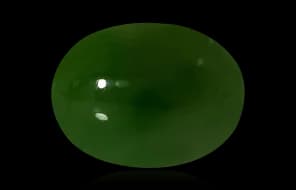
Jade Nephrite
Jade Nephrite is a remarkably tough jade prized for its silky texture, rich green colors and centuries of craftsmanship. Its durability makes it ideal for jewelry and carving.
Jade Nephrite is one of the two principal gem materials known as jade, the other being jadeite. It is a calcium-magnesium-iron amphibole material composed primarily of interlocking microscopic fibers of the tremolite-actinolite series. This dense fibrous structure gives nephrite exceptional toughness and allows it to withstand impact better than its moderate Mohs hardness alone would suggest. Nephrite has a monoclinic crystal system, a Mohs hardness of approximately 6 to 6.5, a refractive index of 1.606 to 1.632, and a specific gravity generally around 2.90 to 3.10. Its luster ranges from greasy to vitreous, while transparency is usually translucent to opaque. Nephrite occurs in colors ranging from white and cream to gray, yellow, brown, black and several shades of green. Iron content commonly contributes to darker green and black coloration, while lower iron content can produce pale or creamy material. Fine, even color, attractive translucency and a compact, uniform texture are especially desirable. Important sources and historic jade-working regions include New Zealand, China, Canada, Russia, Australia and parts of Central Asia and North America. New Zealand pounamu is particularly well known for its cultural and artistic importance, while Chinese nephrite from regions such as Xinjiang has a long history of highly skilled carving. Archaeological evidence shows that nephrite has been worked by humans for thousands of years into tools, ornaments, ceremonial objects and carvings. In modern jewelry, nephrite is commonly fashioned into cabochons, beads, pendants, bracelets, rings and carved objects. Its combination of toughness, distinctive texture, natural color and cultural heritage makes it appealing to jewelry buyers, collectors and carving enthusiasts. When shopping for natural Jade Nephrite, buyers generally value attractive color, fine texture, good translucency, minimal fractures and high-quality craftsmanship.
- Mineral Family
- Jade
- Chemical Formula
- Ca2(Mg,Fe)5Si8O22(OH)2
- Mohs Hardness
- 6.0 - 6.5
- Refractive Index
- 1.606 - 1.632
- Specific Gravity
- 2.90 - 3.10
- Cleavage
- None; the dense interlocking fibrous structure commonly obscures cleavage
- Crystal System
- Monoclinic
- Luster
- Greasy
- Color Range
- Green, White, Gray, Black, Yellow, Orange, Pink
When buying Jade Nephrite, evaluate the material as a whole rather than relying on color alone. Color is important, with evenly distributed, attractive green shades often commanding greater interest, although fine white and other naturally occurring colors can also be desirable. Clarity in nephrite is assessed differently from transparent faceted gemstones: buyers should look for a compact, uniform texture, good translucency where present, and an absence of prominent cracks, distracting inclusions or weak areas. Cut and workmanship are particularly important because nephrite is commonly shaped as cabochons, beads, bangles and carvings rather than faceted. A well-executed polish should produce a smooth surface and enhance the material's natural luster. Carat weight is less useful as a standalone quality measure for nephrite than it is for transparent gemstones; size, color, texture, translucency, craftsmanship and the intended object should all be considered. Origin can add historical or collector interest, but it should not automatically be treated as proof of superior quality. Treatment disclosure is essential. Natural nephrite may be sold untreated, while some material can be dyed, coated, impregnated or otherwise enhanced. Buyers should request clear disclosure of any treatment. Natural nephrite is distinct from jadeite and from imitations such as glass, plastic and other green stones. Commercial laboratory-grown nephrite is not a common mainstream jewelry material, so buyers should be especially alert to imitation or treated products marketed simply as jade. For valuable pieces, an independent gemological report can help confirm that the material is nephrite and document relevant observations or treatments. Authenticity should be assessed through professional gemological testing rather than home scratch tests, which can damage the item and are unreliable. Price depends on color, texture, translucency, size, condition, workmanship, provenance and treatment status. Exceptionally fine material and important carved or historically significant pieces can command substantially higher prices than ordinary commercial nephrite.
Jade Nephrite is tough and suitable for many types of jewelry, but its moderate hardness means its polished surface can still be scratched by harder materials. For routine cleaning, use lukewarm water, a small amount of mild soap and a soft cloth or soft brush. Rinse thoroughly and dry with a soft cloth. Avoid harsh chemicals, abrasive cleaners, prolonged exposure to strong household chemicals and unnecessary impact. Steam and ultrasonic cleaning are best avoided unless a qualified professional has confirmed that the specific piece and any treatment or setting can safely withstand them. Store nephrite separately from harder gemstones such as diamond and sapphire to reduce scratching. Keep carved pieces and jewelry in a soft pouch or lined compartment when not being worn. For rings and bracelets, remove the jewelry before heavy manual work, sports or activities where it may receive strong impact. If the piece contains treatments, a porous setting material or delicate metalwork, follow the care instructions supplied by the jeweler or laboratory. No special cleansing or recharging process is required to maintain natural nephrite.
Jade Nephrite is one of the two principal gem materials known as jade, the other being jadeite. It is a calcium-magnesium-iron amphibole material composed primarily of interlocking microscopic fibers of the tremolite-actinolite series. This dense fibrous structure gives nephrite exceptional toughness and allows it to withstand impact better than its moderate Mohs hardness alone would suggest. Nephrite has a monoclinic crystal system, a Mohs hardness of approximately 6 to 6.5, a refractive index of 1.606 to 1.632, and a specific gravity generally around 2.90 to 3.10. Its luster ranges from greasy to vitreous, while transparency is usually translucent to opaque. Nephrite occurs in colors ranging from white and cream to gray, yellow, brown, black and several shades of green. Iron content commonly contributes to darker green and black coloration, while lower iron content can produce pale or creamy material. Fine, even color, attractive translucency and a compact, uniform texture are especially desirable. Important sources and historic jade-working regions include New Zealand, China, Canada, Russia, Australia and parts of Central Asia and North America. New Zealand pounamu is particularly well known for its cultural and artistic importance, while Chinese nephrite from regions such as Xinjiang has a long history of highly skilled carving. Archaeological evidence shows that nephrite has been worked by humans for thousands of years into tools, ornaments, ceremonial objects and carvings. In modern jewelry, nephrite is commonly fashioned into cabochons, beads, pendants, bracelets, rings and carved objects. Its combination of toughness, distinctive texture, natural color and cultural heritage makes it appealing to jewelry buyers, collectors and carving enthusiasts. When shopping for natural Jade Nephrite, buyers generally value attractive color, fine texture, good translucency, minimal fractures and high-quality craftsmanship.
- Mineral Family
- Jade
- Chemical Formula
- Ca2(Mg,Fe)5Si8O22(OH)2
- Mohs Hardness
- 6.0 - 6.5
- Refractive Index
- 1.606 - 1.632
- Specific Gravity
- 2.90 - 3.10
- Cleavage
- None; the dense interlocking fibrous structure commonly obscures cleavage
- Crystal System
- Monoclinic
- Luster
- Greasy
- Color Range
- Green, White, Gray, Black, Yellow, Orange, Pink
When buying Jade Nephrite, evaluate the material as a whole rather than relying on color alone. Color is important, with evenly distributed, attractive green shades often commanding greater interest, although fine white and other naturally occurring colors can also be desirable. Clarity in nephrite is assessed differently from transparent faceted gemstones: buyers should look for a compact, uniform texture, good translucency where present, and an absence of prominent cracks, distracting inclusions or weak areas. Cut and workmanship are particularly important because nephrite is commonly shaped as cabochons, beads, bangles and carvings rather than faceted. A well-executed polish should produce a smooth surface and enhance the material's natural luster. Carat weight is less useful as a standalone quality measure for nephrite than it is for transparent gemstones; size, color, texture, translucency, craftsmanship and the intended object should all be considered. Origin can add historical or collector interest, but it should not automatically be treated as proof of superior quality. Treatment disclosure is essential. Natural nephrite may be sold untreated, while some material can be dyed, coated, impregnated or otherwise enhanced. Buyers should request clear disclosure of any treatment. Natural nephrite is distinct from jadeite and from imitations such as glass, plastic and other green stones. Commercial laboratory-grown nephrite is not a common mainstream jewelry material, so buyers should be especially alert to imitation or treated products marketed simply as jade. For valuable pieces, an independent gemological report can help confirm that the material is nephrite and document relevant observations or treatments. Authenticity should be assessed through professional gemological testing rather than home scratch tests, which can damage the item and are unreliable. Price depends on color, texture, translucency, size, condition, workmanship, provenance and treatment status. Exceptionally fine material and important carved or historically significant pieces can command substantially higher prices than ordinary commercial nephrite.
Jade Nephrite is tough and suitable for many types of jewelry, but its moderate hardness means its polished surface can still be scratched by harder materials. For routine cleaning, use lukewarm water, a small amount of mild soap and a soft cloth or soft brush. Rinse thoroughly and dry with a soft cloth. Avoid harsh chemicals, abrasive cleaners, prolonged exposure to strong household chemicals and unnecessary impact. Steam and ultrasonic cleaning are best avoided unless a qualified professional has confirmed that the specific piece and any treatment or setting can safely withstand them. Store nephrite separately from harder gemstones such as diamond and sapphire to reduce scratching. Keep carved pieces and jewelry in a soft pouch or lined compartment when not being worn. For rings and bracelets, remove the jewelry before heavy manual work, sports or activities where it may receive strong impact. If the piece contains treatments, a porous setting material or delicate metalwork, follow the care instructions supplied by the jeweler or laboratory. No special cleansing or recharging process is required to maintain natural nephrite.
Jade Nephrite for Sale
No gems found
Try broadening your search or adjusting your filters.
Have a gem of your own? List it free - no fees