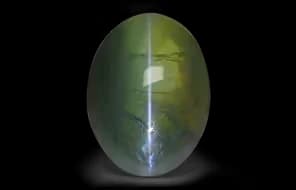
Indian Cats Eye
Indian Cats Eye is valued for its distinctive moving band of light, rich yellow-green tones, and excellent durability, making it a striking choice for fine jewelry and collectors.
Indian Cats Eye is a trade name commonly used for cat's-eye chrysoberyl associated with Indian material or claimed Indian origin. Gemologically, true cat's-eye chrysoberyl is a chatoyant variety of chrysoberyl, an oxide mineral composed of beryllium aluminum oxide (BeAl2O4). It is not a member of the beryl mineral family despite the similar name. The characteristic cat's-eye effect, called chatoyancy, occurs when light reflects from densely packed, parallel fibers, needles, or other oriented inclusions within the gemstone. When the stone is properly oriented and polished as a cabochon, these features create a narrow band of light that appears to glide across the curved surface as the gem is moved. GIA describes cat's-eye chrysoberyl as the gemstone to which the unqualified term cat's-eye normally refers. Chrysoberyl has a Mohs hardness of 8.5, a vitreous luster, an orthorhombic crystal system, a refractive index around 1.746-1.755, and a specific gravity generally around 3.69-3.81. Its cleavage is distinct in one direction, so care is required during cutting, setting, and repairs. Indian-associated chrysoberyl has been reported from regions including Odisha, while important chrysoberyl sources worldwide include Sri Lanka, Brazil, Madagascar, Tanzania, and other East African localities. Because geographic origin can affect value and cannot reliably be established from appearance alone, an origin claim should be supported by appropriate laboratory testing. Indian Cats Eye commonly appears in honey yellow, yellow-green, greenish-gray, and related earthy tones. The most visually desirable stones usually show a sharp, bright, well-centered eye, attractive body color, good polish, and pleasing translucency. The classic cabochon cut is preferred because the curved dome allows the chatoyant band to be displayed clearly. Fine cat's-eye chrysoberyl is valued for its unusual optical phenomenon, durability, scarcity in attractive qualities, and ability to create distinctive rings, pendants, earrings, and collector pieces. Quartz cat's-eye and other chatoyant materials should not be described simply as cat's-eye chrysoberyl; the mineral species should always be identified when accuracy matters.
- Mineral Family
- Chrysoberyl
- Chemical Formula
- BeAl2O4
- Mohs Hardness
- 8.5
- Refractive Index
- 1.746 - 1.755
- Specific Gravity
- 3.69 - 3.81
- Cleavage
- Distinct in one direction; imperfect in another
- Crystal System
- Orthorhombic
- Luster
- Vitreous
- Color Range
- Yellow, Green, Gray
When buying Indian Cats Eye online, first establish exactly what the seller means by the name. If the stone is represented as natural chrysoberyl cat's-eye, the mineral identity should be supported by gemological testing. Color is important, with attractive honey-yellow, yellow-green, greenish, and grayish tones generally preferred when combined with good contrast between the body color and eye. Chatoyancy is the defining quality factor: look for a bright, narrow, continuous and well-centered band that moves smoothly across the dome as the stone is tilted. GIA notes that chatoyancy results from oriented reflective inclusions and that careful cabochon orientation is essential for producing the effect. Clarity should be judged differently from transparent faceted gems. Natural internal features are expected in chatoyant chrysoberyl because they help create the optical effect, but fractures, cavities, or surface-reaching damage can reduce durability and value. Cut is normally a polished cabochon, with the dome and orientation designed to maximize the eye. Carat weight also affects price, but a larger stone is not automatically more valuable if its eye is weak or poorly centered. Origin can influence market value, but an Indian origin claim should be verified rather than inferred from color or appearance. Treatment history should be disclosed by the seller, and buyers should not assume that a gemstone is untreated simply because it is described as natural. Natural means formed in nature; it does not by itself guarantee the absence of treatment. Lab-grown or synthetic material and simulants can resemble natural cat's-eye gemstones, so a laboratory report is especially useful for higher-value purchases. For authenticity, look for an independent gemological report identifying the material as chrysoberyl and, where relevant, stating whether the stone is natural and whether an origin determination is available. Price depends primarily on species, natural status, strength and quality of chatoyancy, color, transparency, cut, carat weight, condition, treatment, origin evidence, and certification. Avoid relying on astrology, guaranteed benefits, or unusually low prices as indicators of quality.
Chrysoberyl is durable enough for regular jewelry wear because it ranks 8.5 on the Mohs scale, but its distinct cleavage means it should still be protected from hard impacts. Clean Indian Cats Eye with lukewarm water, a small amount of mild soap, and a soft cloth or very soft brush. Rinse thoroughly and dry with a lint-free cloth. Avoid harsh chemicals, abrasive powders, sudden temperature changes, and unnecessary exposure to heat. Because the stone is usually cabochon cut, inspect the dome periodically for scratches, chips, or abrasions. Store it separately from softer gemstones to prevent them from being scratched, and use a soft-lined jewelry box or pouch. Remove Indian Cats Eye jewelry before activities involving strong impact, heavy manual work, or contact with abrasive surfaces. If the jewelry requires repair, soldering, or significant heat, have the stone protected or removed by a qualified jeweler because heat and cleavage can create avoidable risks.
Indian Cats Eye is a trade name commonly used for cat's-eye chrysoberyl associated with Indian material or claimed Indian origin. Gemologically, true cat's-eye chrysoberyl is a chatoyant variety of chrysoberyl, an oxide mineral composed of beryllium aluminum oxide (BeAl2O4). It is not a member of the beryl mineral family despite the similar name. The characteristic cat's-eye effect, called chatoyancy, occurs when light reflects from densely packed, parallel fibers, needles, or other oriented inclusions within the gemstone. When the stone is properly oriented and polished as a cabochon, these features create a narrow band of light that appears to glide across the curved surface as the gem is moved. GIA describes cat's-eye chrysoberyl as the gemstone to which the unqualified term cat's-eye normally refers. Chrysoberyl has a Mohs hardness of 8.5, a vitreous luster, an orthorhombic crystal system, a refractive index around 1.746-1.755, and a specific gravity generally around 3.69-3.81. Its cleavage is distinct in one direction, so care is required during cutting, setting, and repairs. Indian-associated chrysoberyl has been reported from regions including Odisha, while important chrysoberyl sources worldwide include Sri Lanka, Brazil, Madagascar, Tanzania, and other East African localities. Because geographic origin can affect value and cannot reliably be established from appearance alone, an origin claim should be supported by appropriate laboratory testing. Indian Cats Eye commonly appears in honey yellow, yellow-green, greenish-gray, and related earthy tones. The most visually desirable stones usually show a sharp, bright, well-centered eye, attractive body color, good polish, and pleasing translucency. The classic cabochon cut is preferred because the curved dome allows the chatoyant band to be displayed clearly. Fine cat's-eye chrysoberyl is valued for its unusual optical phenomenon, durability, scarcity in attractive qualities, and ability to create distinctive rings, pendants, earrings, and collector pieces. Quartz cat's-eye and other chatoyant materials should not be described simply as cat's-eye chrysoberyl; the mineral species should always be identified when accuracy matters.
- Mineral Family
- Chrysoberyl
- Chemical Formula
- BeAl2O4
- Mohs Hardness
- 8.5
- Refractive Index
- 1.746 - 1.755
- Specific Gravity
- 3.69 - 3.81
- Cleavage
- Distinct in one direction; imperfect in another
- Crystal System
- Orthorhombic
- Luster
- Vitreous
- Color Range
- Yellow, Green, Gray
When buying Indian Cats Eye online, first establish exactly what the seller means by the name. If the stone is represented as natural chrysoberyl cat's-eye, the mineral identity should be supported by gemological testing. Color is important, with attractive honey-yellow, yellow-green, greenish, and grayish tones generally preferred when combined with good contrast between the body color and eye. Chatoyancy is the defining quality factor: look for a bright, narrow, continuous and well-centered band that moves smoothly across the dome as the stone is tilted. GIA notes that chatoyancy results from oriented reflective inclusions and that careful cabochon orientation is essential for producing the effect. Clarity should be judged differently from transparent faceted gems. Natural internal features are expected in chatoyant chrysoberyl because they help create the optical effect, but fractures, cavities, or surface-reaching damage can reduce durability and value. Cut is normally a polished cabochon, with the dome and orientation designed to maximize the eye. Carat weight also affects price, but a larger stone is not automatically more valuable if its eye is weak or poorly centered. Origin can influence market value, but an Indian origin claim should be verified rather than inferred from color or appearance. Treatment history should be disclosed by the seller, and buyers should not assume that a gemstone is untreated simply because it is described as natural. Natural means formed in nature; it does not by itself guarantee the absence of treatment. Lab-grown or synthetic material and simulants can resemble natural cat's-eye gemstones, so a laboratory report is especially useful for higher-value purchases. For authenticity, look for an independent gemological report identifying the material as chrysoberyl and, where relevant, stating whether the stone is natural and whether an origin determination is available. Price depends primarily on species, natural status, strength and quality of chatoyancy, color, transparency, cut, carat weight, condition, treatment, origin evidence, and certification. Avoid relying on astrology, guaranteed benefits, or unusually low prices as indicators of quality.
Chrysoberyl is durable enough for regular jewelry wear because it ranks 8.5 on the Mohs scale, but its distinct cleavage means it should still be protected from hard impacts. Clean Indian Cats Eye with lukewarm water, a small amount of mild soap, and a soft cloth or very soft brush. Rinse thoroughly and dry with a lint-free cloth. Avoid harsh chemicals, abrasive powders, sudden temperature changes, and unnecessary exposure to heat. Because the stone is usually cabochon cut, inspect the dome periodically for scratches, chips, or abrasions. Store it separately from softer gemstones to prevent them from being scratched, and use a soft-lined jewelry box or pouch. Remove Indian Cats Eye jewelry before activities involving strong impact, heavy manual work, or contact with abrasive surfaces. If the jewelry requires repair, soldering, or significant heat, have the stone protected or removed by a qualified jeweler because heat and cleavage can create avoidable risks.
Indian Cats Eye for Sale
No gems found
Try broadening your search or adjusting your filters.
Have a gem of your own? List it free - no fees