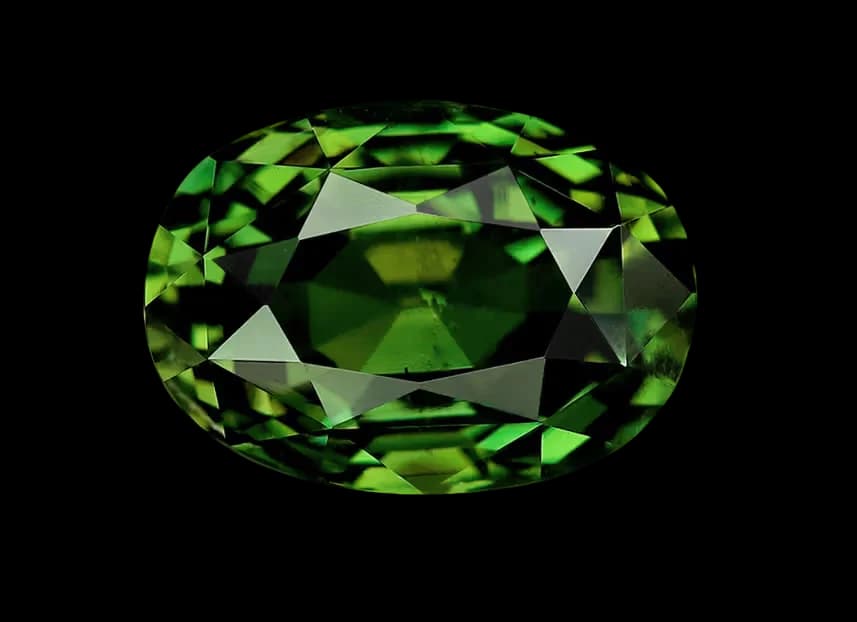
Green Alexandrite
Green Alexandrite is a rare color-change gemstone prized for its vivid green daylight appearance, reddish to purplish tones in warm light, exceptional durability, and collector appeal.
Green Alexandrite is the green-dominant color-change variety of chrysoberyl, a rare beryllium aluminum oxide mineral prized for its remarkable optical behavior. Its defining feature is the alexandrite effect: a noticeable shift from green to bluish green in daylight or fluorescent illumination toward red, purplish red, or purple under incandescent lighting. The effect is caused by the way chromium in the crystal selectively absorbs portions of visible light; it should not be confused with pleochroism, although alexandrite can also display strong pleochroism.
Alexandrite belongs to the chrysoberyl mineral family and crystallizes in the orthorhombic crystal system. Its chemical formula is BeAl₂O₄. With a Mohs hardness of 8.5, no cleavage, excellent toughness, a vitreous luster, a refractive index of approximately 1.746–1.755, and a specific gravity around 3.73, it is well suited to many jewelry designs, including rings, earrings, pendants, and bracelets.
Natural Alexandrite forms in unusual geological environments, and significant deposits have been associated with Russia's Ural Mountains, Brazil, Sri Lanka, and East Africa. The original Russian deposits discovered in the 1830s became famous for exceptional green-to-red color change, while later sources have produced important material of their own. Fine natural Alexandrite remains scarce, particularly in larger sizes with strong color change and attractive saturation.
Color is central to Alexandrite's appeal. Desirable stones commonly show vivid green to bluish-green tones in daylight and a distinct reddish, purplish-red, or purple appearance under incandescent light. The strength and quality of the color change, bodycolor, clarity, cut, and overall visual balance all influence desirability. Alexandrite may also show cat's-eye chatoyancy when suitable parallel inclusions are present, although this is a separate phenomenon from its color change.
Famous Alexandrite sources include the historic Ural Mountains deposits of Russia and notable occurrences in Brazil, Sri Lanka, and East Africa. Today, exceptional natural stones are highly sought after by collectors and connoisseurs. Because fine Alexandrite is uncommon, especially at larger carat weights, it can command significant prices compared with many other colored gemstones.
Modern Alexandrite jewelry appeals to buyers who want a gemstone with a distinctive visual identity rather than a conventional single-color appearance. Oval, cushion, round, pear, and mixed cuts can be used, with cutting often balancing brilliance, color change, and weight retention. Green Alexandrite works beautifully with platinum, white gold, yellow gold, and rose gold, while diamond accents can emphasize its changing colors.
Buyers value natural Green Alexandrite for its rarity, documented origin, strong color-change phenomenon, durability, and collector interest. A reputable laboratory report can help establish whether a stone is natural or laboratory-grown, identify detectable treatments, and, when possible and requested, provide an opinion on geographic origin. For an important purchase, certification and transparent disclosure are especially valuable.
- Mineral Family
- Chrysoberyl
- Chemical Formula
- BeAl₂O₄
- Mohs Hardness
- 8.5
- Refractive Index
- 1.746 - 1.755
- Specific Gravity
- 3.73
- Cleavage
- None
- Crystal System
- Orthorhombic
- Luster
- Vitreous
- Color Range
- Green, Purple, Red
When buying Green Alexandrite online, evaluate the stone as a combination of color, color change, clarity, cut, carat weight, origin, treatment status, and documentation rather than focusing on size alone.
Color: Look for attractive green to bluish-green daylight color with a distinct and appealing shift toward red, purplish red, or purple under incandescent light. The quality and strength of the change are major considerations. A dramatic color change does not automatically make every stone superior; bodycolor, saturation, brightness, and overall appearance also matter.
Clarity: Alexandrite commonly contains natural inclusions, and fine examples with good transparency and few distracting inclusions are particularly desirable. Avoid judging clarity only from a photograph because lighting, magnification, and image processing can significantly affect appearance.
Cut: A well-executed cut can improve brilliance and present the color-change phenomenon effectively. Common shapes include oval, cushion, round, pear, and mixed cuts. Because natural Alexandrite is scarce, cutters may sometimes prioritize weight retention, so assess symmetry, proportions, polish, windowing, and overall face-up appearance.
Carat: Most faceted Alexandrites are relatively small, and larger natural stones with strong color change become increasingly scarce. Price can rise sharply as size increases, particularly when the stone also has excellent color, clarity, and color change. A smaller exceptional stone can be more valuable than a larger stone with weaker characteristics.
Origin: Russia's historic Ural Mountain Alexandrite is famous for its exceptional material, but important Alexandrite has also been found in Brazil, Sri Lanka, and East Africa. Origin can influence desirability and price, but it should be supported by credible laboratory documentation rather than seller claims alone.
Treatments: Alexandrites are usually untreated, although individual stones may have fractures or other characteristics requiring disclosure. Ask whether any treatment has been detected and how it affects care. Do not assume that every natural Alexandrite is untreated simply because untreated material is highly valued.
Natural vs lab-grown: Laboratory-grown Alexandrite exists and can reproduce the material's chemical and physical characteristics while being produced artificially. It should be clearly disclosed as laboratory-grown and should not be marketed as natural. Natural and laboratory-grown stones can require laboratory testing for reliable identification.
Certification: For valuable Green Alexandrite, request an independent report from a reputable gemological laboratory. A laboratory report can identify whether the stone is natural or laboratory-grown, document its characteristics and detectable treatments, and may provide an origin opinion when possible.
Authenticity: Do not rely solely on a visible color change, because imitations and laboratory-grown materials can also display color-change effects. For significant purchases, compare the stone's report, measurements, photographs, seller disclosures, and return policy.
Price factors: Price is influenced primarily by natural status, color quality, strength and attractiveness of color change, clarity, cut, carat weight, origin when reliably established, and laboratory documentation. Exceptional larger stones can be particularly rare and valuable.
Green Alexandrite is a durable gemstone with a Mohs hardness of 8.5, no cleavage, and excellent toughness, making it suitable for many types of jewelry, including pieces intended for regular wear. Nevertheless, sensible care helps preserve its polish and the condition of its setting.
Cleaning: Clean Alexandrite with warm, soapy water and a soft cloth or gentle brush. Rinse thoroughly and dry with a soft lint-free cloth. GIA notes that ultrasonic and steam cleaning are usually safe for Alexandrite, but if the stone has been fracture-filled or its treatment status is uncertain, use only warm, soapy water and seek professional advice.
Storage: Store Green Alexandrite separately from harder gemstones such as diamond to reduce the chance of scratching. A lined jewelry box, individual pouch, or separate compartment is suitable. Keeping the stone protected from hard knocks also helps preserve the setting and facet edges.
Everyday wear: Alexandrite's hardness and toughness make it appropriate for many everyday jewelry applications. Rings are still more exposed to impact than pendants or earrings, so remove valuable pieces during activities involving heavy impact, tools, sports, or manual work. Periodically check prongs and settings for looseness.
Things to avoid: Avoid unnecessary exposure to harsh chemicals, abrasive cleaners, and rough handling. While Alexandrite is stable under normal wearing conditions, jewelry containing the gemstone should still be protected from situations that could damage the stone or its setting. If the gemstone has a known fracture treatment, follow the specific care instructions provided by the laboratory or jeweler.
Green Alexandrite is the green-dominant color-change variety of chrysoberyl, a rare beryllium aluminum oxide mineral prized for its remarkable optical behavior. Its defining feature is the alexandrite effect: a noticeable shift from green to bluish green in daylight or fluorescent illumination toward red, purplish red, or purple under incandescent lighting. The effect is caused by the way chromium in the crystal selectively absorbs portions of visible light; it should not be confused with pleochroism, although alexandrite can also display strong pleochroism.
Alexandrite belongs to the chrysoberyl mineral family and crystallizes in the orthorhombic crystal system. Its chemical formula is BeAl₂O₄. With a Mohs hardness of 8.5, no cleavage, excellent toughness, a vitreous luster, a refractive index of approximately 1.746–1.755, and a specific gravity around 3.73, it is well suited to many jewelry designs, including rings, earrings, pendants, and bracelets.
Natural Alexandrite forms in unusual geological environments, and significant deposits have been associated with Russia's Ural Mountains, Brazil, Sri Lanka, and East Africa. The original Russian deposits discovered in the 1830s became famous for exceptional green-to-red color change, while later sources have produced important material of their own. Fine natural Alexandrite remains scarce, particularly in larger sizes with strong color change and attractive saturation.
Color is central to Alexandrite's appeal. Desirable stones commonly show vivid green to bluish-green tones in daylight and a distinct reddish, purplish-red, or purple appearance under incandescent light. The strength and quality of the color change, bodycolor, clarity, cut, and overall visual balance all influence desirability. Alexandrite may also show cat's-eye chatoyancy when suitable parallel inclusions are present, although this is a separate phenomenon from its color change.
Famous Alexandrite sources include the historic Ural Mountains deposits of Russia and notable occurrences in Brazil, Sri Lanka, and East Africa. Today, exceptional natural stones are highly sought after by collectors and connoisseurs. Because fine Alexandrite is uncommon, especially at larger carat weights, it can command significant prices compared with many other colored gemstones.
Modern Alexandrite jewelry appeals to buyers who want a gemstone with a distinctive visual identity rather than a conventional single-color appearance. Oval, cushion, round, pear, and mixed cuts can be used, with cutting often balancing brilliance, color change, and weight retention. Green Alexandrite works beautifully with platinum, white gold, yellow gold, and rose gold, while diamond accents can emphasize its changing colors.
Buyers value natural Green Alexandrite for its rarity, documented origin, strong color-change phenomenon, durability, and collector interest. A reputable laboratory report can help establish whether a stone is natural or laboratory-grown, identify detectable treatments, and, when possible and requested, provide an opinion on geographic origin. For an important purchase, certification and transparent disclosure are especially valuable.
- Mineral Family
- Chrysoberyl
- Chemical Formula
- BeAl₂O₄
- Mohs Hardness
- 8.5
- Refractive Index
- 1.746 - 1.755
- Specific Gravity
- 3.73
- Cleavage
- None
- Crystal System
- Orthorhombic
- Luster
- Vitreous
- Color Range
- Green, Purple, Red
When buying Green Alexandrite online, evaluate the stone as a combination of color, color change, clarity, cut, carat weight, origin, treatment status, and documentation rather than focusing on size alone.
Color: Look for attractive green to bluish-green daylight color with a distinct and appealing shift toward red, purplish red, or purple under incandescent light. The quality and strength of the change are major considerations. A dramatic color change does not automatically make every stone superior; bodycolor, saturation, brightness, and overall appearance also matter.
Clarity: Alexandrite commonly contains natural inclusions, and fine examples with good transparency and few distracting inclusions are particularly desirable. Avoid judging clarity only from a photograph because lighting, magnification, and image processing can significantly affect appearance.
Cut: A well-executed cut can improve brilliance and present the color-change phenomenon effectively. Common shapes include oval, cushion, round, pear, and mixed cuts. Because natural Alexandrite is scarce, cutters may sometimes prioritize weight retention, so assess symmetry, proportions, polish, windowing, and overall face-up appearance.
Carat: Most faceted Alexandrites are relatively small, and larger natural stones with strong color change become increasingly scarce. Price can rise sharply as size increases, particularly when the stone also has excellent color, clarity, and color change. A smaller exceptional stone can be more valuable than a larger stone with weaker characteristics.
Origin: Russia's historic Ural Mountain Alexandrite is famous for its exceptional material, but important Alexandrite has also been found in Brazil, Sri Lanka, and East Africa. Origin can influence desirability and price, but it should be supported by credible laboratory documentation rather than seller claims alone.
Treatments: Alexandrites are usually untreated, although individual stones may have fractures or other characteristics requiring disclosure. Ask whether any treatment has been detected and how it affects care. Do not assume that every natural Alexandrite is untreated simply because untreated material is highly valued.
Natural vs lab-grown: Laboratory-grown Alexandrite exists and can reproduce the material's chemical and physical characteristics while being produced artificially. It should be clearly disclosed as laboratory-grown and should not be marketed as natural. Natural and laboratory-grown stones can require laboratory testing for reliable identification.
Certification: For valuable Green Alexandrite, request an independent report from a reputable gemological laboratory. A laboratory report can identify whether the stone is natural or laboratory-grown, document its characteristics and detectable treatments, and may provide an origin opinion when possible.
Authenticity: Do not rely solely on a visible color change, because imitations and laboratory-grown materials can also display color-change effects. For significant purchases, compare the stone's report, measurements, photographs, seller disclosures, and return policy.
Price factors: Price is influenced primarily by natural status, color quality, strength and attractiveness of color change, clarity, cut, carat weight, origin when reliably established, and laboratory documentation. Exceptional larger stones can be particularly rare and valuable.
Green Alexandrite is a durable gemstone with a Mohs hardness of 8.5, no cleavage, and excellent toughness, making it suitable for many types of jewelry, including pieces intended for regular wear. Nevertheless, sensible care helps preserve its polish and the condition of its setting.
Cleaning: Clean Alexandrite with warm, soapy water and a soft cloth or gentle brush. Rinse thoroughly and dry with a soft lint-free cloth. GIA notes that ultrasonic and steam cleaning are usually safe for Alexandrite, but if the stone has been fracture-filled or its treatment status is uncertain, use only warm, soapy water and seek professional advice.
Storage: Store Green Alexandrite separately from harder gemstones such as diamond to reduce the chance of scratching. A lined jewelry box, individual pouch, or separate compartment is suitable. Keeping the stone protected from hard knocks also helps preserve the setting and facet edges.
Everyday wear: Alexandrite's hardness and toughness make it appropriate for many everyday jewelry applications. Rings are still more exposed to impact than pendants or earrings, so remove valuable pieces during activities involving heavy impact, tools, sports, or manual work. Periodically check prongs and settings for looseness.
Things to avoid: Avoid unnecessary exposure to harsh chemicals, abrasive cleaners, and rough handling. While Alexandrite is stable under normal wearing conditions, jewelry containing the gemstone should still be protected from situations that could damage the stone or its setting. If the gemstone has a known fracture treatment, follow the specific care instructions provided by the laboratory or jeweler.
Green Alexandrite for Sale
No gems found
Try broadening your search or adjusting your filters.
Have a gem of your own? List it free - no fees