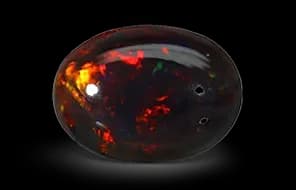
Ethiopian Black Opal
Ethiopian Black Opal is prized for its dark bodycolor and vivid play-of-color, creating dramatic flashes of red, orange, green, blue, and yellow in a distinctive natural gemstone.
Ethiopian Black Opal is a precious opal valued for its dark bodycolor and striking play-of-color. Opal belongs to the hydrated silica family rather than a crystalline mineral group, and its chemical composition is commonly expressed as SiO₂·nH₂O. It is amorphous, with a Mohs hardness of about 5-6.5, a refractive index generally around 1.37-1.47, and a specific gravity near 2.15. Its luster ranges from vitreous to resinous. Ethiopian opal deposits are especially important in the Wollo region of northern Ethiopia, while earlier commercial production also came from Shewa. The Stayish deposit in Wollo became known for naturally dark and black opal and has been commercially productive since around 2013. The dark bodycolor provides a strong contrast for the gemstone's play-of-color, which may appear as vivid red, orange, yellow, green, blue, and other spectral flashes. In precious opal, play-of-color results from diffraction of light interacting with organized microscopic silica spheres. Ethiopian opal is often hydrophane, meaning it can be porous enough to absorb water and other liquids. This characteristic can affect transparency and appearance and may increase the risk of cracking in some specimens. Famous material associated with Ethiopia includes opal from the Wollo and Shewa provinces, with Stayish being particularly notable for black opal. Today, Ethiopian Black Opal is commonly fashioned as cabochons and used in rings, pendants, earrings, bracelets, and collector pieces. Buyers value it for its dramatic contrast, distinctive patterns, natural origin, and individuality, since every opal can display a different arrangement and intensity of play-of-color.
- Mineral Family
- Opal
- Chemical Formula
- SiO₂·nH₂O
- Mohs Hardness
- 5 - 6.5
- Refractive Index
- 1.37 - 1.47
- Specific Gravity
- Approximately 2.15
- Cleavage
- None
- Crystal System
- Amorphous
- Luster
- Vitreous
- Color Range
- Black, Gray, Red, Orange, Blue, Green, Yellow, White
When buying Ethiopian Black Opal, evaluate the stone as a combination of bodycolor, play-of-color, pattern, clarity, size, cut, origin, and treatment. Color and play-of-color are usually the most important visual factors. A dark, even bodycolor can provide an excellent background for bright flashes, while strong red and orange play-of-color can be particularly desirable. Pattern also matters: broad, vivid, well-distributed flashes can increase appeal, while unusual patterns may add collector interest. Clarity should be judged according to the type of opal; some natural inclusions and internal features are expected, but cracks, crazing, and significant structural damage can reduce durability and value. Carat weight affects price, although quality and visual performance are more important than size alone. Cut should maximize the visible play-of-color while retaining as much valuable material as practical. Ethiopian origin should be supported by reliable documentation when provenance is important. Treatment deserves particular attention because hydrophane Ethiopian opal can absorb substances. Ethiopian opal has been treated by dyeing, smoke treatment, impregnation, and other processes, so sellers should clearly disclose treatments. GIA has documented smoke treatment used to produce a dark bodycolor in Ethiopian hydrophane opal. Natural Ethiopian Black Opal should be distinguished from synthetic or imitation opal, and buyers seeking a high-value stone should consider an independent gemological report from a reputable laboratory. A certificate can help document whether the material is natural, its identified variety, detectable treatments, and other relevant characteristics. Price depends heavily on play-of-color, pattern, bodycolor, clarity, size, origin, workmanship, and treatment status rather than a fixed price per carat.
Ethiopian Black Opal should be handled with care because opal is softer and less durable than many traditional jewelry gemstones. Clean it gently with lukewarm water, mild soap, and a soft cloth. Avoid ultrasonic cleaners, steam cleaners, harsh chemicals, and sudden temperature changes, which can increase the risk of damage or crazing. Many Ethiopian opals are hydrophane and can absorb water or other liquids, so prolonged immersion should be avoided. Store the gemstone separately from harder jewelry materials to prevent scratches, ideally in a soft pouch or lined jewelry box. For everyday wear, Ethiopian Black Opal is better suited to pieces where it is protected from hard impacts, such as pendants and earrings. Rings can be worn, but protective settings and sensible use are recommended. Remove opal jewelry before strenuous activities, cleaning, swimming, or situations involving chemicals and strong heat.
Ethiopian Black Opal is a precious opal valued for its dark bodycolor and striking play-of-color. Opal belongs to the hydrated silica family rather than a crystalline mineral group, and its chemical composition is commonly expressed as SiO₂·nH₂O. It is amorphous, with a Mohs hardness of about 5-6.5, a refractive index generally around 1.37-1.47, and a specific gravity near 2.15. Its luster ranges from vitreous to resinous. Ethiopian opal deposits are especially important in the Wollo region of northern Ethiopia, while earlier commercial production also came from Shewa. The Stayish deposit in Wollo became known for naturally dark and black opal and has been commercially productive since around 2013. The dark bodycolor provides a strong contrast for the gemstone's play-of-color, which may appear as vivid red, orange, yellow, green, blue, and other spectral flashes. In precious opal, play-of-color results from diffraction of light interacting with organized microscopic silica spheres. Ethiopian opal is often hydrophane, meaning it can be porous enough to absorb water and other liquids. This characteristic can affect transparency and appearance and may increase the risk of cracking in some specimens. Famous material associated with Ethiopia includes opal from the Wollo and Shewa provinces, with Stayish being particularly notable for black opal. Today, Ethiopian Black Opal is commonly fashioned as cabochons and used in rings, pendants, earrings, bracelets, and collector pieces. Buyers value it for its dramatic contrast, distinctive patterns, natural origin, and individuality, since every opal can display a different arrangement and intensity of play-of-color.
- Mineral Family
- Opal
- Chemical Formula
- SiO₂·nH₂O
- Mohs Hardness
- 5 - 6.5
- Refractive Index
- 1.37 - 1.47
- Specific Gravity
- Approximately 2.15
- Cleavage
- None
- Crystal System
- Amorphous
- Luster
- Vitreous
- Color Range
- Black, Gray, Red, Orange, Blue, Green, Yellow, White
When buying Ethiopian Black Opal, evaluate the stone as a combination of bodycolor, play-of-color, pattern, clarity, size, cut, origin, and treatment. Color and play-of-color are usually the most important visual factors. A dark, even bodycolor can provide an excellent background for bright flashes, while strong red and orange play-of-color can be particularly desirable. Pattern also matters: broad, vivid, well-distributed flashes can increase appeal, while unusual patterns may add collector interest. Clarity should be judged according to the type of opal; some natural inclusions and internal features are expected, but cracks, crazing, and significant structural damage can reduce durability and value. Carat weight affects price, although quality and visual performance are more important than size alone. Cut should maximize the visible play-of-color while retaining as much valuable material as practical. Ethiopian origin should be supported by reliable documentation when provenance is important. Treatment deserves particular attention because hydrophane Ethiopian opal can absorb substances. Ethiopian opal has been treated by dyeing, smoke treatment, impregnation, and other processes, so sellers should clearly disclose treatments. GIA has documented smoke treatment used to produce a dark bodycolor in Ethiopian hydrophane opal. Natural Ethiopian Black Opal should be distinguished from synthetic or imitation opal, and buyers seeking a high-value stone should consider an independent gemological report from a reputable laboratory. A certificate can help document whether the material is natural, its identified variety, detectable treatments, and other relevant characteristics. Price depends heavily on play-of-color, pattern, bodycolor, clarity, size, origin, workmanship, and treatment status rather than a fixed price per carat.
Ethiopian Black Opal should be handled with care because opal is softer and less durable than many traditional jewelry gemstones. Clean it gently with lukewarm water, mild soap, and a soft cloth. Avoid ultrasonic cleaners, steam cleaners, harsh chemicals, and sudden temperature changes, which can increase the risk of damage or crazing. Many Ethiopian opals are hydrophane and can absorb water or other liquids, so prolonged immersion should be avoided. Store the gemstone separately from harder jewelry materials to prevent scratches, ideally in a soft pouch or lined jewelry box. For everyday wear, Ethiopian Black Opal is better suited to pieces where it is protected from hard impacts, such as pendants and earrings. Rings can be worn, but protective settings and sensible use are recommended. Remove opal jewelry before strenuous activities, cleaning, swimming, or situations involving chemicals and strong heat.
Ethiopian Black Opal for Sale
No gems found
Try broadening your search or adjusting your filters.
Have a gem of your own? List it free - no fees