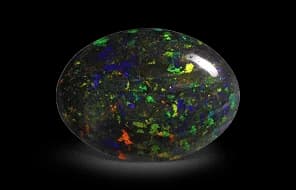
Black Opal
Black Opal is prized for its dark body color and vivid play-of-color, creating a dramatic contrast that makes each natural stone distinctive and highly desirable in jewelry.
Black Opal is a prized variety of precious opal, best known for a dark body tone that makes its flashes of spectral color especially vivid. Opal is a hydrated amorphous form of silica rather than a crystalline mineral, with water content that can vary. Its chemical composition is commonly expressed as SiO₂·nH₂O. Black Opal is primarily associated with the opal fields of Lightning Ridge in New South Wales, Australia, one of the world's most important sources of fine material. The dark body color can range from black to dark gray and may also appear with blue or green tones. Its defining feature is play-of-color, where shifting patches of red, orange, yellow, green, blue, or violet appear as the stone moves under light. Black Opal typically has a Mohs hardness of about 5.5–6.5, so it is suitable for jewelry but benefits from thoughtful everyday care. Opal has no cleavage and is amorphous rather than crystalline, with a vitreous to resinous luster. Among famous Black Opals is the Aurora Australis, a historic Lightning Ridge stone renowned for its strong play-of-color and distinctive pattern. Opal has a long history of collection and trade, while Australian Black Opal became particularly important to the modern international gemstone market through the development of Lightning Ridge mining. Today, Black Opal is used in rings, pendants, earrings, bracelets, and collector pieces. Buyers value it for its natural individuality, dramatic body tone, rarity of fine material, and exceptional play-of-color.
- Mineral Family
- Opal
- Chemical Formula
- SiO₂·nH₂O
- Mohs Hardness
- 5.5 - 6.5
- Refractive Index
- 1.37 - 1.47
- Specific Gravity
- 2.15 - 2.20
- Cleavage
- None
- Crystal System
- Amorphous
- Luster
- Waxy
- Color Range
- Black, Gray, Blue, Green
When buying a Black Opal gemstone, evaluate the stone as a combination of body tone, play-of-color, pattern, brightness, clarity, cut, size, and provenance. Color is particularly important: a dark body tone provides a strong backdrop for vivid play-of-color, while red and orange flashes can command strong interest when accompanied by excellent brightness and pattern. Clarity in opal differs from transparent gems; buyers should inspect the surface and body for cracks, crazing, pits, fractures, or other durability concerns. Cut should preserve the best play-of-color and provide an attractive, even profile. Carat weight matters, but quality and visual performance generally have a greater influence on value than size alone. Origin can affect desirability and price, with Lightning Ridge in Australia being especially significant for fine Black Opal. Treatments and assembled materials should always be disclosed. Natural Black Opal is mined material, while synthetic opal is laboratory-created and should not be represented as natural. Composite products such as doublets and triplets should also be clearly identified because they differ from solid opal. A reputable gemological report can help confirm material identity and disclose detectable treatments or assembled construction. Buyers should review the laboratory's credentials and ensure that the report description matches the stone being purchased. Price varies widely according to body tone, brightness, play-of-color, pattern, surface condition, size, origin, and whether the material is solid natural opal or an assembled product. For an informed purchase, compare stones under neutral lighting, inspect them from multiple angles, and buy from a transparent seller with clear return and certification policies.
Black Opal should be handled with care because its moderate hardness and natural water content make it more vulnerable to scratches, impact, dehydration-related cracking, and sudden environmental changes than many harder gemstones. Clean Black Opal gently with a soft, damp cloth and mild soapy water when necessary, then dry it thoroughly. Avoid ultrasonic and steam cleaners, harsh chemicals, solvents, and prolonged exposure to high heat. Protect the stone from hard impacts and avoid wearing Black Opal jewelry during activities where it may be struck or scratched. Store each piece separately in a soft pouch or lined jewelry compartment to prevent contact with harder gemstones. Keeping Black Opal away from rapid temperature changes is especially important. With careful handling and appropriate storage, a fine Black Opal can retain its distinctive play-of-color and polished appearance for many years.
Black Opal is a prized variety of precious opal, best known for a dark body tone that makes its flashes of spectral color especially vivid. Opal is a hydrated amorphous form of silica rather than a crystalline mineral, with water content that can vary. Its chemical composition is commonly expressed as SiO₂·nH₂O. Black Opal is primarily associated with the opal fields of Lightning Ridge in New South Wales, Australia, one of the world's most important sources of fine material. The dark body color can range from black to dark gray and may also appear with blue or green tones. Its defining feature is play-of-color, where shifting patches of red, orange, yellow, green, blue, or violet appear as the stone moves under light. Black Opal typically has a Mohs hardness of about 5.5–6.5, so it is suitable for jewelry but benefits from thoughtful everyday care. Opal has no cleavage and is amorphous rather than crystalline, with a vitreous to resinous luster. Among famous Black Opals is the Aurora Australis, a historic Lightning Ridge stone renowned for its strong play-of-color and distinctive pattern. Opal has a long history of collection and trade, while Australian Black Opal became particularly important to the modern international gemstone market through the development of Lightning Ridge mining. Today, Black Opal is used in rings, pendants, earrings, bracelets, and collector pieces. Buyers value it for its natural individuality, dramatic body tone, rarity of fine material, and exceptional play-of-color.
- Mineral Family
- Opal
- Chemical Formula
- SiO₂·nH₂O
- Mohs Hardness
- 5.5 - 6.5
- Refractive Index
- 1.37 - 1.47
- Specific Gravity
- 2.15 - 2.20
- Cleavage
- None
- Crystal System
- Amorphous
- Luster
- Waxy
- Color Range
- Black, Gray, Blue, Green
When buying a Black Opal gemstone, evaluate the stone as a combination of body tone, play-of-color, pattern, brightness, clarity, cut, size, and provenance. Color is particularly important: a dark body tone provides a strong backdrop for vivid play-of-color, while red and orange flashes can command strong interest when accompanied by excellent brightness and pattern. Clarity in opal differs from transparent gems; buyers should inspect the surface and body for cracks, crazing, pits, fractures, or other durability concerns. Cut should preserve the best play-of-color and provide an attractive, even profile. Carat weight matters, but quality and visual performance generally have a greater influence on value than size alone. Origin can affect desirability and price, with Lightning Ridge in Australia being especially significant for fine Black Opal. Treatments and assembled materials should always be disclosed. Natural Black Opal is mined material, while synthetic opal is laboratory-created and should not be represented as natural. Composite products such as doublets and triplets should also be clearly identified because they differ from solid opal. A reputable gemological report can help confirm material identity and disclose detectable treatments or assembled construction. Buyers should review the laboratory's credentials and ensure that the report description matches the stone being purchased. Price varies widely according to body tone, brightness, play-of-color, pattern, surface condition, size, origin, and whether the material is solid natural opal or an assembled product. For an informed purchase, compare stones under neutral lighting, inspect them from multiple angles, and buy from a transparent seller with clear return and certification policies.
Black Opal should be handled with care because its moderate hardness and natural water content make it more vulnerable to scratches, impact, dehydration-related cracking, and sudden environmental changes than many harder gemstones. Clean Black Opal gently with a soft, damp cloth and mild soapy water when necessary, then dry it thoroughly. Avoid ultrasonic and steam cleaners, harsh chemicals, solvents, and prolonged exposure to high heat. Protect the stone from hard impacts and avoid wearing Black Opal jewelry during activities where it may be struck or scratched. Store each piece separately in a soft pouch or lined jewelry compartment to prevent contact with harder gemstones. Keeping Black Opal away from rapid temperature changes is especially important. With careful handling and appropriate storage, a fine Black Opal can retain its distinctive play-of-color and polished appearance for many years.
Black Opal for Sale
No gems found
Try broadening your search or adjusting your filters.
Have a gem of your own? List it free - no fees