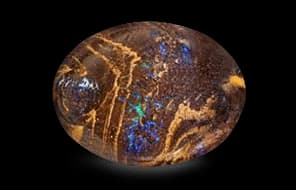
Boulder Opal
Boulder Opal is a distinctive Australian opal variety with vivid play-of-color naturally formed within ironstone, prized for its character, rarity, and jewelry appeal.
Boulder Opal is a natural precious opal in which veins and patches of hydrated amorphous silica occur within or alongside ironstone host rock. It belongs to the opal group and is valued for its striking play-of-color, which can produce flashes of blue, green, yellow, orange and red as the stone moves in light. Its chemical composition is commonly represented as SiO2·nH2O, with variable water content. Opal is amorphous rather than crystalline, with a Mohs hardness of approximately 5.5-6.5, a refractive index of about 1.37-1.52, and a specific gravity around 2.15-2.20. Boulder Opal commonly has a vitreous to waxy luster and no cleavage. The ironstone host gives many specimens their brown, gray, reddish-brown or dark body color and provides a natural contrast that can make the play-of-color especially vivid. Most fine material is associated with Queensland, Australia, particularly the Winton, Quilpie, Koroit and Yowah areas. Yowah is well known for its distinctive 'Yowah nut' formations, while Koroit is noted for strongly patterned ironstone matrix with colorful opal veins. Boulder Opal has a long history within Australia's opal industry and remains an important choice for contemporary jewelry and mineral collections. Unlike transparent faceted gemstones, it is commonly fashioned as a cabochon, free-form polished stone, carving, or natural specimen so that the color pattern and host rock remain visible. Boulder Opal jewelry can include rings, pendants, earrings and statement pieces. Buyers value natural Boulder Opal for its individuality: every specimen has a distinctive combination of body color, ironstone pattern, opal distribution and play-of-color.
- Mineral Family
- Opal
- Chemical Formula
- SiO2·nH2O
- Mohs Hardness
- 5.5 - 6.5
- Refractive Index
- 1.37 - 1.52
- Specific Gravity
- 2.15 - 2.20
- Cleavage
- None
- Crystal System
- Amorphous
- Luster
- Waxy
- Color Range
- Black, Blue, Green, Gray, Orange, Red, White
When buying Boulder Opal, evaluate the stone as a combination of precious opal and its natural ironstone host rather than using the same criteria applied to transparent faceted gems. Color and play-of-color are usually the most important visual factors. Look for vivid flashes, strong contrast against the darker host rock, attractive pattern distribution and color that remains visible from several viewing angles. Red and orange flashes can be particularly desirable when they are bright and well distributed, while blue and green are also common and attractive. Clarity is less important because Boulder Opal is typically opaque overall; instead, inspect the surface for cracks, pits, excessive porosity and distracting ironstone patterns. Cut should preserve the most attractive opal veins and color while providing a smooth, well-polished surface. Free-form shapes are common, although symmetrical cabochons can also be made when the rough permits. Carat weight affects value, but price does not increase automatically with size because unusually large pieces may be less practical for jewelry. Origin can influence market appeal, with Australian Boulder Opal, especially material from established Queensland fields, being highly regarded. Ask whether the stone is natural and whether any treatments or enhancements have been applied. Boulder Opal is generally sold in its natural form with cutting and polishing rather than conventional gemstone treatments, but disclosure is important. Synthetic or laboratory-grown opal should not be represented as natural Boulder Opal. For valuable purchases, request an independent gemological report identifying the material and noting treatments where applicable. Authenticity is best assessed through a reputable seller, transparent product details and, for higher-value stones, professional laboratory identification. Price is influenced by play-of-color intensity, color combination, pattern, contrast, condition, craftsmanship, origin, size, and overall visual appeal. Compare stones individually rather than relying solely on a price-per-carat figure.
Boulder Opal is softer and more vulnerable to scratching than many traditional jewelry gemstones, so it is best treated with care. Clean it gently with a soft cloth or a small amount of mild soapy water at room temperature, then rinse and dry thoroughly. Avoid ultrasonic cleaners, steam cleaners, harsh chemicals, prolonged soaking, and sudden temperature changes. Store Boulder Opal separately from harder gemstones such as diamond, sapphire and ruby to prevent scratches. A soft jewelry pouch or lined compartment is suitable. Although the ironstone host can provide structural support, the opal itself can still chip or fracture if struck. Rings worn every day should be protected from impacts, especially during sports, manual work, household cleaning or other activities where the stone may be knocked. Avoid exposing the gemstone to strong heat or rapid changes in temperature. Proper care helps preserve its polished surface and natural play-of-color.
Boulder Opal is a natural precious opal in which veins and patches of hydrated amorphous silica occur within or alongside ironstone host rock. It belongs to the opal group and is valued for its striking play-of-color, which can produce flashes of blue, green, yellow, orange and red as the stone moves in light. Its chemical composition is commonly represented as SiO2·nH2O, with variable water content. Opal is amorphous rather than crystalline, with a Mohs hardness of approximately 5.5-6.5, a refractive index of about 1.37-1.52, and a specific gravity around 2.15-2.20. Boulder Opal commonly has a vitreous to waxy luster and no cleavage. The ironstone host gives many specimens their brown, gray, reddish-brown or dark body color and provides a natural contrast that can make the play-of-color especially vivid. Most fine material is associated with Queensland, Australia, particularly the Winton, Quilpie, Koroit and Yowah areas. Yowah is well known for its distinctive 'Yowah nut' formations, while Koroit is noted for strongly patterned ironstone matrix with colorful opal veins. Boulder Opal has a long history within Australia's opal industry and remains an important choice for contemporary jewelry and mineral collections. Unlike transparent faceted gemstones, it is commonly fashioned as a cabochon, free-form polished stone, carving, or natural specimen so that the color pattern and host rock remain visible. Boulder Opal jewelry can include rings, pendants, earrings and statement pieces. Buyers value natural Boulder Opal for its individuality: every specimen has a distinctive combination of body color, ironstone pattern, opal distribution and play-of-color.
- Mineral Family
- Opal
- Chemical Formula
- SiO2·nH2O
- Mohs Hardness
- 5.5 - 6.5
- Refractive Index
- 1.37 - 1.52
- Specific Gravity
- 2.15 - 2.20
- Cleavage
- None
- Crystal System
- Amorphous
- Luster
- Waxy
- Color Range
- Black, Blue, Green, Gray, Orange, Red, White
When buying Boulder Opal, evaluate the stone as a combination of precious opal and its natural ironstone host rather than using the same criteria applied to transparent faceted gems. Color and play-of-color are usually the most important visual factors. Look for vivid flashes, strong contrast against the darker host rock, attractive pattern distribution and color that remains visible from several viewing angles. Red and orange flashes can be particularly desirable when they are bright and well distributed, while blue and green are also common and attractive. Clarity is less important because Boulder Opal is typically opaque overall; instead, inspect the surface for cracks, pits, excessive porosity and distracting ironstone patterns. Cut should preserve the most attractive opal veins and color while providing a smooth, well-polished surface. Free-form shapes are common, although symmetrical cabochons can also be made when the rough permits. Carat weight affects value, but price does not increase automatically with size because unusually large pieces may be less practical for jewelry. Origin can influence market appeal, with Australian Boulder Opal, especially material from established Queensland fields, being highly regarded. Ask whether the stone is natural and whether any treatments or enhancements have been applied. Boulder Opal is generally sold in its natural form with cutting and polishing rather than conventional gemstone treatments, but disclosure is important. Synthetic or laboratory-grown opal should not be represented as natural Boulder Opal. For valuable purchases, request an independent gemological report identifying the material and noting treatments where applicable. Authenticity is best assessed through a reputable seller, transparent product details and, for higher-value stones, professional laboratory identification. Price is influenced by play-of-color intensity, color combination, pattern, contrast, condition, craftsmanship, origin, size, and overall visual appeal. Compare stones individually rather than relying solely on a price-per-carat figure.
Boulder Opal is softer and more vulnerable to scratching than many traditional jewelry gemstones, so it is best treated with care. Clean it gently with a soft cloth or a small amount of mild soapy water at room temperature, then rinse and dry thoroughly. Avoid ultrasonic cleaners, steam cleaners, harsh chemicals, prolonged soaking, and sudden temperature changes. Store Boulder Opal separately from harder gemstones such as diamond, sapphire and ruby to prevent scratches. A soft jewelry pouch or lined compartment is suitable. Although the ironstone host can provide structural support, the opal itself can still chip or fracture if struck. Rings worn every day should be protected from impacts, especially during sports, manual work, household cleaning or other activities where the stone may be knocked. Avoid exposing the gemstone to strong heat or rapid changes in temperature. Proper care helps preserve its polished surface and natural play-of-color.
Boulder Opal for Sale
No gems found
Try broadening your search or adjusting your filters.
Have a gem of your own? List it free - no fees