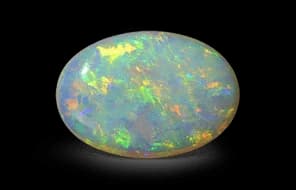
Australian Opal
Australian Opal is prized for its mesmerizing play-of-color, distinctive body tones, and remarkable variety. From rare Lightning Ridge black opal to Queensland boulder opal, each stone has its own character.
Australian Opal is precious opal from Australia, a hydrated silica mineraloid rather than a crystalline mineral. Its chemical composition is commonly expressed as SiO₂·nH₂O, with variable water content. Opal is amorphous and its distinctive play-of-color results from the diffraction of light by regularly arranged microscopic silica spheres. The size and arrangement of these spheres influence the colors and patterns visible in the stone.
Australian opal formed mainly through the deposition of silica-rich groundwater in sedimentary environments. In many Australian deposits, silica was released during the weathering of Cretaceous-age sandstones and mudstones and was carried by groundwater into cavities, fractures, and other openings, where it gradually formed opal. Australia remains the world's leading source of precious opal, with major fields in South Australia, New South Wales, and Queensland.
Important Australian varieties include black opal, white or light opal, crystal opal, and boulder opal. Lightning Ridge in New South Wales is especially renowned for black opal, whose dark body tone can create dramatic contrast with vivid flashes of red, orange, green, blue, and other colors. Coober Pedy is a major source of white and light opal, while Queensland is famous for boulder opal, which naturally retains ironstone host rock on its back. Andamooka is also known for several forms of opal, including matrix and crystal material.
The Australian opal story developed into a major commercial industry in the late 19th century. Commercial production began at Listowel Downs in Queensland in 1875, followed by important discoveries at White Cliffs, Lightning Ridge, Coober Pedy, Andamooka, and other fields. Famous specimens include the Olympic Australis from Coober Pedy and the Aurora Australis from Lightning Ridge.
Australian Opal jewelry is commonly designed as cabochons or freeform cuts because these shapes can preserve and display the stone's play-of-color. Opals are used in rings, pendants, earrings, bracelets, and collector pieces, although their moderate hardness and relatively fragile toughness make protective settings particularly useful for rings. Buyers value natural Australian Opal for its distinctive origin, individuality, color display, rarity, and the fact that every fine stone can have a highly personal pattern of play-of-color.
- Mineral Family
- Opal
- Chemical Formula
- SiO₂·nH₂O
- Mohs Hardness
- 5-6.5
- Refractive Index
- 1.37-1.47
- Specific Gravity
- 2.15 (+0.08/-0.90)
- Cleavage
- None
- Crystal System
- Amorphous
- Luster
- Waxy
- Color Range
- White, Black, Blue, Green, Yellow, Orange, Red, Pink, Purple, Gray, Cyan
When buying Australian Opal online, evaluate the individual stone rather than relying only on its locality or variety. Play-of-color is one of the most important quality factors. Look for strong, vivid flashes, attractive color combinations, and a pattern that remains impressive from different viewing angles. Red and orange flashes can be particularly scarce in fine material, while a dark body tone can provide exceptional contrast in black opal.
Color should be considered together with body tone, pattern, brightness, and distribution of play-of-color. Clarity requirements vary by opal type, so a transparent crystal opal should not be judged by exactly the same standards as an opaque black or boulder opal. Avoid stones with significant cracks, chips, or structural weakness, especially when the opal is intended for everyday jewelry.
Cut should maximize the visible play-of-color while preserving as much valuable material as possible. Cabochons and freeform shapes are common, and Australian boulder opals may retain natural ironstone backing. Carat weight matters, but size alone does not determine value. A smaller opal with exceptional brightness, pattern, color, and rarity can be considerably more valuable than a larger stone with weaker appearance.
Origin can add desirability and collectability, but it should not replace quality assessment. Fine opal can come from several Australian fields, and locality alone does not guarantee a premium. Treatments and construction should also be disclosed. Australian opals may be natural solids, while doublets and triplets combine a thin layer of opal with backing or additional material. Some opals may also have treatments such as impregnation, smoke treatment, sugar treatment, or other surface modifications.
For high-value purchases, request a reputable gemological report or independent identification report when appropriate. A professional report can help establish whether the material is natural or laboratory-grown and disclose detectable treatments. When buying natural Australian Opal online, ask for clear photographs or videos under neutral lighting, accurate dimensions and carat weight, treatment disclosure, and information about whether the stone is solid, a doublet, or a triplet. Price is ultimately influenced by the combination of play-of-color, brightness, pattern, body tone, clarity, size, shape, condition, construction, provenance, and market demand.
Australian Opal requires more care than harder gemstones because its Mohs hardness is generally around 5 to 6.5 and its toughness can range from poor to fair. For cleaning, use warm water, mild soap, and a soft cloth or very soft brush. Rinse carefully and dry with a soft cloth.
Avoid ultrasonic cleaners, steam cleaners, harsh chemicals, and prolonged exposure to intense heat. Sudden temperature changes and high heat can contribute to cracking or crazing in opal. Do not use abrasive materials that can scratch the polished surface.
For everyday wear, Australian Opal is best protected from knocks, sharp impacts, and contact with harder gemstones. Rings deserve particular caution because they are more exposed to accidental impact; protective settings can help. Remove opal jewelry before strenuous activities, household cleaning, or situations where the stone could be struck or scratched.
Store each opal separately in a soft pouch or lined jewelry compartment to prevent contact with harder stones. Avoid prolonged exposure to very dry or very hot environments. There is no need to routinely immerse an opal in water for storage. With sensible handling and appropriate cleaning, natural Australian Opal can remain beautiful for many years.
Australian Opal is precious opal from Australia, a hydrated silica mineraloid rather than a crystalline mineral. Its chemical composition is commonly expressed as SiO₂·nH₂O, with variable water content. Opal is amorphous and its distinctive play-of-color results from the diffraction of light by regularly arranged microscopic silica spheres. The size and arrangement of these spheres influence the colors and patterns visible in the stone.
Australian opal formed mainly through the deposition of silica-rich groundwater in sedimentary environments. In many Australian deposits, silica was released during the weathering of Cretaceous-age sandstones and mudstones and was carried by groundwater into cavities, fractures, and other openings, where it gradually formed opal. Australia remains the world's leading source of precious opal, with major fields in South Australia, New South Wales, and Queensland.
Important Australian varieties include black opal, white or light opal, crystal opal, and boulder opal. Lightning Ridge in New South Wales is especially renowned for black opal, whose dark body tone can create dramatic contrast with vivid flashes of red, orange, green, blue, and other colors. Coober Pedy is a major source of white and light opal, while Queensland is famous for boulder opal, which naturally retains ironstone host rock on its back. Andamooka is also known for several forms of opal, including matrix and crystal material.
The Australian opal story developed into a major commercial industry in the late 19th century. Commercial production began at Listowel Downs in Queensland in 1875, followed by important discoveries at White Cliffs, Lightning Ridge, Coober Pedy, Andamooka, and other fields. Famous specimens include the Olympic Australis from Coober Pedy and the Aurora Australis from Lightning Ridge.
Australian Opal jewelry is commonly designed as cabochons or freeform cuts because these shapes can preserve and display the stone's play-of-color. Opals are used in rings, pendants, earrings, bracelets, and collector pieces, although their moderate hardness and relatively fragile toughness make protective settings particularly useful for rings. Buyers value natural Australian Opal for its distinctive origin, individuality, color display, rarity, and the fact that every fine stone can have a highly personal pattern of play-of-color.
- Mineral Family
- Opal
- Chemical Formula
- SiO₂·nH₂O
- Mohs Hardness
- 5-6.5
- Refractive Index
- 1.37-1.47
- Specific Gravity
- 2.15 (+0.08/-0.90)
- Cleavage
- None
- Crystal System
- Amorphous
- Luster
- Waxy
- Color Range
- White, Black, Blue, Green, Yellow, Orange, Red, Pink, Purple, Gray, Cyan
When buying Australian Opal online, evaluate the individual stone rather than relying only on its locality or variety. Play-of-color is one of the most important quality factors. Look for strong, vivid flashes, attractive color combinations, and a pattern that remains impressive from different viewing angles. Red and orange flashes can be particularly scarce in fine material, while a dark body tone can provide exceptional contrast in black opal.
Color should be considered together with body tone, pattern, brightness, and distribution of play-of-color. Clarity requirements vary by opal type, so a transparent crystal opal should not be judged by exactly the same standards as an opaque black or boulder opal. Avoid stones with significant cracks, chips, or structural weakness, especially when the opal is intended for everyday jewelry.
Cut should maximize the visible play-of-color while preserving as much valuable material as possible. Cabochons and freeform shapes are common, and Australian boulder opals may retain natural ironstone backing. Carat weight matters, but size alone does not determine value. A smaller opal with exceptional brightness, pattern, color, and rarity can be considerably more valuable than a larger stone with weaker appearance.
Origin can add desirability and collectability, but it should not replace quality assessment. Fine opal can come from several Australian fields, and locality alone does not guarantee a premium. Treatments and construction should also be disclosed. Australian opals may be natural solids, while doublets and triplets combine a thin layer of opal with backing or additional material. Some opals may also have treatments such as impregnation, smoke treatment, sugar treatment, or other surface modifications.
For high-value purchases, request a reputable gemological report or independent identification report when appropriate. A professional report can help establish whether the material is natural or laboratory-grown and disclose detectable treatments. When buying natural Australian Opal online, ask for clear photographs or videos under neutral lighting, accurate dimensions and carat weight, treatment disclosure, and information about whether the stone is solid, a doublet, or a triplet. Price is ultimately influenced by the combination of play-of-color, brightness, pattern, body tone, clarity, size, shape, condition, construction, provenance, and market demand.
Australian Opal requires more care than harder gemstones because its Mohs hardness is generally around 5 to 6.5 and its toughness can range from poor to fair. For cleaning, use warm water, mild soap, and a soft cloth or very soft brush. Rinse carefully and dry with a soft cloth.
Avoid ultrasonic cleaners, steam cleaners, harsh chemicals, and prolonged exposure to intense heat. Sudden temperature changes and high heat can contribute to cracking or crazing in opal. Do not use abrasive materials that can scratch the polished surface.
For everyday wear, Australian Opal is best protected from knocks, sharp impacts, and contact with harder gemstones. Rings deserve particular caution because they are more exposed to accidental impact; protective settings can help. Remove opal jewelry before strenuous activities, household cleaning, or situations where the stone could be struck or scratched.
Store each opal separately in a soft pouch or lined jewelry compartment to prevent contact with harder stones. Avoid prolonged exposure to very dry or very hot environments. There is no need to routinely immerse an opal in water for storage. With sensible handling and appropriate cleaning, natural Australian Opal can remain beautiful for many years.
Australian Opal for Sale
No gems found
Try broadening your search or adjusting your filters.
Have a gem of your own? List it free - no fees