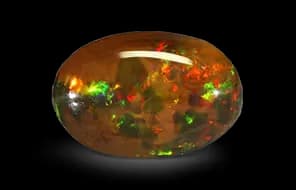
Brown Opal
Brown Opal combines warm earthy body colors with the possibility of vivid play-of-color, creating distinctive gemstones prized for jewelry, collectors, and natural beauty.
Brown Opal is a variety of opal, a hydrated amorphous form of silica that contains variable amounts of water. Unlike crystalline quartz, opal has no organized crystal structure. Its brown body color can range from light tan and honey-brown to deep chocolate tones, while some specimens display precious opal play-of-color with flashes of green, blue, orange, red, or other hues. Other brown opals are common opal and show little or no play-of-color. Brown Opal forms when silica-rich water moves through rocks and sediments, depositing hydrated silica into cavities, fractures, and other openings. Its chemical composition is commonly expressed as SiO2·nH2O, reflecting variable water content. Opal has a Mohs hardness of about 5.5-6.5, a refractive index of approximately 1.37-1.52, and a specific gravity generally around 2.15-2.20. Its luster may range from vitreous to resinous. Opal has no cleavage and is amorphous rather than belonging to a conventional crystal system. Australia is especially renowned for opal, including material from Queensland, New South Wales, and South Australia, while important opal deposits also occur in Ethiopia, Mexico, Brazil, and other regions. Australian boulder opal can naturally occur with dark or brown ironstone matrix, producing dramatic contrasts and distinctive patterns. The famous Olympic Australis is one of the world's best-known opal specimens, although it is not specifically a Brown Opal. Today, Brown Opal is used in cabochons, pendants, rings, earrings, bracelets, and collector specimens. Buyers value it for its earthy body color, individuality, potential play-of-color, natural patterns, and the visual character produced by its geological origin.
- Mineral Family
- Opal
- Chemical Formula
- SiO2·nH2O
- Mohs Hardness
- 5.5 - 6.5
- Refractive Index
- 1.37 - 1.52
- Specific Gravity
- 2.15 - 2.20
- Cleavage
- None
- Crystal System
- Amorphous
- Luster
- Waxy
- Color Range
- Orange
When buying Brown Opal, evaluate the stone as a whole rather than relying on body color alone. Color: Rich, attractive brown body colors can be desirable, but for precious Brown Opal the quality, brightness, coverage, and pattern of play-of-color are especially important. Clarity: Opal may be opaque, translucent, or transparent depending on its type. For many brown opals, attractive pattern and play-of-color matter more than conventional gemstone clarity grading. Cut: Brown Opal is commonly fashioned as a cabochon because a smooth domed surface can display body color and play-of-color effectively. The cut should be well polished, symmetrical, and appropriate for the rough. Carat: Larger fine-quality pieces can be scarcer and more valuable, but size should always be considered alongside color, play-of-color, pattern, condition, and origin. Origin: Australian Brown Opal, including boulder opal from Queensland and other established Australian fields, is well known among collectors. Ethiopian, Mexican, Brazilian, and other opals can also be attractive and valuable. Origin should be supported by reliable documentation when it is being used as a value factor. Treatments: Opal may be subjected to treatments or assembled into composites such as doublets and triplets. Smoke treatment, dyeing, impregnation, and backing can alter appearance, depending on the material and process. Buyers should ask whether the stone is untreated, treated, or assembled. Natural vs lab-grown: Natural opal is formed through geological processes. Laboratory-created or synthetic opal can reproduce some visual characteristics of natural opal but should be clearly disclosed and should not be represented as natural. Certification: For valuable or unusual specimens, an independent gemological report can document whether the material is natural, identify treatments or composites, and provide useful identification information. Authenticity: Buy from a reputable seller, request treatment disclosure, and be cautious of descriptions that promise unusually high value without supporting evidence. Price factors: Brown Opal value depends on whether it is common or precious opal, body color, play-of-color, pattern, brightness, transparency, size, condition, origin, workmanship, treatment status, and market demand. There is no single fixed price per carat for all Brown Opal.
Brown Opal requires more care than harder gemstones such as sapphire or ruby. Clean it gently with lukewarm water, a soft cloth, and mild soap when necessary, then rinse and dry carefully. Avoid ultrasonic cleaners, steam cleaners, harsh chemicals, sudden temperature changes, and abrasive materials. Store opal separately from harder jewelry to reduce scratching. A soft pouch or lined jewelry box is suitable. Avoid wearing Brown Opal during strenuous activities, household cleaning, gardening, or situations where it may receive sharp impacts. If the stone is a doublet or triplet, avoid prolonged soaking because moisture can affect the adhesive or backing. Regularly inspect mounted opal jewelry for loose settings or damage.
Brown Opal is a variety of opal, a hydrated amorphous form of silica that contains variable amounts of water. Unlike crystalline quartz, opal has no organized crystal structure. Its brown body color can range from light tan and honey-brown to deep chocolate tones, while some specimens display precious opal play-of-color with flashes of green, blue, orange, red, or other hues. Other brown opals are common opal and show little or no play-of-color. Brown Opal forms when silica-rich water moves through rocks and sediments, depositing hydrated silica into cavities, fractures, and other openings. Its chemical composition is commonly expressed as SiO2·nH2O, reflecting variable water content. Opal has a Mohs hardness of about 5.5-6.5, a refractive index of approximately 1.37-1.52, and a specific gravity generally around 2.15-2.20. Its luster may range from vitreous to resinous. Opal has no cleavage and is amorphous rather than belonging to a conventional crystal system. Australia is especially renowned for opal, including material from Queensland, New South Wales, and South Australia, while important opal deposits also occur in Ethiopia, Mexico, Brazil, and other regions. Australian boulder opal can naturally occur with dark or brown ironstone matrix, producing dramatic contrasts and distinctive patterns. The famous Olympic Australis is one of the world's best-known opal specimens, although it is not specifically a Brown Opal. Today, Brown Opal is used in cabochons, pendants, rings, earrings, bracelets, and collector specimens. Buyers value it for its earthy body color, individuality, potential play-of-color, natural patterns, and the visual character produced by its geological origin.
- Mineral Family
- Opal
- Chemical Formula
- SiO2·nH2O
- Mohs Hardness
- 5.5 - 6.5
- Refractive Index
- 1.37 - 1.52
- Specific Gravity
- 2.15 - 2.20
- Cleavage
- None
- Crystal System
- Amorphous
- Luster
- Waxy
- Color Range
- Orange
When buying Brown Opal, evaluate the stone as a whole rather than relying on body color alone. Color: Rich, attractive brown body colors can be desirable, but for precious Brown Opal the quality, brightness, coverage, and pattern of play-of-color are especially important. Clarity: Opal may be opaque, translucent, or transparent depending on its type. For many brown opals, attractive pattern and play-of-color matter more than conventional gemstone clarity grading. Cut: Brown Opal is commonly fashioned as a cabochon because a smooth domed surface can display body color and play-of-color effectively. The cut should be well polished, symmetrical, and appropriate for the rough. Carat: Larger fine-quality pieces can be scarcer and more valuable, but size should always be considered alongside color, play-of-color, pattern, condition, and origin. Origin: Australian Brown Opal, including boulder opal from Queensland and other established Australian fields, is well known among collectors. Ethiopian, Mexican, Brazilian, and other opals can also be attractive and valuable. Origin should be supported by reliable documentation when it is being used as a value factor. Treatments: Opal may be subjected to treatments or assembled into composites such as doublets and triplets. Smoke treatment, dyeing, impregnation, and backing can alter appearance, depending on the material and process. Buyers should ask whether the stone is untreated, treated, or assembled. Natural vs lab-grown: Natural opal is formed through geological processes. Laboratory-created or synthetic opal can reproduce some visual characteristics of natural opal but should be clearly disclosed and should not be represented as natural. Certification: For valuable or unusual specimens, an independent gemological report can document whether the material is natural, identify treatments or composites, and provide useful identification information. Authenticity: Buy from a reputable seller, request treatment disclosure, and be cautious of descriptions that promise unusually high value without supporting evidence. Price factors: Brown Opal value depends on whether it is common or precious opal, body color, play-of-color, pattern, brightness, transparency, size, condition, origin, workmanship, treatment status, and market demand. There is no single fixed price per carat for all Brown Opal.
Brown Opal requires more care than harder gemstones such as sapphire or ruby. Clean it gently with lukewarm water, a soft cloth, and mild soap when necessary, then rinse and dry carefully. Avoid ultrasonic cleaners, steam cleaners, harsh chemicals, sudden temperature changes, and abrasive materials. Store opal separately from harder jewelry to reduce scratching. A soft pouch or lined jewelry box is suitable. Avoid wearing Brown Opal during strenuous activities, household cleaning, gardening, or situations where it may receive sharp impacts. If the stone is a doublet or triplet, avoid prolonged soaking because moisture can affect the adhesive or backing. Regularly inspect mounted opal jewelry for loose settings or damage.
Brown Opal for Sale
No gems found
Try broadening your search or adjusting your filters.
Have a gem of your own? List it free - no fees