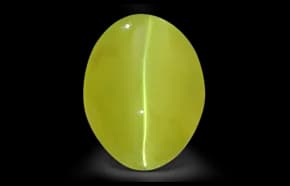
Chrysoberyl Cats Eye
Chrysoberyl Cat’s Eye is a rare and durable gemstone prized for its sharp, luminous chatoyancy—a moving band of light that resembles a cat’s eye.
Chrysoberyl Cat’s Eye is the chatoyant variety of chrysoberyl, a beryllium aluminum oxide mineral distinct from beryl. Its chemical formula is BeAl2O4, and it crystallizes in the orthorhombic system. With a Mohs hardness of 8.5, chrysoberyl is a durable gemstone suitable for many types of jewelry. Its luster is typically vitreous, while its refractive index is approximately 1.746–1.755 and specific gravity is generally around 3.5–3.8. The defining feature of natural Chrysoberyl Cat’s Eye is chatoyancy. Fine, parallel needle-like inclusions—usually rutile—reflect light into a concentrated band that moves across the surface of a properly oriented cabochon. The quality of the effect depends on the inclusion structure, orientation, cutting, and dome of the stone. Colors commonly range from yellow and golden tones through yellow-green and green to grayish shades. Warm honey and golden-yellow stones are particularly sought after when combined with a strong, centered eye. Important sources of chrysoberyl include Sri Lanka, Brazil, Madagascar, Tanzania, and other gem-producing regions. Sri Lanka is especially well known for fine chrysoberyl and cat’s-eye material. Cat’s-eye chrysoberyl has a long history as a collectible phenomenal gemstone and remains highly valued by jewelry buyers and collectors for its rarity, durability, optical character, and distinctive appearance. In modern jewelry, it is most often fashioned as a cabochon and used in rings, pendants, bracelets, and statement pieces. Buyers value natural Chrysoberyl Cat’s Eye primarily for a sharp and well-centered eye, attractive body color, good cutting, rarity, and credible documentation.
- Mineral Family
- Chrysoberyl
- Chemical Formula
- BeAl2O4
- Mohs Hardness
- 8.5
- Refractive Index
- 1.746 - 1.755
- Specific Gravity
- 3.5 - 3.8
- Cleavage
- Good in one direction; imperfect in another
- Crystal System
- Orthorhombic
- Luster
- Vitreous
- Color Range
- Yellow, Green, Gray
When buying Chrysoberyl Cat’s Eye online, evaluate the stone as a complete combination of color, clarity, chatoyancy, cut, carat weight, origin, treatment status, and documentation. Color: Look for attractive, even body color. Golden yellow, honey, yellow-green, and rich green tones can be desirable, while the best choice depends on personal preference and overall quality. Clarity: Cat’s-eye chrysoberyl is intentionally included because its parallel internal features create chatoyancy. Fine, translucent material with well-oriented inclusions can show a strong eye; excessive fractures or distracting inclusions can reduce durability and visual appeal. Cut: Most cat’s-eye chrysoberyl is cut as a cabochon. A well-proportioned dome and correct orientation of the inclusions are essential for producing a straight, bright, centered eye. Carat: Larger stones with excellent color and strong chatoyancy can become substantially rarer and more valuable, although carat weight should never be considered separately from quality. Origin: Sri Lanka is an important source of fine cat’s-eye chrysoberyl, while Brazil, Madagascar, Tanzania, and other localities also produce chrysoberyl. Origin can influence market interest, but it should be supported by reliable documentation rather than assumed from appearance alone. Treatments: Natural cat’s-eye chrysoberyl is commonly encountered without treatment, but buyers should ask whether any treatment or enhancement has been applied and ensure that disclosures are included in the sale documentation. Natural vs lab-grown: Natural chrysoberyl forms through geological processes, while synthetic chrysoberyl can be produced in laboratories. A laboratory-created stone may reproduce the material and optical phenomenon but should not be represented as natural. Certification: For valuable stones, request an independent laboratory report identifying the material as natural chrysoberyl and documenting relevant treatments when applicable. Authenticity: A strong cat’s-eye effect alone does not prove that a stone is natural Chrysoberyl Cat’s Eye. Professional gemological testing can distinguish chrysoberyl from other chatoyant materials and help identify synthetics or imitations. Price factors: Prices can vary considerably according to the sharpness and centering of the eye, body color, transparency, surface condition, cut quality, carat weight, origin, treatment status, and laboratory documentation. A high-quality natural Chrysoberyl Cat’s Eye should be judged individually rather than by carat weight alone.
Chrysoberyl Cat’s Eye is relatively hard and durable, but it should still be handled carefully because cleavage and internal inclusions can make a stone vulnerable to impact. Clean the gemstone with lukewarm water, mild soap, and a soft brush, then rinse and dry it with a soft cloth. Avoid harsh chemicals, abrasive cleaners, prolonged exposure to extreme heat, and sudden temperature changes. Ultrasonic or steam cleaning should be avoided unless a qualified gemologist has confirmed that the specific stone is suitable for it, particularly when significant fractures or treatments are present. Store Chrysoberyl Cat’s Eye jewelry separately from softer gemstones to reduce scratching and protect the cabochon surface. For rings worn regularly, inspect the setting periodically and remove the jewelry before activities involving heavy impact, household chemicals, or strenuous work. These simple precautions help preserve the gemstone’s polish, color, and distinctive chatoyancy.
Chrysoberyl Cat’s Eye is the chatoyant variety of chrysoberyl, a beryllium aluminum oxide mineral distinct from beryl. Its chemical formula is BeAl2O4, and it crystallizes in the orthorhombic system. With a Mohs hardness of 8.5, chrysoberyl is a durable gemstone suitable for many types of jewelry. Its luster is typically vitreous, while its refractive index is approximately 1.746–1.755 and specific gravity is generally around 3.5–3.8. The defining feature of natural Chrysoberyl Cat’s Eye is chatoyancy. Fine, parallel needle-like inclusions—usually rutile—reflect light into a concentrated band that moves across the surface of a properly oriented cabochon. The quality of the effect depends on the inclusion structure, orientation, cutting, and dome of the stone. Colors commonly range from yellow and golden tones through yellow-green and green to grayish shades. Warm honey and golden-yellow stones are particularly sought after when combined with a strong, centered eye. Important sources of chrysoberyl include Sri Lanka, Brazil, Madagascar, Tanzania, and other gem-producing regions. Sri Lanka is especially well known for fine chrysoberyl and cat’s-eye material. Cat’s-eye chrysoberyl has a long history as a collectible phenomenal gemstone and remains highly valued by jewelry buyers and collectors for its rarity, durability, optical character, and distinctive appearance. In modern jewelry, it is most often fashioned as a cabochon and used in rings, pendants, bracelets, and statement pieces. Buyers value natural Chrysoberyl Cat’s Eye primarily for a sharp and well-centered eye, attractive body color, good cutting, rarity, and credible documentation.
- Mineral Family
- Chrysoberyl
- Chemical Formula
- BeAl2O4
- Mohs Hardness
- 8.5
- Refractive Index
- 1.746 - 1.755
- Specific Gravity
- 3.5 - 3.8
- Cleavage
- Good in one direction; imperfect in another
- Crystal System
- Orthorhombic
- Luster
- Vitreous
- Color Range
- Yellow, Green, Gray
When buying Chrysoberyl Cat’s Eye online, evaluate the stone as a complete combination of color, clarity, chatoyancy, cut, carat weight, origin, treatment status, and documentation. Color: Look for attractive, even body color. Golden yellow, honey, yellow-green, and rich green tones can be desirable, while the best choice depends on personal preference and overall quality. Clarity: Cat’s-eye chrysoberyl is intentionally included because its parallel internal features create chatoyancy. Fine, translucent material with well-oriented inclusions can show a strong eye; excessive fractures or distracting inclusions can reduce durability and visual appeal. Cut: Most cat’s-eye chrysoberyl is cut as a cabochon. A well-proportioned dome and correct orientation of the inclusions are essential for producing a straight, bright, centered eye. Carat: Larger stones with excellent color and strong chatoyancy can become substantially rarer and more valuable, although carat weight should never be considered separately from quality. Origin: Sri Lanka is an important source of fine cat’s-eye chrysoberyl, while Brazil, Madagascar, Tanzania, and other localities also produce chrysoberyl. Origin can influence market interest, but it should be supported by reliable documentation rather than assumed from appearance alone. Treatments: Natural cat’s-eye chrysoberyl is commonly encountered without treatment, but buyers should ask whether any treatment or enhancement has been applied and ensure that disclosures are included in the sale documentation. Natural vs lab-grown: Natural chrysoberyl forms through geological processes, while synthetic chrysoberyl can be produced in laboratories. A laboratory-created stone may reproduce the material and optical phenomenon but should not be represented as natural. Certification: For valuable stones, request an independent laboratory report identifying the material as natural chrysoberyl and documenting relevant treatments when applicable. Authenticity: A strong cat’s-eye effect alone does not prove that a stone is natural Chrysoberyl Cat’s Eye. Professional gemological testing can distinguish chrysoberyl from other chatoyant materials and help identify synthetics or imitations. Price factors: Prices can vary considerably according to the sharpness and centering of the eye, body color, transparency, surface condition, cut quality, carat weight, origin, treatment status, and laboratory documentation. A high-quality natural Chrysoberyl Cat’s Eye should be judged individually rather than by carat weight alone.
Chrysoberyl Cat’s Eye is relatively hard and durable, but it should still be handled carefully because cleavage and internal inclusions can make a stone vulnerable to impact. Clean the gemstone with lukewarm water, mild soap, and a soft brush, then rinse and dry it with a soft cloth. Avoid harsh chemicals, abrasive cleaners, prolonged exposure to extreme heat, and sudden temperature changes. Ultrasonic or steam cleaning should be avoided unless a qualified gemologist has confirmed that the specific stone is suitable for it, particularly when significant fractures or treatments are present. Store Chrysoberyl Cat’s Eye jewelry separately from softer gemstones to reduce scratching and protect the cabochon surface. For rings worn regularly, inspect the setting periodically and remove the jewelry before activities involving heavy impact, household chemicals, or strenuous work. These simple precautions help preserve the gemstone’s polish, color, and distinctive chatoyancy.
Chrysoberyl Cats Eye for Sale
No gems found
Try broadening your search or adjusting your filters.
Have a gem of your own? List it free - no fees