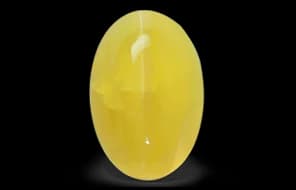
Cats Eye Opal
Cat's Eye Opal is a rare opal variety prized for its luminous chatoyancy, distinctive body colors, and, in exceptional specimens, an intriguing combination of cat's-eye and play-of-color.
Cat's Eye Opal is an unusual variety of opal that displays chatoyancy, the moving band of light commonly called the cat's-eye effect. Unlike chrysoberyl cat's-eye, it is an opal material rather than a separate crystalline mineral species. Cat's-eye opal may occur as common opal, where the optical effect is produced by aligned fibrous or needle-like inclusions, or as precious opal, where chatoyancy can occur alongside play-of-color. GIA has documented rare precious cat's-eye opal as well as cat's-eye common opal from localities including Tanzania and Brazil. Precious cat's-eye opal has also been reported from the United States, Mexico, and Australia. Opal is hydrated silica with the approximate composition SiO₂·nH₂O and has no definite crystal system. Its familiar play-of-color results from diffraction of light by ordered microscopic silica spheres. Cat's-eye effects in opal have different structural causes depending on the material; in common cat's-eye opal, parallel fibrous or needle-like inclusions can reflect light into a narrow moving band. Cat's-eye opal can appear in white, gray, yellow, brown, green, blue, orange, and other natural body colors. Some precious examples combine a visible chatoyant band with flashes of green, blue, red, or other spectral colors. The gemstone is usually fashioned as a cabochon, often with a rounded or high dome, because the curved surface helps display the moving band of light. Opal has a Mohs hardness of approximately 5 to 6.5, so it is best suited to jewelry designs that protect the stone from hard impacts and abrasion. Cat's Eye Opal jewelry is especially appealing in rings, pendants, earrings, bracelets, and collector pieces where its unusual optical effect can be viewed easily. Buyers value natural Cat's Eye Opal for the rarity of chatoyancy, the individuality of its pattern, and the possibility of finding a specimen with both a well-defined eye and attractive play-of-color.
- Mineral Family
- Opal
- Chemical Formula
- SiO₂·nH₂O
- Mohs Hardness
- 5 - 6.5
- Refractive Index
- 1.37 - 1.47
- Specific Gravity
- Approximately 2.15
- Cleavage
- None
- Crystal System
- Amorphous
- Luster
- Waxy
- Color Range
- White, Gray, Yellow, Green, Blue, Orange, Black
When buying Cat's Eye Opal, evaluate the actual stone rather than relying only on the name. Color should be attractive and evenly presented, with body color considered alongside any play-of-color. For precious cat's-eye material, vivid and clearly visible flashes can increase desirability. The most important feature is chatoyancy: look for a distinct, continuous band that moves smoothly across the dome as the stone or light source changes position. A sharp, centered eye is generally more desirable than a diffuse or broken band. Clarity requirements vary because inclusions may be responsible for the cat's-eye effect, so an included stone is not automatically lower quality. Cut is particularly important. Well-shaped, properly oriented cabochons can maximize the visibility of chatoyancy, while an unsuitable orientation may weaken the effect. Carat weight matters, but rarity and optical quality can have a greater influence on value than size alone. Origin may add interest and provenance, particularly when supported by reliable documentation, but it should not be treated as a guarantee of quality. Ask whether the gemstone is natural, treated, assembled, or an imitation. Opal can be subjected to treatments that alter appearance or durability, and some opal products may be assembled or manufactured to imitate natural material. Do not assume that every stone marketed as Cat's Eye Opal is natural. A reputable laboratory report can help confirm identity and disclose important treatment or composition information. For higher-value purchases, request an independent gemological certificate from a recognized laboratory. Buy Cat's Eye Opal online only when the seller provides clear photographs or video, accurate measurements, carat weight, treatment disclosure, and a transparent return policy. Price depends on the strength and sharpness of chatoyancy, presence and quality of play-of-color, body color, transparency, pattern, size, cut, condition, provenance, treatment status, and overall rarity. Because exceptional cat's-eye opal is uncommon, there is no reliable universal price per carat; compare stones of similar quality rather than choosing solely by weight or a quoted price.
Cat's Eye Opal requires thoughtful care because opal is softer and more sensitive to environmental changes than many crystalline gemstones. Clean the gemstone gently with lukewarm water, a small amount of mild soap, and a soft cloth. Rinse carefully and pat dry with a soft, lint-free cloth. Avoid ultrasonic cleaners, steam cleaners, abrasive materials, strong chemicals, and prolonged exposure to high heat. Sudden temperature changes should also be avoided. Perfume, cosmetics, hairspray, household chemicals, and harsh cleaning products should be kept away from the stone. Store Cat's Eye Opal separately from harder gemstones such as diamond, sapphire, and ruby to reduce scratching. A soft jewelry pouch or individual compartment is preferable. For everyday wear, pendants and earrings are generally easier to protect than rings because rings experience more knocks and abrasion. Remove Cat's Eye Opal jewelry before sports, heavy manual work, gardening, swimming, or household cleaning. Inspect settings periodically, particularly for rings, to ensure the cabochon remains secure. Proper handling and storage will help preserve the polish, surface condition, and optical beauty of natural Cat's Eye Opal.
Cat's Eye Opal is an unusual variety of opal that displays chatoyancy, the moving band of light commonly called the cat's-eye effect. Unlike chrysoberyl cat's-eye, it is an opal material rather than a separate crystalline mineral species. Cat's-eye opal may occur as common opal, where the optical effect is produced by aligned fibrous or needle-like inclusions, or as precious opal, where chatoyancy can occur alongside play-of-color. GIA has documented rare precious cat's-eye opal as well as cat's-eye common opal from localities including Tanzania and Brazil. Precious cat's-eye opal has also been reported from the United States, Mexico, and Australia. Opal is hydrated silica with the approximate composition SiO₂·nH₂O and has no definite crystal system. Its familiar play-of-color results from diffraction of light by ordered microscopic silica spheres. Cat's-eye effects in opal have different structural causes depending on the material; in common cat's-eye opal, parallel fibrous or needle-like inclusions can reflect light into a narrow moving band. Cat's-eye opal can appear in white, gray, yellow, brown, green, blue, orange, and other natural body colors. Some precious examples combine a visible chatoyant band with flashes of green, blue, red, or other spectral colors. The gemstone is usually fashioned as a cabochon, often with a rounded or high dome, because the curved surface helps display the moving band of light. Opal has a Mohs hardness of approximately 5 to 6.5, so it is best suited to jewelry designs that protect the stone from hard impacts and abrasion. Cat's Eye Opal jewelry is especially appealing in rings, pendants, earrings, bracelets, and collector pieces where its unusual optical effect can be viewed easily. Buyers value natural Cat's Eye Opal for the rarity of chatoyancy, the individuality of its pattern, and the possibility of finding a specimen with both a well-defined eye and attractive play-of-color.
- Mineral Family
- Opal
- Chemical Formula
- SiO₂·nH₂O
- Mohs Hardness
- 5 - 6.5
- Refractive Index
- 1.37 - 1.47
- Specific Gravity
- Approximately 2.15
- Cleavage
- None
- Crystal System
- Amorphous
- Luster
- Waxy
- Color Range
- White, Gray, Yellow, Green, Blue, Orange, Black
When buying Cat's Eye Opal, evaluate the actual stone rather than relying only on the name. Color should be attractive and evenly presented, with body color considered alongside any play-of-color. For precious cat's-eye material, vivid and clearly visible flashes can increase desirability. The most important feature is chatoyancy: look for a distinct, continuous band that moves smoothly across the dome as the stone or light source changes position. A sharp, centered eye is generally more desirable than a diffuse or broken band. Clarity requirements vary because inclusions may be responsible for the cat's-eye effect, so an included stone is not automatically lower quality. Cut is particularly important. Well-shaped, properly oriented cabochons can maximize the visibility of chatoyancy, while an unsuitable orientation may weaken the effect. Carat weight matters, but rarity and optical quality can have a greater influence on value than size alone. Origin may add interest and provenance, particularly when supported by reliable documentation, but it should not be treated as a guarantee of quality. Ask whether the gemstone is natural, treated, assembled, or an imitation. Opal can be subjected to treatments that alter appearance or durability, and some opal products may be assembled or manufactured to imitate natural material. Do not assume that every stone marketed as Cat's Eye Opal is natural. A reputable laboratory report can help confirm identity and disclose important treatment or composition information. For higher-value purchases, request an independent gemological certificate from a recognized laboratory. Buy Cat's Eye Opal online only when the seller provides clear photographs or video, accurate measurements, carat weight, treatment disclosure, and a transparent return policy. Price depends on the strength and sharpness of chatoyancy, presence and quality of play-of-color, body color, transparency, pattern, size, cut, condition, provenance, treatment status, and overall rarity. Because exceptional cat's-eye opal is uncommon, there is no reliable universal price per carat; compare stones of similar quality rather than choosing solely by weight or a quoted price.
Cat's Eye Opal requires thoughtful care because opal is softer and more sensitive to environmental changes than many crystalline gemstones. Clean the gemstone gently with lukewarm water, a small amount of mild soap, and a soft cloth. Rinse carefully and pat dry with a soft, lint-free cloth. Avoid ultrasonic cleaners, steam cleaners, abrasive materials, strong chemicals, and prolonged exposure to high heat. Sudden temperature changes should also be avoided. Perfume, cosmetics, hairspray, household chemicals, and harsh cleaning products should be kept away from the stone. Store Cat's Eye Opal separately from harder gemstones such as diamond, sapphire, and ruby to reduce scratching. A soft jewelry pouch or individual compartment is preferable. For everyday wear, pendants and earrings are generally easier to protect than rings because rings experience more knocks and abrasion. Remove Cat's Eye Opal jewelry before sports, heavy manual work, gardening, swimming, or household cleaning. Inspect settings periodically, particularly for rings, to ensure the cabochon remains secure. Proper handling and storage will help preserve the polish, surface condition, and optical beauty of natural Cat's Eye Opal.
Cats Eye Opal for Sale
No gems found
Try broadening your search or adjusting your filters.
Have a gem of your own? List it free - no fees