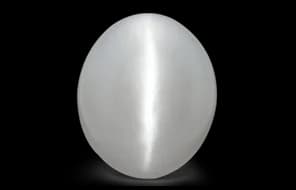
Cats Eye Moonstone
Cat's Eye Moonstone is a captivating moonstone variety combining a soft floating sheen with a moving cat's-eye line, prized for its distinctive optical beauty in jewelry.
Cat's Eye Moonstone is a phenomenal variety of moonstone, a feldspar-group gemstone best known for its soft, floating adularescence. Moonstone is associated primarily with orthoclase feldspar and forms through an intergrowth of orthoclase and albite layers; light scattering through these microscopic layers creates the characteristic adularescence. In some moonstones, aligned internal features also produce chatoyancy, creating a narrow band of light that moves across the polished surface and gives the stone its cat's-eye appearance.
Its chemical composition is commonly represented as KAlSi3O8, potassium aluminum silicate. Cat's Eye Moonstone crystallizes in the monoclinic system and has a Mohs hardness of 6 to 6.5, a refractive index of approximately 1.518 to 1.526, and a specific gravity around 2.56 to 2.59. It has perfect cleavage in two directions, so it should be protected from hard impacts. Its luster can appear vitreous to pearly, especially when the cabochon is polished to emphasize its optical effects.
Typical body colors include colorless, white, gray, cream, peach, yellow, and pale green. The most attractive examples can combine good transparency or translucency with a strong, mobile sheen and a distinct, well-centered cat's-eye band. Cabochon cutting is preferred because the dome and orientation can maximize both the floating moonstone glow and chatoyancy.
Moonstone has a long history as a decorative gemstone and has been used in jewelry and carved objects for generations. Important moonstone material has been produced in Sri Lanka and India, while other sources occur in regions including Madagascar and Tanzania. Individual origin should not automatically be treated as a guarantee of quality; the visual characteristics and verified identity of the particular stone remain more important.
Today, Cat's Eye Moonstone jewelry is found in rings, pendants, earrings, bracelets, and collector pieces. Because of its moderate hardness and cleavage, pendants and earrings are generally safer choices for frequent wear than rings exposed to repeated impact. Buyers value natural Cat's Eye Moonstone primarily for the rarity and visual appeal of its combination of adularescence and chatoyancy.
- Mineral Family
- Feldspar
- Chemical Formula
- KAlSi3O8
- Mohs Hardness
- 6.0 - 6.5
- Refractive Index
- 1.518 - 1.526
- Specific Gravity
- 2.56 - 2.59
- Cleavage
- Perfect in two directions
- Crystal System
- Monoclinic
- Luster
- Pearly
- Color Range
- White, Gray, Yellow, Orange, Pink, Green
When buying Cat's Eye Moonstone online, evaluate the stone itself rather than relying only on the name, origin, or marketing description. Color should be attractive and even, with white, gray, cream, peach, yellow, and pale tones commonly encountered. A pleasing body color combined with a strong optical effect can increase desirability.
The cat's-eye effect is one of the most important quality factors. Look for a distinct, bright band that appears to move across the surface as the stone or light source changes position. A good adularescent glow should also appear natural and mobile rather than looking like a fixed surface reflection. High-quality material may show an attractive balance between body transparency, sheen, and chatoyancy.
Clarity should be assessed in context. Natural moonstone commonly contains inclusions and internal features, so perfectly clean material is not required. However, fractures, excessive cloudiness, or surface-reaching damage can reduce beauty and durability. Cut is particularly important: well-proportioned oval, round, or other domed cabochons can orient the optical phenomenon effectively. Carat weight matters, but a larger stone is not automatically more valuable if its cat's-eye effect, clarity, polish, or body appearance is weak.
Origin can influence collector interest and market value, but it should be supported by credible documentation when an origin claim is significant. Treatments should always be disclosed by the seller. Natural Cat's Eye Moonstone should be distinguished from imitations and other materials that may be marketed using confusing trade descriptions. Do not assume that every stone described as moonstone is a natural untreated specimen.
For important purchases, request an independent gemological report confirming the gemstone's identity and, where relevant, stating detectable treatments. Examine clear photographs or videos taken under controlled lighting and ask for multiple views of the cat's-eye effect. Buy from a seller that provides transparent specifications, return terms, and authenticity documentation. Price depends on the strength and sharpness of chatoyancy, adularescence, body color, clarity, cut, polish, size, provenance, treatment status, and overall rarity. Extremely low prices for supposedly exceptional natural stones warrant additional verification.
Cat's Eye Moonstone requires thoughtful care because its 6 to 6.5 Mohs hardness and perfect cleavage make it vulnerable to scratches and impact damage. For routine cleaning, use lukewarm water, a small amount of mild soap, and a soft microfiber or lint-free cloth. Gently wipe the gemstone and rinse it carefully before drying.
Avoid ultrasonic and steam cleaners, abrasive powders, harsh detergents, bleach, and strong chemicals. Protect the stone from sudden temperature changes and high heat, which can increase the risk of damage. Perfume, cosmetics, hairspray, and household chemicals should be applied before putting on the jewelry and allowed to dry.
Store Cat's Eye Moonstone separately from harder gemstones such as diamond, sapphire, and ruby. A soft-lined jewelry compartment or individual fabric pouch helps prevent scratches. For everyday wear, pendants and earrings are generally more suitable than rings because rings receive more frequent knocks. Remove Cat's Eye Moonstone jewelry before sports, gardening, heavy household work, swimming, or activities where the stone could be struck or exposed to chemicals.
Cat's Eye Moonstone is a phenomenal variety of moonstone, a feldspar-group gemstone best known for its soft, floating adularescence. Moonstone is associated primarily with orthoclase feldspar and forms through an intergrowth of orthoclase and albite layers; light scattering through these microscopic layers creates the characteristic adularescence. In some moonstones, aligned internal features also produce chatoyancy, creating a narrow band of light that moves across the polished surface and gives the stone its cat's-eye appearance.
Its chemical composition is commonly represented as KAlSi3O8, potassium aluminum silicate. Cat's Eye Moonstone crystallizes in the monoclinic system and has a Mohs hardness of 6 to 6.5, a refractive index of approximately 1.518 to 1.526, and a specific gravity around 2.56 to 2.59. It has perfect cleavage in two directions, so it should be protected from hard impacts. Its luster can appear vitreous to pearly, especially when the cabochon is polished to emphasize its optical effects.
Typical body colors include colorless, white, gray, cream, peach, yellow, and pale green. The most attractive examples can combine good transparency or translucency with a strong, mobile sheen and a distinct, well-centered cat's-eye band. Cabochon cutting is preferred because the dome and orientation can maximize both the floating moonstone glow and chatoyancy.
Moonstone has a long history as a decorative gemstone and has been used in jewelry and carved objects for generations. Important moonstone material has been produced in Sri Lanka and India, while other sources occur in regions including Madagascar and Tanzania. Individual origin should not automatically be treated as a guarantee of quality; the visual characteristics and verified identity of the particular stone remain more important.
Today, Cat's Eye Moonstone jewelry is found in rings, pendants, earrings, bracelets, and collector pieces. Because of its moderate hardness and cleavage, pendants and earrings are generally safer choices for frequent wear than rings exposed to repeated impact. Buyers value natural Cat's Eye Moonstone primarily for the rarity and visual appeal of its combination of adularescence and chatoyancy.
- Mineral Family
- Feldspar
- Chemical Formula
- KAlSi3O8
- Mohs Hardness
- 6.0 - 6.5
- Refractive Index
- 1.518 - 1.526
- Specific Gravity
- 2.56 - 2.59
- Cleavage
- Perfect in two directions
- Crystal System
- Monoclinic
- Luster
- Pearly
- Color Range
- White, Gray, Yellow, Orange, Pink, Green
When buying Cat's Eye Moonstone online, evaluate the stone itself rather than relying only on the name, origin, or marketing description. Color should be attractive and even, with white, gray, cream, peach, yellow, and pale tones commonly encountered. A pleasing body color combined with a strong optical effect can increase desirability.
The cat's-eye effect is one of the most important quality factors. Look for a distinct, bright band that appears to move across the surface as the stone or light source changes position. A good adularescent glow should also appear natural and mobile rather than looking like a fixed surface reflection. High-quality material may show an attractive balance between body transparency, sheen, and chatoyancy.
Clarity should be assessed in context. Natural moonstone commonly contains inclusions and internal features, so perfectly clean material is not required. However, fractures, excessive cloudiness, or surface-reaching damage can reduce beauty and durability. Cut is particularly important: well-proportioned oval, round, or other domed cabochons can orient the optical phenomenon effectively. Carat weight matters, but a larger stone is not automatically more valuable if its cat's-eye effect, clarity, polish, or body appearance is weak.
Origin can influence collector interest and market value, but it should be supported by credible documentation when an origin claim is significant. Treatments should always be disclosed by the seller. Natural Cat's Eye Moonstone should be distinguished from imitations and other materials that may be marketed using confusing trade descriptions. Do not assume that every stone described as moonstone is a natural untreated specimen.
For important purchases, request an independent gemological report confirming the gemstone's identity and, where relevant, stating detectable treatments. Examine clear photographs or videos taken under controlled lighting and ask for multiple views of the cat's-eye effect. Buy from a seller that provides transparent specifications, return terms, and authenticity documentation. Price depends on the strength and sharpness of chatoyancy, adularescence, body color, clarity, cut, polish, size, provenance, treatment status, and overall rarity. Extremely low prices for supposedly exceptional natural stones warrant additional verification.
Cat's Eye Moonstone requires thoughtful care because its 6 to 6.5 Mohs hardness and perfect cleavage make it vulnerable to scratches and impact damage. For routine cleaning, use lukewarm water, a small amount of mild soap, and a soft microfiber or lint-free cloth. Gently wipe the gemstone and rinse it carefully before drying.
Avoid ultrasonic and steam cleaners, abrasive powders, harsh detergents, bleach, and strong chemicals. Protect the stone from sudden temperature changes and high heat, which can increase the risk of damage. Perfume, cosmetics, hairspray, and household chemicals should be applied before putting on the jewelry and allowed to dry.
Store Cat's Eye Moonstone separately from harder gemstones such as diamond, sapphire, and ruby. A soft-lined jewelry compartment or individual fabric pouch helps prevent scratches. For everyday wear, pendants and earrings are generally more suitable than rings because rings receive more frequent knocks. Remove Cat's Eye Moonstone jewelry before sports, gardening, heavy household work, swimming, or activities where the stone could be struck or exposed to chemicals.
Cats Eye Moonstone for Sale
No gems found
Try broadening your search or adjusting your filters.
Have a gem of your own? List it free - no fees