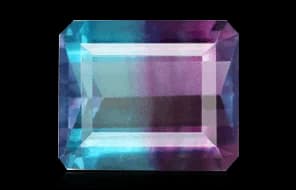
Rainbow Fluorite
Rainbow Fluorite is a striking variety of fluorite distinguished by natural bands and zones of purple, green, blue, yellow and other colors. Its vivid patterns make it especially appealing to collectors and jewelry enthusiasts.
Rainbow Fluorite is a multicolored form of fluorite, a halide mineral composed of calcium fluoride (CaF2). The name describes its attractive natural color zoning rather than a separate mineral species. Individual specimens may display contrasting bands or zones of purple, green, blue, yellow, white, pink and orange, with the pattern developing as the crystal grows under changing geological conditions. Fluorite commonly forms in hydrothermal veins and cavities, where mineral-rich fluids deposit crystals over successive stages of growth. It crystallizes in the cubic, or isometric, crystal system and commonly forms cubic or octahedral crystals. Rainbow Fluorite has a Mohs hardness of 4, a vitreous luster, a specific gravity around 3.18 and a refractive index generally around 1.433-1.448. Its perfect octahedral cleavage makes it notably vulnerable to chipping and splitting when struck. Fluorite occurs in many parts of the world, with important material found in locations including China, Mexico, the United States, the United Kingdom and other mineral-producing regions. Famous fluorite localities include the historic Blue John deposits of Derbyshire, England, although Blue John is a distinctive banded fluorite variety rather than a synonym for all Rainbow Fluorite. Fluorite has a long history as an ornamental and industrial mineral and has also been cut into collector-quality gemstones. Today, Rainbow Fluorite is used for cabochons, faceted stones, beads, carvings and mineral specimens. Because of its softness and cleavage, it is better suited to protected jewelry designs such as pendants and earrings than rings exposed to frequent impact. Buyers value Rainbow Fluorite primarily for its natural color zoning, transparency, pattern, attractive luster and distinctive individuality from one specimen to another.
- Mineral Family
- Fluorite
- Chemical Formula
- CaF2
- Mohs Hardness
- 4
- Refractive Index
- 1.433 - 1.448
- Specific Gravity
- 3.18
- Cleavage
- Perfect octahedral cleavage in four directions
- Crystal System
- Cubic
- Luster
- Vitreous
- Color Range
- Purple, Blue, Green, Yellow, White, Pink, Orange
When buying Rainbow Fluorite, begin with color and pattern. Strong, attractive contrast between naturally occurring color zones can make a specimen especially desirable, while balanced and visually interesting banding often adds to its appeal. Clarity is also important: transparent to translucent material with good visual depth and fewer distracting fractures is generally preferred for faceted gems and polished pieces. However, natural inclusions and growth features are part of fluorite's character and should not automatically be considered defects. Cut has a major effect on appearance because fluorite is soft and has perfect cleavage. Well-polished cabochons, carefully faceted gems and precision carvings should have clean surfaces and no obvious impact damage. Carat weight matters, but fluorite is available in relatively large sizes, so size alone does not determine value. Origin can add collector interest when the locality is documented, but geographic origin should not automatically be treated as a quality grade. Ask whether the material is natural, synthetic or treated. Rainbow coloration should be consistent with natural growth zoning, while any disclosed dyeing, irradiation, heat treatment or other enhancement should be considered when comparing stones. Natural Rainbow Fluorite and synthetic fluorite should not be represented as equivalent materials. For higher-value purchases, an independent gemological or mineralogical report can provide useful confirmation of identity, measurements and disclosed treatments. Authenticity is best evaluated through professional testing rather than appearance alone. Price depends mainly on color, pattern, transparency, clarity, cut quality, size, condition, origin, rarity of the material and whether treatments are present. Since fluorite has a Mohs hardness of only 4 and perfect cleavage, unusually low prices are not necessarily a problem, but buyers should pay close attention to condition and accurate disclosure. When you buy Rainbow Fluorite online, look for clear photographs under neutral lighting, accurate dimensions and weight, treatment disclosure, return terms and reliable seller information.
Rainbow Fluorite requires more care than harder jewelry gemstones. Clean it gently with lukewarm water, a soft cloth and mild soap when necessary, then rinse and dry thoroughly. Avoid ultrasonic cleaners, steam cleaners, harsh chemicals and sudden temperature changes because fluorite's cleavage and relative softness can make it vulnerable to damage. Store Rainbow Fluorite separately from harder gemstones such as quartz, topaz, sapphire and diamond to prevent scratches. A soft pouch or individual jewelry compartment is ideal. For everyday jewelry, choose protective settings and avoid wearing fluorite rings during sports, manual work, cleaning or other activities where the stone could receive a sharp impact. Do not expose the stone unnecessarily to abrasive surfaces. With careful handling, a Rainbow Fluorite gemstone can retain its color, polish and distinctive natural zoning for many years.
Rainbow Fluorite is a multicolored form of fluorite, a halide mineral composed of calcium fluoride (CaF2). The name describes its attractive natural color zoning rather than a separate mineral species. Individual specimens may display contrasting bands or zones of purple, green, blue, yellow, white, pink and orange, with the pattern developing as the crystal grows under changing geological conditions. Fluorite commonly forms in hydrothermal veins and cavities, where mineral-rich fluids deposit crystals over successive stages of growth. It crystallizes in the cubic, or isometric, crystal system and commonly forms cubic or octahedral crystals. Rainbow Fluorite has a Mohs hardness of 4, a vitreous luster, a specific gravity around 3.18 and a refractive index generally around 1.433-1.448. Its perfect octahedral cleavage makes it notably vulnerable to chipping and splitting when struck. Fluorite occurs in many parts of the world, with important material found in locations including China, Mexico, the United States, the United Kingdom and other mineral-producing regions. Famous fluorite localities include the historic Blue John deposits of Derbyshire, England, although Blue John is a distinctive banded fluorite variety rather than a synonym for all Rainbow Fluorite. Fluorite has a long history as an ornamental and industrial mineral and has also been cut into collector-quality gemstones. Today, Rainbow Fluorite is used for cabochons, faceted stones, beads, carvings and mineral specimens. Because of its softness and cleavage, it is better suited to protected jewelry designs such as pendants and earrings than rings exposed to frequent impact. Buyers value Rainbow Fluorite primarily for its natural color zoning, transparency, pattern, attractive luster and distinctive individuality from one specimen to another.
- Mineral Family
- Fluorite
- Chemical Formula
- CaF2
- Mohs Hardness
- 4
- Refractive Index
- 1.433 - 1.448
- Specific Gravity
- 3.18
- Cleavage
- Perfect octahedral cleavage in four directions
- Crystal System
- Cubic
- Luster
- Vitreous
- Color Range
- Purple, Blue, Green, Yellow, White, Pink, Orange
When buying Rainbow Fluorite, begin with color and pattern. Strong, attractive contrast between naturally occurring color zones can make a specimen especially desirable, while balanced and visually interesting banding often adds to its appeal. Clarity is also important: transparent to translucent material with good visual depth and fewer distracting fractures is generally preferred for faceted gems and polished pieces. However, natural inclusions and growth features are part of fluorite's character and should not automatically be considered defects. Cut has a major effect on appearance because fluorite is soft and has perfect cleavage. Well-polished cabochons, carefully faceted gems and precision carvings should have clean surfaces and no obvious impact damage. Carat weight matters, but fluorite is available in relatively large sizes, so size alone does not determine value. Origin can add collector interest when the locality is documented, but geographic origin should not automatically be treated as a quality grade. Ask whether the material is natural, synthetic or treated. Rainbow coloration should be consistent with natural growth zoning, while any disclosed dyeing, irradiation, heat treatment or other enhancement should be considered when comparing stones. Natural Rainbow Fluorite and synthetic fluorite should not be represented as equivalent materials. For higher-value purchases, an independent gemological or mineralogical report can provide useful confirmation of identity, measurements and disclosed treatments. Authenticity is best evaluated through professional testing rather than appearance alone. Price depends mainly on color, pattern, transparency, clarity, cut quality, size, condition, origin, rarity of the material and whether treatments are present. Since fluorite has a Mohs hardness of only 4 and perfect cleavage, unusually low prices are not necessarily a problem, but buyers should pay close attention to condition and accurate disclosure. When you buy Rainbow Fluorite online, look for clear photographs under neutral lighting, accurate dimensions and weight, treatment disclosure, return terms and reliable seller information.
Rainbow Fluorite requires more care than harder jewelry gemstones. Clean it gently with lukewarm water, a soft cloth and mild soap when necessary, then rinse and dry thoroughly. Avoid ultrasonic cleaners, steam cleaners, harsh chemicals and sudden temperature changes because fluorite's cleavage and relative softness can make it vulnerable to damage. Store Rainbow Fluorite separately from harder gemstones such as quartz, topaz, sapphire and diamond to prevent scratches. A soft pouch or individual jewelry compartment is ideal. For everyday jewelry, choose protective settings and avoid wearing fluorite rings during sports, manual work, cleaning or other activities where the stone could receive a sharp impact. Do not expose the stone unnecessarily to abrasive surfaces. With careful handling, a Rainbow Fluorite gemstone can retain its color, polish and distinctive natural zoning for many years.
Rainbow Fluorite for Sale
No gems found
Try broadening your search or adjusting your filters.
Have a gem of your own? List it free - no fees