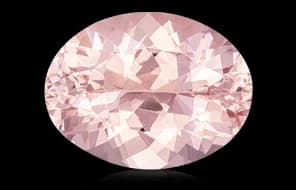
Pink Morganite
Pink Morganite is a refined pink variety of beryl prized for its soft pastel color, vitreous brilliance, good durability, and elegant appeal in fine jewelry.
Pink Morganite is the pink to orange-pink variety of beryl, the mineral family that also includes emerald and aquamarine. Its chemical formula is Be3Al2Si6O18, and trace manganese is responsible for its characteristic pink coloration. Morganite crystallizes in the hexagonal system and commonly forms prismatic crystals. It has a vitreous luster, a refractive index of about 1.583-1.590, specific gravity of 2.80-2.91, and Mohs hardness of 7.5-8. It has imperfect basal cleavage, so protection from hard impacts is important despite its good hardness. Pink Morganite can range from delicate pastel pink and rose to purplish pink and orangy pink. Stronger, more saturated pink is less common and can command greater interest, while lighter material is widely appreciated for its elegant, romantic appearance. Morganite commonly forms in granitic pegmatites, and important sources have included Brazil, Madagascar, Mozambique, Afghanistan, Namibia, and the United States. Brazil, particularly Minas Gerais, is an important modern source, while historic Madagascar material is renowned for attractive saturated pink and magenta hues. The gemstone was named after American financier and gem collector J. P. Morgan. Large crystals are possible, and exceptionally large faceted stones can be produced because suitable rough may occur in substantial sizes. Today, Pink Morganite is widely used in rings, engagement rings, earrings, pendants, bracelets, and other fine jewelry. Its pastel color pairs especially well with white, yellow, and rose gold as well as diamond accents. Buyers value Pink Morganite for its distinctive color, availability in larger sizes, good jewelry durability, and generally accessible pricing compared with many highly saturated pink gemstones.
- Mineral Family
- Beryl
- Chemical Formula
- Be3Al2Si6O18
- Mohs Hardness
- 7.5 - 8
- Refractive Index
- 1.583 - 1.590
- Specific Gravity
- 2.80 - 2.91
- Cleavage
- Imperfect, basal
- Crystal System
- Hexagonal
- Luster
- Vitreous
- Color Range
- Pink, Orange, Purple
When buying Pink Morganite, start with color. Strong, attractive pink is generally more desirable than very pale material, although the preferred shade is ultimately a matter of taste. Pink can show purple or orange modifiers, and untreated material may have a noticeable orange or salmon component. Clarity is also important because well-cut Morganite is commonly transparent and eye-clean examples are desirable. Examine the stone for visible fractures, cavities, and distracting inclusions, particularly in larger gems. Cut should provide balanced proportions, good symmetry, polish, and attractive light return. Because Morganite is often light in tone, cutters may use deeper proportions to help strengthen apparent color. Carat weight should be considered alongside color, clarity, and cut rather than by weight alone; large Morganite is readily available compared with many rare pink gems. Origin can add interest and provenance, but it should not automatically be treated as a guarantee of superior quality. Treatment disclosure is important. Heat treatment may be used to modify color, and buyers should ask whether a stone is untreated or treated and whether any additional enhancement has been detected. Natural Morganite and laboratory-grown Morganite should be clearly distinguished. A reputable laboratory identification report can confirm whether the material is natural or laboratory-grown and disclose detectable treatments; GIA evaluates Morganite but does not issue a quality grade for it. For expensive stones, independent laboratory documentation is especially useful. Authenticity should be assessed through a qualified gem laboratory, reliable seller, consistent gemological measurements, and clear treatment disclosure. Price depends primarily on color quality, clarity, cut, carat weight, treatment status, origin and overall appearance. There is no single fixed price per carat for all Pink Morganite, so compare stones of similar quality rather than relying on a generic price claim.
Pink Morganite is suitable for regular jewelry wear when treated with reasonable care. Clean it with warm water, mild soap, and a soft brush, then rinse and dry gently. Avoid harsh chemicals, sudden temperature changes, and unnecessary heat exposure. GIA recommends avoiding heat and notes that warm, soapy water is a safe cleaning method. Ultrasonic or steam cleaning may be suitable for some stones, but should be avoided when liquid inclusions, fractures, or certain treatments are present. Because Morganite has imperfect basal cleavage and is less hard than diamond or sapphire, protect it from sharp impacts and hard knocks, especially in rings. Store Pink Morganite separately from harder gemstones to reduce scratching, ideally in a soft pouch or individual jewelry compartment.
Pink Morganite is the pink to orange-pink variety of beryl, the mineral family that also includes emerald and aquamarine. Its chemical formula is Be3Al2Si6O18, and trace manganese is responsible for its characteristic pink coloration. Morganite crystallizes in the hexagonal system and commonly forms prismatic crystals. It has a vitreous luster, a refractive index of about 1.583-1.590, specific gravity of 2.80-2.91, and Mohs hardness of 7.5-8. It has imperfect basal cleavage, so protection from hard impacts is important despite its good hardness. Pink Morganite can range from delicate pastel pink and rose to purplish pink and orangy pink. Stronger, more saturated pink is less common and can command greater interest, while lighter material is widely appreciated for its elegant, romantic appearance. Morganite commonly forms in granitic pegmatites, and important sources have included Brazil, Madagascar, Mozambique, Afghanistan, Namibia, and the United States. Brazil, particularly Minas Gerais, is an important modern source, while historic Madagascar material is renowned for attractive saturated pink and magenta hues. The gemstone was named after American financier and gem collector J. P. Morgan. Large crystals are possible, and exceptionally large faceted stones can be produced because suitable rough may occur in substantial sizes. Today, Pink Morganite is widely used in rings, engagement rings, earrings, pendants, bracelets, and other fine jewelry. Its pastel color pairs especially well with white, yellow, and rose gold as well as diamond accents. Buyers value Pink Morganite for its distinctive color, availability in larger sizes, good jewelry durability, and generally accessible pricing compared with many highly saturated pink gemstones.
- Mineral Family
- Beryl
- Chemical Formula
- Be3Al2Si6O18
- Mohs Hardness
- 7.5 - 8
- Refractive Index
- 1.583 - 1.590
- Specific Gravity
- 2.80 - 2.91
- Cleavage
- Imperfect, basal
- Crystal System
- Hexagonal
- Luster
- Vitreous
- Color Range
- Pink, Orange, Purple
When buying Pink Morganite, start with color. Strong, attractive pink is generally more desirable than very pale material, although the preferred shade is ultimately a matter of taste. Pink can show purple or orange modifiers, and untreated material may have a noticeable orange or salmon component. Clarity is also important because well-cut Morganite is commonly transparent and eye-clean examples are desirable. Examine the stone for visible fractures, cavities, and distracting inclusions, particularly in larger gems. Cut should provide balanced proportions, good symmetry, polish, and attractive light return. Because Morganite is often light in tone, cutters may use deeper proportions to help strengthen apparent color. Carat weight should be considered alongside color, clarity, and cut rather than by weight alone; large Morganite is readily available compared with many rare pink gems. Origin can add interest and provenance, but it should not automatically be treated as a guarantee of superior quality. Treatment disclosure is important. Heat treatment may be used to modify color, and buyers should ask whether a stone is untreated or treated and whether any additional enhancement has been detected. Natural Morganite and laboratory-grown Morganite should be clearly distinguished. A reputable laboratory identification report can confirm whether the material is natural or laboratory-grown and disclose detectable treatments; GIA evaluates Morganite but does not issue a quality grade for it. For expensive stones, independent laboratory documentation is especially useful. Authenticity should be assessed through a qualified gem laboratory, reliable seller, consistent gemological measurements, and clear treatment disclosure. Price depends primarily on color quality, clarity, cut, carat weight, treatment status, origin and overall appearance. There is no single fixed price per carat for all Pink Morganite, so compare stones of similar quality rather than relying on a generic price claim.
Pink Morganite is suitable for regular jewelry wear when treated with reasonable care. Clean it with warm water, mild soap, and a soft brush, then rinse and dry gently. Avoid harsh chemicals, sudden temperature changes, and unnecessary heat exposure. GIA recommends avoiding heat and notes that warm, soapy water is a safe cleaning method. Ultrasonic or steam cleaning may be suitable for some stones, but should be avoided when liquid inclusions, fractures, or certain treatments are present. Because Morganite has imperfect basal cleavage and is less hard than diamond or sapphire, protect it from sharp impacts and hard knocks, especially in rings. Store Pink Morganite separately from harder gemstones to reduce scratching, ideally in a soft pouch or individual jewelry compartment.
Pink Morganite for Sale
No gems found
Try broadening your search or adjusting your filters.
Have a gem of your own? List it free - no fees