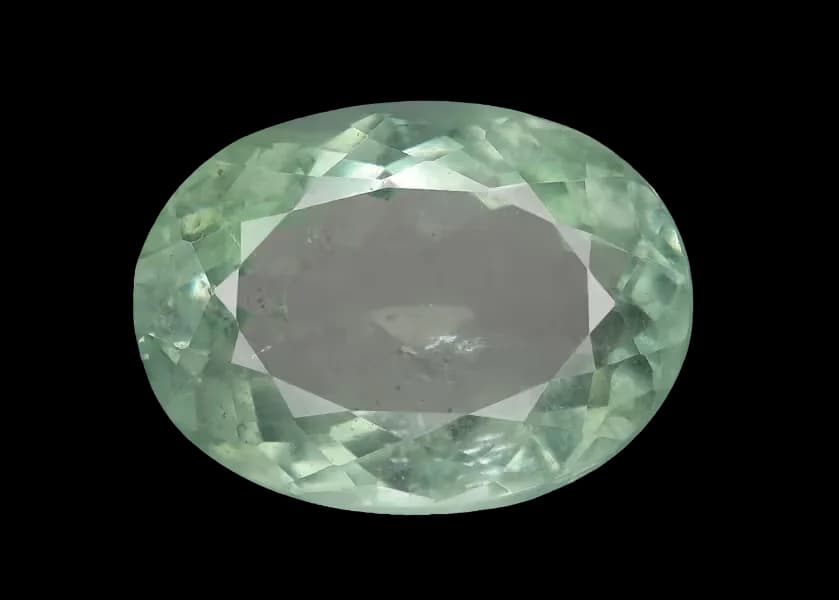
Green Aquamarine
Green Aquamarine is a distinctive beryl gemstone prized for its fresh green to blue-green hues, transparency and elegant appeal in jewelry and collections.
Green Aquamarine is a trade and descriptive name used for green to blue-green beryl that is visually associated with aquamarine. Gemologically, the boundary between aquamarine, green beryl and emerald depends strongly on color characteristics. Aquamarine is the blue to greenish-blue variety of beryl, while distinctly green beryl may be classified separately rather than automatically being called aquamarine or emerald. This makes accurate laboratory identification especially valuable when purchasing a stone marketed as Green Aquamarine. Beryl belongs to the beryl mineral family and has the chemical formula Be₃Al₂Si₆O₁₈. It crystallizes in the hexagonal system and commonly forms elongated prismatic crystals. Its hardness of 7.5–8 on the Mohs scale makes it well suited to jewelry when properly designed and worn with reasonable care. Green coloration in beryl can be associated with trace elements including iron, chromium and vanadium, with the exact color mechanism varying by material and locality. Aquamarine's characteristic blue to greenish-blue color is primarily associated with iron, while chromium and vanadium are important colorants in green beryl and emerald. Green Aquamarine can range from pale green and blue-green to more saturated greenish hues. Attractive examples generally combine pleasing color with good transparency and a lively appearance. Like other beryls, it has vitreous luster and can display excellent clarity when gem quality. Beryl commonly forms in granitic pegmatites, where mineral-rich fluids allow large crystals to develop. Brazil is historically one of the world's best-known sources of aquamarine and other gem beryls, while beryl varieties also occur in countries including Pakistan, Nigeria, Madagascar, Mozambique, Zambia and other regions. Notable aquamarine localities include Brazil and Pakistan, while green beryl and emerald-quality material occur in several additional geological environments. Green Aquamarine is valued by buyers who appreciate unusual beryl colors and prefer a gemstone with a fresh, natural appearance. It can be fashioned into faceted gems for rings, earrings, pendants and other jewelry, although protective settings are sensible for rings exposed to frequent impact. When shopping for natural Green Aquamarine, buyers should pay close attention to the exact gemological identity, color, transparency, treatment status and laboratory documentation rather than relying solely on the commercial name.
- Mineral Family
- Beryl
- Chemical Formula
- Be₃Al₂Si₆O₁₈
- Mohs Hardness
- 7.5 - 8
- Refractive Index
- 1.577 - 1.583
- Specific Gravity
- 2.72
- Cleavage
- Imperfect basal cleavage
- Crystal System
- Hexagonal
- Luster
- Vitreous
- Color Range
- Green, Cyan
When buying Green Aquamarine online, start with color. Look for an attractive, even green, blue-green or greenish-blue appearance appropriate to the stone's identity and your preference. Because color boundaries within beryl can overlap, a laboratory report is particularly useful when a seller describes a stone specifically as Green Aquamarine. Clarity is another important consideration. Aquamarine and many other gem beryls can occur with high transparency, so eye-clean material is often desirable, although inclusions can provide useful evidence of natural origin and geological history. Cut affects brilliance, color presentation and overall beauty. Well-proportioned oval, emerald, cushion, pear, round and other cuts can work well depending on the rough material. A poorly proportioned cut may make a pale stone appear washed out or reduce its brightness. Carat weight should be evaluated together with color, clarity, cut and transparency rather than treated as the sole measure of value. Larger clean beryl crystals are possible, but fine color and quality remain important. Origin can add interest and collector appeal, but it should not automatically determine value. A reputable seller should distinguish documented geographic origin from an unsupported locality claim. Treatments must also be disclosed. Heat treatment is widely used in aquamarine to modify color toward a more blue appearance, while treatment practices can vary among beryl materials. Buyers should ask whether the stone is untreated, heated or otherwise enhanced and whether the treatment is stable under normal jewelry care. Natural Green Aquamarine should not be confused with laboratory-grown or synthetic beryl, imitations or other green gemstones. A reputable independent gemological laboratory can establish whether the material is natural, identify the gemstone species and variety where possible, and document detectable treatments. Certification is especially valuable for higher-value stones or unusual material marketed under a specialized trade name. Authenticity should be assessed through an independent report, transparent seller disclosures, clear photographs and consistent gemological information. Price depends on the combination of color, clarity, transparency, cut, carat weight, natural status, treatment, origin when reliably documented, and market demand. When comparing prices, compare stones of genuinely similar quality and identification rather than relying on price-per-carat alone.
Green Aquamarine can be maintained with simple, gentle care. Clean the gemstone using lukewarm water, a mild soap and a soft brush or lint-free cloth, then rinse and dry it thoroughly. Avoid sudden temperature changes, harsh chemicals, abrasive cleaners and prolonged exposure to strong heat unless the stone's treatment and care requirements are known. Because beryl has a hardness of 7.5–8 but imperfect cleavage, it can still chip or fracture if struck against a hard surface, particularly around facet junctions or edges. Remove Green Aquamarine jewelry before heavy manual work, sports or activities where the stone could receive direct impact. Store each piece separately in a soft pouch or lined compartment so it does not scratch softer materials and is not scratched by harder gemstones. If the stone has been treated, follow the care instructions supplied by the seller or gemological laboratory, especially regarding heat, chemicals and cleaning equipment. For valuable natural Green Aquamarine jewelry, professional inspection and cleaning can help identify loose settings or damage before it becomes serious.
Green Aquamarine is a trade and descriptive name used for green to blue-green beryl that is visually associated with aquamarine. Gemologically, the boundary between aquamarine, green beryl and emerald depends strongly on color characteristics. Aquamarine is the blue to greenish-blue variety of beryl, while distinctly green beryl may be classified separately rather than automatically being called aquamarine or emerald. This makes accurate laboratory identification especially valuable when purchasing a stone marketed as Green Aquamarine. Beryl belongs to the beryl mineral family and has the chemical formula Be₃Al₂Si₆O₁₈. It crystallizes in the hexagonal system and commonly forms elongated prismatic crystals. Its hardness of 7.5–8 on the Mohs scale makes it well suited to jewelry when properly designed and worn with reasonable care. Green coloration in beryl can be associated with trace elements including iron, chromium and vanadium, with the exact color mechanism varying by material and locality. Aquamarine's characteristic blue to greenish-blue color is primarily associated with iron, while chromium and vanadium are important colorants in green beryl and emerald. Green Aquamarine can range from pale green and blue-green to more saturated greenish hues. Attractive examples generally combine pleasing color with good transparency and a lively appearance. Like other beryls, it has vitreous luster and can display excellent clarity when gem quality. Beryl commonly forms in granitic pegmatites, where mineral-rich fluids allow large crystals to develop. Brazil is historically one of the world's best-known sources of aquamarine and other gem beryls, while beryl varieties also occur in countries including Pakistan, Nigeria, Madagascar, Mozambique, Zambia and other regions. Notable aquamarine localities include Brazil and Pakistan, while green beryl and emerald-quality material occur in several additional geological environments. Green Aquamarine is valued by buyers who appreciate unusual beryl colors and prefer a gemstone with a fresh, natural appearance. It can be fashioned into faceted gems for rings, earrings, pendants and other jewelry, although protective settings are sensible for rings exposed to frequent impact. When shopping for natural Green Aquamarine, buyers should pay close attention to the exact gemological identity, color, transparency, treatment status and laboratory documentation rather than relying solely on the commercial name.
- Mineral Family
- Beryl
- Chemical Formula
- Be₃Al₂Si₆O₁₈
- Mohs Hardness
- 7.5 - 8
- Refractive Index
- 1.577 - 1.583
- Specific Gravity
- 2.72
- Cleavage
- Imperfect basal cleavage
- Crystal System
- Hexagonal
- Luster
- Vitreous
- Color Range
- Green, Cyan
When buying Green Aquamarine online, start with color. Look for an attractive, even green, blue-green or greenish-blue appearance appropriate to the stone's identity and your preference. Because color boundaries within beryl can overlap, a laboratory report is particularly useful when a seller describes a stone specifically as Green Aquamarine. Clarity is another important consideration. Aquamarine and many other gem beryls can occur with high transparency, so eye-clean material is often desirable, although inclusions can provide useful evidence of natural origin and geological history. Cut affects brilliance, color presentation and overall beauty. Well-proportioned oval, emerald, cushion, pear, round and other cuts can work well depending on the rough material. A poorly proportioned cut may make a pale stone appear washed out or reduce its brightness. Carat weight should be evaluated together with color, clarity, cut and transparency rather than treated as the sole measure of value. Larger clean beryl crystals are possible, but fine color and quality remain important. Origin can add interest and collector appeal, but it should not automatically determine value. A reputable seller should distinguish documented geographic origin from an unsupported locality claim. Treatments must also be disclosed. Heat treatment is widely used in aquamarine to modify color toward a more blue appearance, while treatment practices can vary among beryl materials. Buyers should ask whether the stone is untreated, heated or otherwise enhanced and whether the treatment is stable under normal jewelry care. Natural Green Aquamarine should not be confused with laboratory-grown or synthetic beryl, imitations or other green gemstones. A reputable independent gemological laboratory can establish whether the material is natural, identify the gemstone species and variety where possible, and document detectable treatments. Certification is especially valuable for higher-value stones or unusual material marketed under a specialized trade name. Authenticity should be assessed through an independent report, transparent seller disclosures, clear photographs and consistent gemological information. Price depends on the combination of color, clarity, transparency, cut, carat weight, natural status, treatment, origin when reliably documented, and market demand. When comparing prices, compare stones of genuinely similar quality and identification rather than relying on price-per-carat alone.
Green Aquamarine can be maintained with simple, gentle care. Clean the gemstone using lukewarm water, a mild soap and a soft brush or lint-free cloth, then rinse and dry it thoroughly. Avoid sudden temperature changes, harsh chemicals, abrasive cleaners and prolonged exposure to strong heat unless the stone's treatment and care requirements are known. Because beryl has a hardness of 7.5–8 but imperfect cleavage, it can still chip or fracture if struck against a hard surface, particularly around facet junctions or edges. Remove Green Aquamarine jewelry before heavy manual work, sports or activities where the stone could receive direct impact. Store each piece separately in a soft pouch or lined compartment so it does not scratch softer materials and is not scratched by harder gemstones. If the stone has been treated, follow the care instructions supplied by the seller or gemological laboratory, especially regarding heat, chemicals and cleaning equipment. For valuable natural Green Aquamarine jewelry, professional inspection and cleaning can help identify loose settings or damage before it becomes serious.
Green Aquamarine for Sale
No gems found
Try broadening your search or adjusting your filters.
Have a gem of your own? List it free - no fees