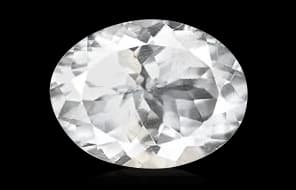
Goshenite
Goshenite is the colorless variety of beryl, prized for its exceptional transparency, bright luster, and elegant appearance in fine jewelry.
Goshenite gemstone is the colorless variety of beryl, a beryllium aluminum silicate mineral best known for producing gems such as emerald and aquamarine. Its chemical formula is Be3Al2Si6O18, and it crystallizes in the hexagonal crystal system. Goshenite typically ranges from colorless to very faint white and is valued for its transparency rather than body color. The name Goshenite comes from Goshen, Massachusetts, where colorless beryl was first identified. Today, Goshenite occurs in beryl-bearing deposits in several countries, including Brazil, the United States, Madagascar, Russia, and other regions with suitable pegmatite geology. Like other beryl varieties, it has a Mohs hardness of 7.5-8, making it suitable for many types of jewelry when properly set and cared for. It has a vitreous luster, a refractive index of approximately 1.577-1.583, and a specific gravity around 2.72. Goshenite can form transparent crystals with excellent clarity, although natural inclusions may occur and can help establish natural origin. Its colorless appearance has historically made clear beryl useful for optical applications, although modern Goshenite is primarily appreciated as a gemstone. In jewelry, well-cut Goshenite can display bright brilliance and is commonly fashioned into oval, round, emerald, cushion, pear, and step cuts. Its neutral appearance pairs easily with white, yellow, or rose gold as well as platinum and silver. Buyers value natural Goshenite for its clean appearance, durability, transparency, and connection to the wider beryl mineral family. As with any gemstone, a natural Goshenite with attractive clarity, proportions, and a high-quality cut can be more desirable than a poorly cut stone regardless of size.
- Mineral Family
- Beryl
- Chemical Formula
- Be3Al2Si6O18
- Mohs Hardness
- 7.5 - 8
- Refractive Index
- 1.577 - 1.583
- Specific Gravity
- 2.72
- Cleavage
- Imperfect, parallel to the basal plane
- Crystal System
- Hexagonal
- Luster
- Vitreous
- Color Range
- White
When buying Goshenite online, start with color and transparency. Since Goshenite is naturally the colorless variety of beryl, a bright, clean appearance and good transparency are more important than body color. Clarity is particularly important because inclusions can reduce transparency and brilliance. However, completely inclusion-free material should not automatically be assumed to be natural, so unusual perfection in a large stone may justify independent laboratory testing. Cut has a major influence on Goshenite jewelry because precise proportions and facet alignment can improve light return and make the stone appear more lively. Common choices include oval, round, pear, cushion, emerald, and other step or brilliant-style cuts. Carat weight also affects price, but larger size alone does not guarantee greater value. Origin can add interest and provenance, but it should not be treated as the sole indicator of quality or price. Ask the seller to disclose any known treatments. Colorless Goshenite may be irradiated to produce other colors, although such material should be properly disclosed and should not be represented as untreated colorless Goshenite. Natural Goshenite and laboratory-created synthetic beryl are different materials in terms of origin, so buyers should confirm whether the stone is natural and request disclosure of any laboratory-grown material. For higher-value purchases, an independent gemological certificate can help confirm species, natural or synthetic origin, and detectable treatments. Authenticity should be assessed through a combination of reputable sourcing, gemological testing, consistent physical properties, and transparent disclosure. Price depends mainly on clarity, transparency, cut quality, carat weight, provenance, treatment status, and overall visual appeal. A good Goshenite buying guide should therefore focus on the individual stone rather than relying on a fixed price per carat.
Goshenite is durable enough for many jewelry applications, but its 7.5-8 Mohs hardness does not make it scratch-proof. Clean Goshenite jewelry with lukewarm water, mild soap, and a soft brush or cloth, then rinse and dry thoroughly. Avoid abrasive cleaners and harsh chemicals that can damage the setting or surface. Store Goshenite separately from harder gemstones such as diamond to reduce the risk of scratching, ideally in a soft pouch or a compartmented jewelry box. Avoid exposing the stone to strong impacts, especially around edges, corners, or areas where the gemstone may have inclusions. For rings worn regularly, remove Goshenite jewelry before strenuous activities, household work, or situations where the stone could receive a hard blow. If a Goshenite has been treated, follow any care instructions provided by the seller or gemological laboratory. Periodic professional inspection of the setting is recommended for valuable Goshenite jewelry.
Goshenite gemstone is the colorless variety of beryl, a beryllium aluminum silicate mineral best known for producing gems such as emerald and aquamarine. Its chemical formula is Be3Al2Si6O18, and it crystallizes in the hexagonal crystal system. Goshenite typically ranges from colorless to very faint white and is valued for its transparency rather than body color. The name Goshenite comes from Goshen, Massachusetts, where colorless beryl was first identified. Today, Goshenite occurs in beryl-bearing deposits in several countries, including Brazil, the United States, Madagascar, Russia, and other regions with suitable pegmatite geology. Like other beryl varieties, it has a Mohs hardness of 7.5-8, making it suitable for many types of jewelry when properly set and cared for. It has a vitreous luster, a refractive index of approximately 1.577-1.583, and a specific gravity around 2.72. Goshenite can form transparent crystals with excellent clarity, although natural inclusions may occur and can help establish natural origin. Its colorless appearance has historically made clear beryl useful for optical applications, although modern Goshenite is primarily appreciated as a gemstone. In jewelry, well-cut Goshenite can display bright brilliance and is commonly fashioned into oval, round, emerald, cushion, pear, and step cuts. Its neutral appearance pairs easily with white, yellow, or rose gold as well as platinum and silver. Buyers value natural Goshenite for its clean appearance, durability, transparency, and connection to the wider beryl mineral family. As with any gemstone, a natural Goshenite with attractive clarity, proportions, and a high-quality cut can be more desirable than a poorly cut stone regardless of size.
- Mineral Family
- Beryl
- Chemical Formula
- Be3Al2Si6O18
- Mohs Hardness
- 7.5 - 8
- Refractive Index
- 1.577 - 1.583
- Specific Gravity
- 2.72
- Cleavage
- Imperfect, parallel to the basal plane
- Crystal System
- Hexagonal
- Luster
- Vitreous
- Color Range
- White
When buying Goshenite online, start with color and transparency. Since Goshenite is naturally the colorless variety of beryl, a bright, clean appearance and good transparency are more important than body color. Clarity is particularly important because inclusions can reduce transparency and brilliance. However, completely inclusion-free material should not automatically be assumed to be natural, so unusual perfection in a large stone may justify independent laboratory testing. Cut has a major influence on Goshenite jewelry because precise proportions and facet alignment can improve light return and make the stone appear more lively. Common choices include oval, round, pear, cushion, emerald, and other step or brilliant-style cuts. Carat weight also affects price, but larger size alone does not guarantee greater value. Origin can add interest and provenance, but it should not be treated as the sole indicator of quality or price. Ask the seller to disclose any known treatments. Colorless Goshenite may be irradiated to produce other colors, although such material should be properly disclosed and should not be represented as untreated colorless Goshenite. Natural Goshenite and laboratory-created synthetic beryl are different materials in terms of origin, so buyers should confirm whether the stone is natural and request disclosure of any laboratory-grown material. For higher-value purchases, an independent gemological certificate can help confirm species, natural or synthetic origin, and detectable treatments. Authenticity should be assessed through a combination of reputable sourcing, gemological testing, consistent physical properties, and transparent disclosure. Price depends mainly on clarity, transparency, cut quality, carat weight, provenance, treatment status, and overall visual appeal. A good Goshenite buying guide should therefore focus on the individual stone rather than relying on a fixed price per carat.
Goshenite is durable enough for many jewelry applications, but its 7.5-8 Mohs hardness does not make it scratch-proof. Clean Goshenite jewelry with lukewarm water, mild soap, and a soft brush or cloth, then rinse and dry thoroughly. Avoid abrasive cleaners and harsh chemicals that can damage the setting or surface. Store Goshenite separately from harder gemstones such as diamond to reduce the risk of scratching, ideally in a soft pouch or a compartmented jewelry box. Avoid exposing the stone to strong impacts, especially around edges, corners, or areas where the gemstone may have inclusions. For rings worn regularly, remove Goshenite jewelry before strenuous activities, household work, or situations where the stone could receive a hard blow. If a Goshenite has been treated, follow any care instructions provided by the seller or gemological laboratory. Periodic professional inspection of the setting is recommended for valuable Goshenite jewelry.
Goshenite for Sale
No gems found
Try broadening your search or adjusting your filters.
Have a gem of your own? List it free - no fees