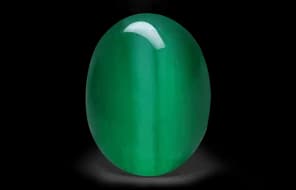
Emerald Cats Eye
Emerald Cats Eye is a rare variety of emerald displaying a distinctive moving band of light, combining rich green color with an unusual and captivating chatoyant effect.
Emerald Cats Eye is a rare chatoyant variety of emerald, the green gem variety of the beryl mineral family. Its defining feature is chatoyancy, a narrow band of reflected light that appears to move across the polished surface as the stone is rotated. In emerald, this effect is uncommon and is generally associated with oriented fibrous or needle-like inclusions that reflect light in a concentrated line. Emerald itself is beryllium aluminum silicate with the chemical formula Be3Al2Si6O18 and crystallizes in the hexagonal system. It has a Mohs hardness of 7.5 to 8, a refractive index of approximately 1.577-1.583, and a specific gravity of about 2.67-2.78. Emerald Cats Eye ranges through green hues, with value influenced by the attractiveness and saturation of the body color as well as the strength and sharpness of the cat's eye. Because chatoyancy is best displayed from a curved surface, these stones are normally fashioned as cabochons rather than faceted gems. Emerald has a long history as one of the world's most admired colored gemstones, with important historic sources including Egypt and later major deposits in Colombia, Zambia, Brazil, and other regions. Today, natural Emerald Cats Eye is particularly interesting to collectors and jewelry buyers seeking an unusual green gemstone with a distinctive optical phenomenon. It can be used in rings, pendants, earrings, bracelets, and custom jewelry, although protective settings are advisable for pieces exposed to impact. Buyers value Emerald Cats Eye for its rarity, natural green color, distinctive chatoyancy, and the individual character created by its inclusions. As with other emeralds, inclusions are common, so visual quality should be judged in relation to the overall appearance rather than by demanding flawless clarity.
- Mineral Family
- Beryl
- Chemical Formula
- Be3Al2Si6O18
- Mohs Hardness
- 7.5 - 8
- Refractive Index
- 1.577 - 1.583
- Specific Gravity
- 2.67 - 2.78
- Cleavage
- Imperfect
- Crystal System
- Hexagonal
- Luster
- Vitreous
- Color Range
- Green
When buying Emerald Cats Eye online, evaluate the stone as both an emerald and a chatoyant gemstone. Color is important: attractive, well-saturated green body color generally adds appeal, while overly dark or dull material may appear less lively. The cat's eye effect is a major consideration. Look for a distinct, continuous band of light that is centered on the cabochon and appears to move as the stone is rotated under a suitable light source. Clarity should be assessed differently from a transparent faceted emerald because inclusions can contribute to chatoyancy. However, excessive fractures, surface-reaching cracks, or inclusions that significantly reduce durability can lower value. Cut is especially important because a well-proportioned, smoothly polished cabochon helps display the optical effect. Oval and other symmetrical cabochon shapes are commonly suitable. Carat weight also affects value, but a larger stone is not automatically better; color, chatoyancy, transparency, condition, and overall appearance should be considered together. Origin can influence market value when a documented source has recognized importance, but origin should not replace an assessment of the individual gemstone. Treatments are common in emeralds, particularly clarity enhancement with oils or other substances, so buyers should ask whether the stone has been treated and request disclosure of any known treatment. Natural Emerald Cats Eye should be distinguished from laboratory-grown emerald and simulants. A laboratory-grown emerald may have the same chemical composition and crystal structure as natural emerald but is manufactured rather than formed naturally; any claim of natural origin should be independently supported. For significant purchases, an independent gemological report can help document identity, natural or laboratory-grown status, detectable treatments, and, where available, geographic origin. Authenticity should be evaluated through a reputable seller, transparent gemstone specifications, high-resolution photographs or video, and appropriate laboratory documentation. Price depends on the combination of green color, strength and quality of chatoyancy, transparency, clarity characteristics, carat weight, cut and polish, treatment status, provenance, certification, rarity, and market demand.
Emerald Cats Eye should be handled with care because emerald has good hardness but can contain fractures and inclusions that affect durability. For routine cleaning, use lukewarm water, a small amount of mild soap, and a soft lint-free cloth or very soft brush. Rinse carefully and dry with a soft cloth. Avoid abrasive cleaners, harsh chemicals, prolonged heat, and sudden temperature changes. Because many emeralds are treated, ultrasonic and steam cleaning should generally be avoided unless a qualified gem professional confirms that the specific stone is suitable. Store the gemstone separately in a soft-lined pouch or jewelry compartment to prevent scratches and accidental contact with harder materials. Pendants and earrings are generally safer for frequent wear than rings because they receive less impact. Remove Emerald Cats Eye jewelry before sports, heavy manual work, gardening, swimming, or activities where the stone may be struck or exposed to chemicals, cosmetics, chlorine, or cleaning products. If the stone becomes loose or the setting is damaged, have the jewelry inspected by a professional before wearing it again.
Emerald Cats Eye is a rare chatoyant variety of emerald, the green gem variety of the beryl mineral family. Its defining feature is chatoyancy, a narrow band of reflected light that appears to move across the polished surface as the stone is rotated. In emerald, this effect is uncommon and is generally associated with oriented fibrous or needle-like inclusions that reflect light in a concentrated line. Emerald itself is beryllium aluminum silicate with the chemical formula Be3Al2Si6O18 and crystallizes in the hexagonal system. It has a Mohs hardness of 7.5 to 8, a refractive index of approximately 1.577-1.583, and a specific gravity of about 2.67-2.78. Emerald Cats Eye ranges through green hues, with value influenced by the attractiveness and saturation of the body color as well as the strength and sharpness of the cat's eye. Because chatoyancy is best displayed from a curved surface, these stones are normally fashioned as cabochons rather than faceted gems. Emerald has a long history as one of the world's most admired colored gemstones, with important historic sources including Egypt and later major deposits in Colombia, Zambia, Brazil, and other regions. Today, natural Emerald Cats Eye is particularly interesting to collectors and jewelry buyers seeking an unusual green gemstone with a distinctive optical phenomenon. It can be used in rings, pendants, earrings, bracelets, and custom jewelry, although protective settings are advisable for pieces exposed to impact. Buyers value Emerald Cats Eye for its rarity, natural green color, distinctive chatoyancy, and the individual character created by its inclusions. As with other emeralds, inclusions are common, so visual quality should be judged in relation to the overall appearance rather than by demanding flawless clarity.
- Mineral Family
- Beryl
- Chemical Formula
- Be3Al2Si6O18
- Mohs Hardness
- 7.5 - 8
- Refractive Index
- 1.577 - 1.583
- Specific Gravity
- 2.67 - 2.78
- Cleavage
- Imperfect
- Crystal System
- Hexagonal
- Luster
- Vitreous
- Color Range
- Green
When buying Emerald Cats Eye online, evaluate the stone as both an emerald and a chatoyant gemstone. Color is important: attractive, well-saturated green body color generally adds appeal, while overly dark or dull material may appear less lively. The cat's eye effect is a major consideration. Look for a distinct, continuous band of light that is centered on the cabochon and appears to move as the stone is rotated under a suitable light source. Clarity should be assessed differently from a transparent faceted emerald because inclusions can contribute to chatoyancy. However, excessive fractures, surface-reaching cracks, or inclusions that significantly reduce durability can lower value. Cut is especially important because a well-proportioned, smoothly polished cabochon helps display the optical effect. Oval and other symmetrical cabochon shapes are commonly suitable. Carat weight also affects value, but a larger stone is not automatically better; color, chatoyancy, transparency, condition, and overall appearance should be considered together. Origin can influence market value when a documented source has recognized importance, but origin should not replace an assessment of the individual gemstone. Treatments are common in emeralds, particularly clarity enhancement with oils or other substances, so buyers should ask whether the stone has been treated and request disclosure of any known treatment. Natural Emerald Cats Eye should be distinguished from laboratory-grown emerald and simulants. A laboratory-grown emerald may have the same chemical composition and crystal structure as natural emerald but is manufactured rather than formed naturally; any claim of natural origin should be independently supported. For significant purchases, an independent gemological report can help document identity, natural or laboratory-grown status, detectable treatments, and, where available, geographic origin. Authenticity should be evaluated through a reputable seller, transparent gemstone specifications, high-resolution photographs or video, and appropriate laboratory documentation. Price depends on the combination of green color, strength and quality of chatoyancy, transparency, clarity characteristics, carat weight, cut and polish, treatment status, provenance, certification, rarity, and market demand.
Emerald Cats Eye should be handled with care because emerald has good hardness but can contain fractures and inclusions that affect durability. For routine cleaning, use lukewarm water, a small amount of mild soap, and a soft lint-free cloth or very soft brush. Rinse carefully and dry with a soft cloth. Avoid abrasive cleaners, harsh chemicals, prolonged heat, and sudden temperature changes. Because many emeralds are treated, ultrasonic and steam cleaning should generally be avoided unless a qualified gem professional confirms that the specific stone is suitable. Store the gemstone separately in a soft-lined pouch or jewelry compartment to prevent scratches and accidental contact with harder materials. Pendants and earrings are generally safer for frequent wear than rings because they receive less impact. Remove Emerald Cats Eye jewelry before sports, heavy manual work, gardening, swimming, or activities where the stone may be struck or exposed to chemicals, cosmetics, chlorine, or cleaning products. If the stone becomes loose or the setting is damaged, have the jewelry inspected by a professional before wearing it again.
Emerald Cats Eye for Sale
No gems found
Try broadening your search or adjusting your filters.
Have a gem of your own? List it free - no fees