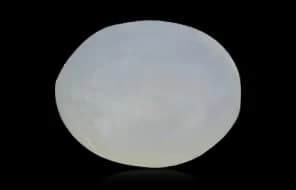
White Onyx
White Onyx is a softly elegant chalcedony known for milky white tones, subtle parallel banding and a smooth polish that suits refined jewelry and carved gems.
White Onyx is a trade name generally used for pale or milky onyx and closely related white chalcedony materials. In strict gemological terminology, true onyx is a variety of chalcedony, a microcrystalline form of quartz, distinguished by straight or approximately parallel bands. Its chemical composition is silicon dioxide (SiO₂), and its aggregate crystal structure belongs to the trigonal quartz system. White Onyx typically ranges from milky white and ivory to pale gray, sometimes showing delicate translucent layers or parallel bands. It has a Mohs hardness of about 6.5–7, no cleavage, a vitreous to waxy luster, a refractive index around 1.530–1.539, and a specific gravity commonly reported within approximately 2.55–2.70. These properties make it suitable for cabochons, beads, pendants, cameos, carvings and other jewelry applications, although it should still be protected from sharp impacts and abrasive materials. Onyx has a long history in decorative arts and engraved gemstones. Ancient artisans valued its layered structure for cameos, seals, intaglios and ornamental objects because different layers could be carved to create contrasting designs. Today, White Onyx appeals to buyers who prefer understated gemstones, neutral color palettes and distinctive natural patterning. Each natural piece can display its own combination of translucency, banding and surface character. Buyers should also be aware of an important terminology issue: the architectural and decorative-stone trade frequently uses 'white onyx' or 'onyx marble' for banded calcite or aragonite. That material is chemically different from true chalcedony onyx and is substantially softer. A reputable jewelry seller should identify the actual mineral material rather than relying on the word 'onyx' alone.
- Mineral Family
- Quartz
- Chemical Formula
- SiO₂
- Mohs Hardness
- 6.5 - 7
- Refractive Index
- 1.530 - 1.539
- Specific Gravity
- 2.55 - 2.70
- Cleavage
- None
- Crystal System
- Trigonal
- Luster
- Waxy
- Color Range
- White, Gray
When buying White Onyx, start with material identity. Confirm whether the piece is true chalcedony onyx, white chalcedony, or commercially named calcite or aragonite 'onyx.' Color should be attractive and naturally consistent with the material, with milky white, ivory and soft gray tones being common. Natural banding, if present, should be evaluated for its pattern and visual appeal rather than assuming that perfectly uniform material is superior. Because White Onyx is commonly opaque to translucent, clarity is less important than surface quality, polish, structural integrity and the attractiveness of its banding. For cabochons and carved pieces, look for an even polish, clean edges and good symmetry. Beads should have smooth drilling and well-finished surfaces. Carat weight matters for jewelry pricing, but size alone does not determine value; color, pattern, craftsmanship, condition, material identity and the quality of the finished piece are usually more important. Origin can be interesting for provenance, but it should not automatically be treated as a guarantee of quality or value. Treatments should always be disclosed. Chalcedony and onyx may be dyed or otherwise color enhanced, while some commercially sold white 'onyx' materials are actually calcite or aragonite. Natural and untreated material can be desirable, but treatment does not necessarily make a gemstone unsuitable when it is accurately disclosed. Lab-grown White Onyx is not a standard commercial category; ask whether a seller is describing natural stone, treated natural material, or a synthetic or imitation product. Certification is not required for every inexpensive piece, but an independent gemological report can be valuable for higher-priced or unusual material, especially where the identity of the stone is uncertain. To check authenticity, purchase from a transparent seller, request treatment and material disclosures, and be cautious of descriptions that make unsupported claims about rarity, origin or value. Price depends primarily on the actual material, quality, size, craftsmanship, treatment status, design and seller rather than on the name 'White Onyx' alone.
White Onyx is reasonably durable for jewelry but can scratch or chip because it has a Mohs hardness of about 6.5–7. Clean it with lukewarm water, a small amount of mild soap and a soft cloth or soft brush. Rinse thoroughly and dry gently. Avoid abrasive cleaners, strong acids, harsh chemicals, sudden temperature changes and prolonged exposure to unsuitable cleaning agents. Ultrasonic and steam cleaning should be avoided unless a qualified professional confirms that the specific stone and setting are safe. Store White Onyx separately from harder gemstones such as sapphire, ruby and diamond to reduce scratching. A soft pouch or lined jewelry box is ideal. Rings and bracelets receive more impact than pendants, so a White Onyx ring should be treated with particular care during sports, manual work and household activities. If the stone is dyed, filled or otherwise treated, follow the care instructions appropriate to that treatment. For long-term jewelry care, periodic professional inspection of the stone and setting can help identify loose mounts, chips or surface damage before they become serious.
White Onyx is a trade name generally used for pale or milky onyx and closely related white chalcedony materials. In strict gemological terminology, true onyx is a variety of chalcedony, a microcrystalline form of quartz, distinguished by straight or approximately parallel bands. Its chemical composition is silicon dioxide (SiO₂), and its aggregate crystal structure belongs to the trigonal quartz system. White Onyx typically ranges from milky white and ivory to pale gray, sometimes showing delicate translucent layers or parallel bands. It has a Mohs hardness of about 6.5–7, no cleavage, a vitreous to waxy luster, a refractive index around 1.530–1.539, and a specific gravity commonly reported within approximately 2.55–2.70. These properties make it suitable for cabochons, beads, pendants, cameos, carvings and other jewelry applications, although it should still be protected from sharp impacts and abrasive materials. Onyx has a long history in decorative arts and engraved gemstones. Ancient artisans valued its layered structure for cameos, seals, intaglios and ornamental objects because different layers could be carved to create contrasting designs. Today, White Onyx appeals to buyers who prefer understated gemstones, neutral color palettes and distinctive natural patterning. Each natural piece can display its own combination of translucency, banding and surface character. Buyers should also be aware of an important terminology issue: the architectural and decorative-stone trade frequently uses 'white onyx' or 'onyx marble' for banded calcite or aragonite. That material is chemically different from true chalcedony onyx and is substantially softer. A reputable jewelry seller should identify the actual mineral material rather than relying on the word 'onyx' alone.
- Mineral Family
- Quartz
- Chemical Formula
- SiO₂
- Mohs Hardness
- 6.5 - 7
- Refractive Index
- 1.530 - 1.539
- Specific Gravity
- 2.55 - 2.70
- Cleavage
- None
- Crystal System
- Trigonal
- Luster
- Waxy
- Color Range
- White, Gray
When buying White Onyx, start with material identity. Confirm whether the piece is true chalcedony onyx, white chalcedony, or commercially named calcite or aragonite 'onyx.' Color should be attractive and naturally consistent with the material, with milky white, ivory and soft gray tones being common. Natural banding, if present, should be evaluated for its pattern and visual appeal rather than assuming that perfectly uniform material is superior. Because White Onyx is commonly opaque to translucent, clarity is less important than surface quality, polish, structural integrity and the attractiveness of its banding. For cabochons and carved pieces, look for an even polish, clean edges and good symmetry. Beads should have smooth drilling and well-finished surfaces. Carat weight matters for jewelry pricing, but size alone does not determine value; color, pattern, craftsmanship, condition, material identity and the quality of the finished piece are usually more important. Origin can be interesting for provenance, but it should not automatically be treated as a guarantee of quality or value. Treatments should always be disclosed. Chalcedony and onyx may be dyed or otherwise color enhanced, while some commercially sold white 'onyx' materials are actually calcite or aragonite. Natural and untreated material can be desirable, but treatment does not necessarily make a gemstone unsuitable when it is accurately disclosed. Lab-grown White Onyx is not a standard commercial category; ask whether a seller is describing natural stone, treated natural material, or a synthetic or imitation product. Certification is not required for every inexpensive piece, but an independent gemological report can be valuable for higher-priced or unusual material, especially where the identity of the stone is uncertain. To check authenticity, purchase from a transparent seller, request treatment and material disclosures, and be cautious of descriptions that make unsupported claims about rarity, origin or value. Price depends primarily on the actual material, quality, size, craftsmanship, treatment status, design and seller rather than on the name 'White Onyx' alone.
White Onyx is reasonably durable for jewelry but can scratch or chip because it has a Mohs hardness of about 6.5–7. Clean it with lukewarm water, a small amount of mild soap and a soft cloth or soft brush. Rinse thoroughly and dry gently. Avoid abrasive cleaners, strong acids, harsh chemicals, sudden temperature changes and prolonged exposure to unsuitable cleaning agents. Ultrasonic and steam cleaning should be avoided unless a qualified professional confirms that the specific stone and setting are safe. Store White Onyx separately from harder gemstones such as sapphire, ruby and diamond to reduce scratching. A soft pouch or lined jewelry box is ideal. Rings and bracelets receive more impact than pendants, so a White Onyx ring should be treated with particular care during sports, manual work and household activities. If the stone is dyed, filled or otherwise treated, follow the care instructions appropriate to that treatment. For long-term jewelry care, periodic professional inspection of the stone and setting can help identify loose mounts, chips or surface damage before they become serious.
White Onyx for Sale
No gems found
Try broadening your search or adjusting your filters.
Have a gem of your own? List it free - no fees