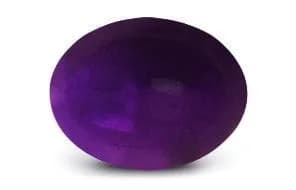
Amethyst Cabochon
Amethyst Cabochon is a polished purple quartz gemstone prized for its smooth domed surface, rich color, durability, and distinctive appeal in jewelry.
Amethyst Cabochon is a form of natural amethyst, a purple variety of quartz cut and polished into a cabochon rather than faceted. Amethyst belongs to the quartz mineral family and is composed of silicon dioxide (SiO2). Its purple color is associated primarily with trace iron and natural irradiation, while color intensity and distribution can vary between stones. Amethyst crystallizes in the trigonal crystal system and has a Mohs hardness of 7, making it suitable for many types of jewelry when handled with reasonable care. It has a vitreous luster, a refractive index of approximately 1.544–1.553, and a specific gravity of about 2.65. Quartz has no cleavage, although amethyst can still fracture or chip if subjected to a hard impact. Amethyst occurs in shades ranging from pale lilac to saturated violet and deep purple, with some material showing attractive color zoning. Brazil is one of the world's most important sources, while significant amethyst deposits also occur in Uruguay, Zambia, Namibia, Bolivia, and other regions. Amethyst has a long history of use in decorative objects and jewelry, and its name comes from the ancient Greek word associated with the idea of being 'not intoxicated.' Today, Amethyst Cabochons are commonly fashioned into rings, pendants, earrings, bracelets, beads, and statement jewelry. The smooth, curved surface can emphasize the gemstone's body color and natural character while offering a different aesthetic from faceted amethyst. Buyers value natural Amethyst Cabochons for their attractive purple color, accessible price point, durability, variety of sizes, and versatility in contemporary and classic jewelry.
- Mineral Family
- Quartz
- Chemical Formula
- SiO2
- Mohs Hardness
- 7
- Refractive Index
- 1.544 - 1.553
- Specific Gravity
- 2.65
- Cleavage
- None
- Crystal System
- Trigonal
- Luster
- Vitreous
- Color Range
- Purple
When buying an Amethyst Cabochon, color is usually one of the most important quality factors. Rich, attractive purple with good saturation and relatively even color distribution is generally preferred, although the ideal appearance depends on personal taste and the intended jewelry design. Extremely dark material may lose visual brightness, while very pale material can appear less vivid. Clarity should be evaluated according to the cabochon's size, shape, and purpose. Natural amethyst can contain inclusions, color zoning, or internal features, and a clean-looking stone is often desirable when transparency and visual brightness are priorities. Cut and polish are especially important for a cabochon. Look for a symmetrical outline, an even dome, a smooth polished surface, and good proportions without obvious scratches, pits, or poorly finished areas. Carat weight affects price, but amethyst is relatively abundant, so price does not typically increase dramatically with size alone. Origin can contribute to desirability when a particular locality is associated with distinctive color or appearance, but origin should not automatically be treated as a guarantee of superior quality. Treatments should always be disclosed. Amethyst may be heat treated to alter its color, and some quartz material can be treated or enhanced in other ways. Ask whether the stone is natural and whether any treatment has been applied. Natural and laboratory-created quartz are different products, and sellers should clearly identify laboratory-created material rather than presenting it as naturally mined amethyst. For higher-value purchases, an independent gemological report can provide useful information about identity, natural or laboratory-created status, and detectable treatments when applicable. Buyers should also check the seller's return policy, product photographs, dimensions, carat weight, treatment disclosure, and any available laboratory documentation. Price is influenced by color, overall appearance, size, clarity, cut quality, origin when relevant, treatment status, craftsmanship, and seller reputation. To buy Amethyst Cabochon online with confidence, compare these factors rather than judging value from color or carat weight alone.
Amethyst Cabochon is reasonably durable with a Mohs hardness of 7, but it can still scratch, chip, or fracture from impacts. Clean it with lukewarm water, mild soap, and a soft cloth or soft brush, then rinse and dry gently. Avoid harsh chemicals, abrasive cleaners, and sudden temperature changes. Prolonged or intense exposure to heat and strong light may affect the appearance of some amethyst, particularly material whose color has been treated or enhanced. Ultrasonic or steam cleaning should be approached cautiously, especially when the stone has fractures, inclusions, or treatment concerns. Store Amethyst Cabochon jewelry separately from harder gemstones and metal pieces that could scratch its polished surface. A soft jewelry pouch or lined compartment is ideal. For everyday wear, remove the jewelry before strenuous activities, household cleaning, or situations where the stone may receive hard knocks. Periodically inspect the setting of rings and pendants to ensure the cabochon remains secure.
Amethyst Cabochon is a form of natural amethyst, a purple variety of quartz cut and polished into a cabochon rather than faceted. Amethyst belongs to the quartz mineral family and is composed of silicon dioxide (SiO2). Its purple color is associated primarily with trace iron and natural irradiation, while color intensity and distribution can vary between stones. Amethyst crystallizes in the trigonal crystal system and has a Mohs hardness of 7, making it suitable for many types of jewelry when handled with reasonable care. It has a vitreous luster, a refractive index of approximately 1.544–1.553, and a specific gravity of about 2.65. Quartz has no cleavage, although amethyst can still fracture or chip if subjected to a hard impact. Amethyst occurs in shades ranging from pale lilac to saturated violet and deep purple, with some material showing attractive color zoning. Brazil is one of the world's most important sources, while significant amethyst deposits also occur in Uruguay, Zambia, Namibia, Bolivia, and other regions. Amethyst has a long history of use in decorative objects and jewelry, and its name comes from the ancient Greek word associated with the idea of being 'not intoxicated.' Today, Amethyst Cabochons are commonly fashioned into rings, pendants, earrings, bracelets, beads, and statement jewelry. The smooth, curved surface can emphasize the gemstone's body color and natural character while offering a different aesthetic from faceted amethyst. Buyers value natural Amethyst Cabochons for their attractive purple color, accessible price point, durability, variety of sizes, and versatility in contemporary and classic jewelry.
- Mineral Family
- Quartz
- Chemical Formula
- SiO2
- Mohs Hardness
- 7
- Refractive Index
- 1.544 - 1.553
- Specific Gravity
- 2.65
- Cleavage
- None
- Crystal System
- Trigonal
- Luster
- Vitreous
- Color Range
- Purple
When buying an Amethyst Cabochon, color is usually one of the most important quality factors. Rich, attractive purple with good saturation and relatively even color distribution is generally preferred, although the ideal appearance depends on personal taste and the intended jewelry design. Extremely dark material may lose visual brightness, while very pale material can appear less vivid. Clarity should be evaluated according to the cabochon's size, shape, and purpose. Natural amethyst can contain inclusions, color zoning, or internal features, and a clean-looking stone is often desirable when transparency and visual brightness are priorities. Cut and polish are especially important for a cabochon. Look for a symmetrical outline, an even dome, a smooth polished surface, and good proportions without obvious scratches, pits, or poorly finished areas. Carat weight affects price, but amethyst is relatively abundant, so price does not typically increase dramatically with size alone. Origin can contribute to desirability when a particular locality is associated with distinctive color or appearance, but origin should not automatically be treated as a guarantee of superior quality. Treatments should always be disclosed. Amethyst may be heat treated to alter its color, and some quartz material can be treated or enhanced in other ways. Ask whether the stone is natural and whether any treatment has been applied. Natural and laboratory-created quartz are different products, and sellers should clearly identify laboratory-created material rather than presenting it as naturally mined amethyst. For higher-value purchases, an independent gemological report can provide useful information about identity, natural or laboratory-created status, and detectable treatments when applicable. Buyers should also check the seller's return policy, product photographs, dimensions, carat weight, treatment disclosure, and any available laboratory documentation. Price is influenced by color, overall appearance, size, clarity, cut quality, origin when relevant, treatment status, craftsmanship, and seller reputation. To buy Amethyst Cabochon online with confidence, compare these factors rather than judging value from color or carat weight alone.
Amethyst Cabochon is reasonably durable with a Mohs hardness of 7, but it can still scratch, chip, or fracture from impacts. Clean it with lukewarm water, mild soap, and a soft cloth or soft brush, then rinse and dry gently. Avoid harsh chemicals, abrasive cleaners, and sudden temperature changes. Prolonged or intense exposure to heat and strong light may affect the appearance of some amethyst, particularly material whose color has been treated or enhanced. Ultrasonic or steam cleaning should be approached cautiously, especially when the stone has fractures, inclusions, or treatment concerns. Store Amethyst Cabochon jewelry separately from harder gemstones and metal pieces that could scratch its polished surface. A soft jewelry pouch or lined compartment is ideal. For everyday wear, remove the jewelry before strenuous activities, household cleaning, or situations where the stone may receive hard knocks. Periodically inspect the setting of rings and pendants to ensure the cabochon remains secure.
Amethyst Cabochon for Sale
No gems found
Try broadening your search or adjusting your filters.
Have a gem of your own? List it free - no fees