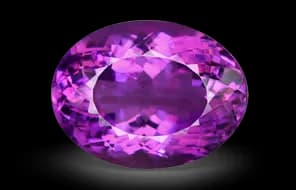
South American Amethyst
South American Amethyst is prized for its rich purple color, excellent durability, and broad appeal in elegant jewelry, collections, and statement pieces.
South American Amethyst is the purple variety of quartz, a widely admired gemstone known for its violet hues and excellent combination of beauty, durability, and affordability. Major South American sources, particularly Brazil, have played an important role in the modern history of amethyst. Brazil became a major source after large deposits were discovered in the 19th century, helping transform amethyst from a historically rare gem into a more accessible choice for jewelry buyers. Amethyst belongs to the quartz mineral family and has the chemical formula SiO₂. It crystallizes in the trigonal crystal system, has a Mohs hardness of 7, a refractive index of approximately 1.544-1.553, a specific gravity around 2.66, and a vitreous luster. Amethyst has no cleavage and commonly forms six-sided prismatic crystals. Its purple color ranges from delicate lilac and pale violet to saturated deep purple, with some stones displaying attractive angular color zoning. The color is associated with trace iron and irradiation-related processes within quartz. South American amethyst is especially associated with Brazil, including important deposits in Rio Grande do Sul and other regions. Brazilian material can range from lighter purple crystals to richly colored gem-quality stones, while large amethyst geodes are also well known from the region. The gemstone has a long global history and has appeared in royal jewelry, historic ornaments, and fine jewelry collections. Today, South American Amethyst is widely fashioned into rings, earrings, pendants, bracelets, necklaces, cabochons, and collector specimens. Buyers value it for its recognizable purple color, good everyday durability, availability in large sizes, and relatively accessible pricing compared with many other colored gemstones. Amethyst is also the traditional February birthstone.
- Mineral Family
- Quartz
- Chemical Formula
- SiO₂
- Mohs Hardness
- 7
- Refractive Index
- 1.544 - 1.553
- Specific Gravity
- 2.66
- Cleavage
- None
- Crystal System
- Trigonal
- Luster
- Vitreous
- Color Range
- Purple
When buying South American Amethyst, color is one of the most important considerations. Rich, attractive purple with good saturation is generally more desirable than very pale material, although lighter lilac tones have their own appeal. Look for balanced color and attractive distribution when viewing a faceted stone face-up. Clarity is also important: fine faceted amethyst is often relatively clean to the eye, while natural inclusions can help confirm its geological character and may be acceptable in larger or unusual specimens. Cut strongly influences brilliance and color presentation. Well-proportioned faceting can maximize the stone's luster and saturation, while unusual cuts may highlight distinctive zoning or inclusions. Carat weight is important because amethyst is available in both small jewelry sizes and very large stones, with size alone not determining quality. Origin can add interest and provenance, particularly for Brazilian material, but country of origin should not automatically be treated as a guarantee of superior quality. Treatments should always be disclosed. Heat treatment is common in the amethyst trade and can permanently alter color; it may lighten very dark material or remove unwanted brownish tones, and some amethyst can turn yellow and become citrine through heating. Natural Amethyst should be distinguished from laboratory-grown synthetic amethyst, which can have essentially the same chemical and physical properties as natural material and may require advanced testing for reliable identification. When purchasing a valuable stone, an independent gemological report can provide additional confidence about identity, treatments, and sometimes origin. Authenticity should be assessed through reputable sellers, accurate disclosures, and appropriate laboratory testing when warranted. Price depends on color quality, clarity, cut, size, treatment status, origin, overall appearance, and market demand rather than carat weight alone.
Amethyst has a Mohs hardness of 7, making it suitable for many types of jewelry, but it can still be scratched by harder materials. For routine cleaning, use lukewarm water, mild soap, and a soft brush or cloth. Rinse thoroughly and dry gently. Ultrasonic cleaning is generally considered acceptable for many amethyst stones, but steam cleaning is not recommended. Avoid prolonged exposure to intense heat and strong sunlight, as some amethyst may fade or change color with excessive exposure. Heat-treated stones can also be somewhat more vulnerable to sudden temperature changes. Store South American Amethyst separately from harder gemstones to prevent scratches, ideally in a soft pouch or lined jewelry compartment. For rings and other frequently worn pieces, remove the jewelry during activities involving impact, harsh chemicals, or significant temperature changes. Pay particular attention to pointed facet edges and corners, which can be more vulnerable to damage.
South American Amethyst is the purple variety of quartz, a widely admired gemstone known for its violet hues and excellent combination of beauty, durability, and affordability. Major South American sources, particularly Brazil, have played an important role in the modern history of amethyst. Brazil became a major source after large deposits were discovered in the 19th century, helping transform amethyst from a historically rare gem into a more accessible choice for jewelry buyers. Amethyst belongs to the quartz mineral family and has the chemical formula SiO₂. It crystallizes in the trigonal crystal system, has a Mohs hardness of 7, a refractive index of approximately 1.544-1.553, a specific gravity around 2.66, and a vitreous luster. Amethyst has no cleavage and commonly forms six-sided prismatic crystals. Its purple color ranges from delicate lilac and pale violet to saturated deep purple, with some stones displaying attractive angular color zoning. The color is associated with trace iron and irradiation-related processes within quartz. South American amethyst is especially associated with Brazil, including important deposits in Rio Grande do Sul and other regions. Brazilian material can range from lighter purple crystals to richly colored gem-quality stones, while large amethyst geodes are also well known from the region. The gemstone has a long global history and has appeared in royal jewelry, historic ornaments, and fine jewelry collections. Today, South American Amethyst is widely fashioned into rings, earrings, pendants, bracelets, necklaces, cabochons, and collector specimens. Buyers value it for its recognizable purple color, good everyday durability, availability in large sizes, and relatively accessible pricing compared with many other colored gemstones. Amethyst is also the traditional February birthstone.
- Mineral Family
- Quartz
- Chemical Formula
- SiO₂
- Mohs Hardness
- 7
- Refractive Index
- 1.544 - 1.553
- Specific Gravity
- 2.66
- Cleavage
- None
- Crystal System
- Trigonal
- Luster
- Vitreous
- Color Range
- Purple
When buying South American Amethyst, color is one of the most important considerations. Rich, attractive purple with good saturation is generally more desirable than very pale material, although lighter lilac tones have their own appeal. Look for balanced color and attractive distribution when viewing a faceted stone face-up. Clarity is also important: fine faceted amethyst is often relatively clean to the eye, while natural inclusions can help confirm its geological character and may be acceptable in larger or unusual specimens. Cut strongly influences brilliance and color presentation. Well-proportioned faceting can maximize the stone's luster and saturation, while unusual cuts may highlight distinctive zoning or inclusions. Carat weight is important because amethyst is available in both small jewelry sizes and very large stones, with size alone not determining quality. Origin can add interest and provenance, particularly for Brazilian material, but country of origin should not automatically be treated as a guarantee of superior quality. Treatments should always be disclosed. Heat treatment is common in the amethyst trade and can permanently alter color; it may lighten very dark material or remove unwanted brownish tones, and some amethyst can turn yellow and become citrine through heating. Natural Amethyst should be distinguished from laboratory-grown synthetic amethyst, which can have essentially the same chemical and physical properties as natural material and may require advanced testing for reliable identification. When purchasing a valuable stone, an independent gemological report can provide additional confidence about identity, treatments, and sometimes origin. Authenticity should be assessed through reputable sellers, accurate disclosures, and appropriate laboratory testing when warranted. Price depends on color quality, clarity, cut, size, treatment status, origin, overall appearance, and market demand rather than carat weight alone.
Amethyst has a Mohs hardness of 7, making it suitable for many types of jewelry, but it can still be scratched by harder materials. For routine cleaning, use lukewarm water, mild soap, and a soft brush or cloth. Rinse thoroughly and dry gently. Ultrasonic cleaning is generally considered acceptable for many amethyst stones, but steam cleaning is not recommended. Avoid prolonged exposure to intense heat and strong sunlight, as some amethyst may fade or change color with excessive exposure. Heat-treated stones can also be somewhat more vulnerable to sudden temperature changes. Store South American Amethyst separately from harder gemstones to prevent scratches, ideally in a soft pouch or lined jewelry compartment. For rings and other frequently worn pieces, remove the jewelry during activities involving impact, harsh chemicals, or significant temperature changes. Pay particular attention to pointed facet edges and corners, which can be more vulnerable to damage.
South American Amethyst for Sale
No gems found
Try broadening your search or adjusting your filters.
Have a gem of your own? List it free - no fees