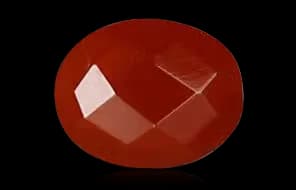
Red Onyx
Red Onyx is a striking chalcedony prized for its rich red tones, smooth polish and distinctive banding, offering an accessible choice for elegant jewelry and carvings.
Red Onyx is a trade name commonly used for red or reddish banded chalcedony, a microcrystalline variety of quartz. True onyx is characterized by parallel bands, while red material may also be marketed as red chalcedony or sardonyx depending on its pattern and composition. Its chemical composition is silicon dioxide (SiO2), and its microscopic quartz crystals give it a hardness of about 6.5-7 on the Mohs scale. It has a refractive index of approximately 1.530-1.540, a specific gravity of about 2.58-2.64, a trigonal crystal system, no cleavage, and a waxy to vitreous luster. Red Onyx can range from warm orange-red and terracotta through brick red and deeper reddish-brown tones, sometimes with white, cream or lighter bands. The color is generally related to mineral impurities and, in commercial material, may also be enhanced by dyeing. Chalcedony forms when silica-rich fluids deposit microscopic quartz in cavities and fractures, often in volcanic rocks and other geological environments where silica can accumulate over time. The material has a long history of use for carved objects, seals, cameos, beads and decorative stone. Today, Red Onyx is used for cabochons, rings, pendants, earrings, bracelets, beads and ornamental carvings. Buyers value it for its attractive color, polish, durability for careful jewelry use and relatively accessible price compared with many fine red gemstones. When shopping for Red Onyx, it is important to distinguish the trade name from mineral identity and to ask whether the color is natural or treated.
- Mineral Family
- Quartz
- Chemical Formula
- SiO2
- Mohs Hardness
- 6.5 - 7
- Refractive Index
- 1.530 - 1.540
- Specific Gravity
- 2.58 - 2.64
- Cleavage
- None
- Crystal System
- Trigonal
- Luster
- Waxy
- Color Range
- Red, Orange, White
A good Red Onyx buying guide begins with color and pattern. Look for an attractive, evenly distributed red tone or a distinctive natural-looking banded pattern, depending on your preferred style. Strong color and visually appealing banding can increase desirability, although there is no universal grading system equivalent to the one used for diamond. Clarity is less important than overall appearance because banding, inclusions and internal texture can be part of the stone's character. Choose a cut that suits the material: cabochons and polished slices emphasize color and banding, while carefully cut transparent or translucent pieces can provide additional visual interest. Carat weight matters less than dimensions, color and workmanship for most Red Onyx jewelry. Origin is generally a secondary consideration because commercial Red Onyx is available from several chalcedony-producing regions and origin alone does not establish quality. Treatment disclosure is particularly important. Red chalcedony and onyx may be dyed to produce or intensify red color, so ask the seller whether the material is untreated, dyed, heated or otherwise enhanced. Natural and lab-grown should not be treated as equivalent categories here: commercial Red Onyx is generally natural chalcedony, while laboratory-grown material is not a standard source for ordinary Red Onyx jewelry. A reputable seller should clearly disclose treatments and material identity. Independent laboratory identification can be useful for higher-value purchases, especially when natural color or treatment status is important. For authenticity, look for credible mineralogical identification, consistent texture and appropriate optical properties rather than relying on appearance alone. Price is influenced by color, pattern, size, finish, craftsmanship, treatment status and overall quality. Buying from a transparent seller who provides treatment information and, when appropriate, laboratory documentation is the safest approach when you buy Red Onyx online.
Red Onyx is reasonably durable but can still scratch, chip or fracture under impact. Clean it with lukewarm water, mild soap and a soft cloth or brush, then rinse and dry thoroughly. Avoid harsh chemicals, abrasive cleaners, steam cleaners and ultrasonic cleaners unless a qualified professional confirms that they are safe for the particular stone and treatment. If the material has been dyed, prolonged exposure to strong chemicals, heat or intense light may affect the color. Remove Red Onyx rings and bracelets before heavy manual work, sports or activities where the stone could receive a hard impact. Store jewelry separately in a soft pouch or lined compartment to reduce scratching from harder gemstones. For everyday wear, pendants and earrings generally face less impact than rings, while rings benefit from extra care and protective settings.
Red Onyx is a trade name commonly used for red or reddish banded chalcedony, a microcrystalline variety of quartz. True onyx is characterized by parallel bands, while red material may also be marketed as red chalcedony or sardonyx depending on its pattern and composition. Its chemical composition is silicon dioxide (SiO2), and its microscopic quartz crystals give it a hardness of about 6.5-7 on the Mohs scale. It has a refractive index of approximately 1.530-1.540, a specific gravity of about 2.58-2.64, a trigonal crystal system, no cleavage, and a waxy to vitreous luster. Red Onyx can range from warm orange-red and terracotta through brick red and deeper reddish-brown tones, sometimes with white, cream or lighter bands. The color is generally related to mineral impurities and, in commercial material, may also be enhanced by dyeing. Chalcedony forms when silica-rich fluids deposit microscopic quartz in cavities and fractures, often in volcanic rocks and other geological environments where silica can accumulate over time. The material has a long history of use for carved objects, seals, cameos, beads and decorative stone. Today, Red Onyx is used for cabochons, rings, pendants, earrings, bracelets, beads and ornamental carvings. Buyers value it for its attractive color, polish, durability for careful jewelry use and relatively accessible price compared with many fine red gemstones. When shopping for Red Onyx, it is important to distinguish the trade name from mineral identity and to ask whether the color is natural or treated.
- Mineral Family
- Quartz
- Chemical Formula
- SiO2
- Mohs Hardness
- 6.5 - 7
- Refractive Index
- 1.530 - 1.540
- Specific Gravity
- 2.58 - 2.64
- Cleavage
- None
- Crystal System
- Trigonal
- Luster
- Waxy
- Color Range
- Red, Orange, White
A good Red Onyx buying guide begins with color and pattern. Look for an attractive, evenly distributed red tone or a distinctive natural-looking banded pattern, depending on your preferred style. Strong color and visually appealing banding can increase desirability, although there is no universal grading system equivalent to the one used for diamond. Clarity is less important than overall appearance because banding, inclusions and internal texture can be part of the stone's character. Choose a cut that suits the material: cabochons and polished slices emphasize color and banding, while carefully cut transparent or translucent pieces can provide additional visual interest. Carat weight matters less than dimensions, color and workmanship for most Red Onyx jewelry. Origin is generally a secondary consideration because commercial Red Onyx is available from several chalcedony-producing regions and origin alone does not establish quality. Treatment disclosure is particularly important. Red chalcedony and onyx may be dyed to produce or intensify red color, so ask the seller whether the material is untreated, dyed, heated or otherwise enhanced. Natural and lab-grown should not be treated as equivalent categories here: commercial Red Onyx is generally natural chalcedony, while laboratory-grown material is not a standard source for ordinary Red Onyx jewelry. A reputable seller should clearly disclose treatments and material identity. Independent laboratory identification can be useful for higher-value purchases, especially when natural color or treatment status is important. For authenticity, look for credible mineralogical identification, consistent texture and appropriate optical properties rather than relying on appearance alone. Price is influenced by color, pattern, size, finish, craftsmanship, treatment status and overall quality. Buying from a transparent seller who provides treatment information and, when appropriate, laboratory documentation is the safest approach when you buy Red Onyx online.
Red Onyx is reasonably durable but can still scratch, chip or fracture under impact. Clean it with lukewarm water, mild soap and a soft cloth or brush, then rinse and dry thoroughly. Avoid harsh chemicals, abrasive cleaners, steam cleaners and ultrasonic cleaners unless a qualified professional confirms that they are safe for the particular stone and treatment. If the material has been dyed, prolonged exposure to strong chemicals, heat or intense light may affect the color. Remove Red Onyx rings and bracelets before heavy manual work, sports or activities where the stone could receive a hard impact. Store jewelry separately in a soft pouch or lined compartment to reduce scratching from harder gemstones. For everyday wear, pendants and earrings generally face less impact than rings, while rings benefit from extra care and protective settings.
Red Onyx for Sale
No gems found
Try broadening your search or adjusting your filters.
Have a gem of your own? List it free - no fees