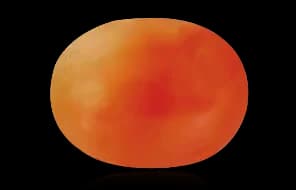
Orange Onyx
Orange Onyx is a warm, translucent decorative gemstone admired for its honey, amber, and orange tones, distinctive banding, and luminous appearance when polished or backlit.
Orange Onyx is a trade name commonly used for orange, honey, or amber-colored banded calcite, particularly material sold as Mexican or decorative onyx. It should not automatically be confused with true gemological onyx, which is a parallel-banded variety of chalcedony, a microcrystalline form of quartz. Orange Onyx in the decorative-stone trade is generally calcite with the chemical formula CaCO3. Calcite belongs to the carbonate mineral group and crystallizes in the trigonal system. It has a Mohs hardness of 3, a specific gravity of about 2.71, and refractive indices of approximately 1.486 and 1.658, producing exceptionally strong birefringence. It also has perfect cleavage in three directions.
Orange calcite can form when calcium-rich waters precipitate carbonate minerals in cavities, fractures, veins, or other geological environments. Changes in mineral-rich fluids and the presence of trace materials can produce its characteristic orange, honey, amber, yellow, cream, and reddish tones. Banded decorative onyx develops through successive layers of carbonate deposition, creating patterns that can become especially striking when the material is polished or illuminated from behind. The term Orange Onyx is therefore best treated as a trade or commercial name rather than evidence of a particular mineral species.
Its translucent quality and warm color make Orange Onyx popular for cabochons, beads, pendants, carvings, ornamental objects, and decorative jewelry. Larger pieces are also used for architectural surfaces and backlit interior features. For jewelry buyers, the material's appeal comes primarily from its color, translucency, pattern, polish, and individual character rather than exceptional hardness. Because calcite is relatively soft and has strong cleavage, Orange Onyx requires more care than quartz-based gemstones.
When buying an Orange Onyx gemstone, it is important to confirm what the seller means by the name. A laboratory report or reputable seller should identify whether the material is calcite, chalcedony, aragonite, or another material marketed under the onyx name. This distinction matters because the physical properties, durability, care requirements, and value can differ substantially.
- Mineral Family
- Quartz
- Chemical Formula
- CaCO3
- Mohs Hardness
- 3
- Refractive Index
- 1.486 - 1.658
- Specific Gravity
- 2.71
- Cleavage
- Perfect in three directions
- Crystal System
- Trigonal
- Luster
- Waxy
- Color Range
- Orange, Yellow, White
When choosing an Orange Onyx gemstone, start with color. Attractive material may range from pale peach and honey to vivid orange, amber, golden-orange, or reddish-orange. Look for an even, appealing body color and natural-looking banding or internal pattern. Strong translucency can increase visual appeal, particularly in polished cabochons and pieces intended for illumination.
Clarity is less important than pattern and translucency for most Orange Onyx used in jewelry. Natural internal features, color zoning, banding, small inclusions, and growth structures are common and can contribute to character. For cabochons and beads, inspect the surface for chips, cracks, pits, or poorly polished areas.
Cut should suit the material. Cabochons, beads, polished freeforms, and carvings are common because they display the color and pattern effectively. Faceting is less practical for calcite because of its low hardness and perfect cleavage. Always consider exact dimensions as well as carat weight when purchasing an Orange Onyx cabochon or ornamental piece.
Carat weight affects price, but size alone should not determine value. Color quality, translucency, pattern, finish, condition, workmanship, and provenance can be more important. Origin may be commercially interesting when a locality is documented, but it should not be assumed solely from the trade name. Orange Onyx is commercially associated with deposits in regions including Mexico and Iran, but the actual origin of a specimen should be supported by reliable documentation.
Treatments should always be disclosed. Calcite and decorative onyx materials may be polished, acid-finished, dyed, filled, stabilized, or otherwise enhanced depending on the material and intended use. Ask specifically whether the color is natural and whether any resin, dye, coating, or surface treatment has been applied. Natural does not necessarily mean untreated.
Be particularly careful with the terms natural Orange Onyx, genuine Orange Onyx, and untreated Orange Onyx. Because 'onyx' is widely used commercially for several different stones, a certificate identifying the actual mineral species is valuable for higher-priced purchases. A reputable laboratory report can help confirm composition, treatment status where detectable, and other identification characteristics. For inexpensive decorative jewelry, a detailed seller disclosure may be sufficient, but expensive pieces deserve stronger documentation.
Price depends on the combination of material identity, color, translucency, pattern, size, workmanship, treatment, condition, and documented origin. A very low price is not necessarily a problem, but buyers should verify that the stone being sold as Orange Onyx is actually the material represented in the listing.
Orange Onyx requires gentle care because calcite has a Mohs hardness of only 3 and perfect cleavage. It can scratch relatively easily and may chip or split if struck. Remove Orange Onyx jewelry before activities involving impact, abrasion, or rough handling.
For cleaning, use a soft lint-free cloth and lukewarm water with a small amount of mild soap when necessary. Rinse gently and dry thoroughly with a soft cloth. Avoid ultrasonic cleaners, steam cleaning, abrasive materials, and strong jewelry-cleaning chemicals.
Keep Orange Onyx away from acids and acidic household products. Calcite reacts readily with weak acids, so substances such as vinegar, citrus juice, acidic cleaners, and some jewelry dips can etch or dull the surface.
Store it separately from harder gemstones such as quartz, sapphire, and diamond to reduce scratching. A soft pouch or individual compartment is ideal. Avoid sudden impacts and excessive heat, particularly with treated or filled material. For rings, Orange Onyx is better suited to occasional or careful wear than demanding everyday use because of its softness and cleavage.
Orange Onyx is a trade name commonly used for orange, honey, or amber-colored banded calcite, particularly material sold as Mexican or decorative onyx. It should not automatically be confused with true gemological onyx, which is a parallel-banded variety of chalcedony, a microcrystalline form of quartz. Orange Onyx in the decorative-stone trade is generally calcite with the chemical formula CaCO3. Calcite belongs to the carbonate mineral group and crystallizes in the trigonal system. It has a Mohs hardness of 3, a specific gravity of about 2.71, and refractive indices of approximately 1.486 and 1.658, producing exceptionally strong birefringence. It also has perfect cleavage in three directions.
Orange calcite can form when calcium-rich waters precipitate carbonate minerals in cavities, fractures, veins, or other geological environments. Changes in mineral-rich fluids and the presence of trace materials can produce its characteristic orange, honey, amber, yellow, cream, and reddish tones. Banded decorative onyx develops through successive layers of carbonate deposition, creating patterns that can become especially striking when the material is polished or illuminated from behind. The term Orange Onyx is therefore best treated as a trade or commercial name rather than evidence of a particular mineral species.
Its translucent quality and warm color make Orange Onyx popular for cabochons, beads, pendants, carvings, ornamental objects, and decorative jewelry. Larger pieces are also used for architectural surfaces and backlit interior features. For jewelry buyers, the material's appeal comes primarily from its color, translucency, pattern, polish, and individual character rather than exceptional hardness. Because calcite is relatively soft and has strong cleavage, Orange Onyx requires more care than quartz-based gemstones.
When buying an Orange Onyx gemstone, it is important to confirm what the seller means by the name. A laboratory report or reputable seller should identify whether the material is calcite, chalcedony, aragonite, or another material marketed under the onyx name. This distinction matters because the physical properties, durability, care requirements, and value can differ substantially.
- Mineral Family
- Quartz
- Chemical Formula
- CaCO3
- Mohs Hardness
- 3
- Refractive Index
- 1.486 - 1.658
- Specific Gravity
- 2.71
- Cleavage
- Perfect in three directions
- Crystal System
- Trigonal
- Luster
- Waxy
- Color Range
- Orange, Yellow, White
When choosing an Orange Onyx gemstone, start with color. Attractive material may range from pale peach and honey to vivid orange, amber, golden-orange, or reddish-orange. Look for an even, appealing body color and natural-looking banding or internal pattern. Strong translucency can increase visual appeal, particularly in polished cabochons and pieces intended for illumination.
Clarity is less important than pattern and translucency for most Orange Onyx used in jewelry. Natural internal features, color zoning, banding, small inclusions, and growth structures are common and can contribute to character. For cabochons and beads, inspect the surface for chips, cracks, pits, or poorly polished areas.
Cut should suit the material. Cabochons, beads, polished freeforms, and carvings are common because they display the color and pattern effectively. Faceting is less practical for calcite because of its low hardness and perfect cleavage. Always consider exact dimensions as well as carat weight when purchasing an Orange Onyx cabochon or ornamental piece.
Carat weight affects price, but size alone should not determine value. Color quality, translucency, pattern, finish, condition, workmanship, and provenance can be more important. Origin may be commercially interesting when a locality is documented, but it should not be assumed solely from the trade name. Orange Onyx is commercially associated with deposits in regions including Mexico and Iran, but the actual origin of a specimen should be supported by reliable documentation.
Treatments should always be disclosed. Calcite and decorative onyx materials may be polished, acid-finished, dyed, filled, stabilized, or otherwise enhanced depending on the material and intended use. Ask specifically whether the color is natural and whether any resin, dye, coating, or surface treatment has been applied. Natural does not necessarily mean untreated.
Be particularly careful with the terms natural Orange Onyx, genuine Orange Onyx, and untreated Orange Onyx. Because 'onyx' is widely used commercially for several different stones, a certificate identifying the actual mineral species is valuable for higher-priced purchases. A reputable laboratory report can help confirm composition, treatment status where detectable, and other identification characteristics. For inexpensive decorative jewelry, a detailed seller disclosure may be sufficient, but expensive pieces deserve stronger documentation.
Price depends on the combination of material identity, color, translucency, pattern, size, workmanship, treatment, condition, and documented origin. A very low price is not necessarily a problem, but buyers should verify that the stone being sold as Orange Onyx is actually the material represented in the listing.
Orange Onyx requires gentle care because calcite has a Mohs hardness of only 3 and perfect cleavage. It can scratch relatively easily and may chip or split if struck. Remove Orange Onyx jewelry before activities involving impact, abrasion, or rough handling.
For cleaning, use a soft lint-free cloth and lukewarm water with a small amount of mild soap when necessary. Rinse gently and dry thoroughly with a soft cloth. Avoid ultrasonic cleaners, steam cleaning, abrasive materials, and strong jewelry-cleaning chemicals.
Keep Orange Onyx away from acids and acidic household products. Calcite reacts readily with weak acids, so substances such as vinegar, citrus juice, acidic cleaners, and some jewelry dips can etch or dull the surface.
Store it separately from harder gemstones such as quartz, sapphire, and diamond to reduce scratching. A soft pouch or individual compartment is ideal. Avoid sudden impacts and excessive heat, particularly with treated or filled material. For rings, Orange Onyx is better suited to occasional or careful wear than demanding everyday use because of its softness and cleavage.
Orange Onyx for Sale
No gems found
Try broadening your search or adjusting your filters.
Have a gem of your own? List it free - no fees