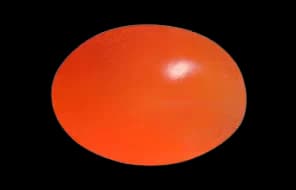
Orange Carnelian
Orange Carnelian is a warm, glowing variety of chalcedony prized for its orange to reddish-orange color, smooth polish, durability, and accessible appeal in jewelry.
Orange Carnelian is an orange variety of chalcedony, the microcrystalline form of quartz. Its chemical composition is silicon dioxide (SiO₂), with trace elements and iron-related color mechanisms contributing to its characteristic warm orange, red-orange, and reddish tones. Carnelian typically has a Mohs hardness of 6.5–7, no cleavage, and a vitreous to waxy luster, making it a practical gemstone for many jewelry applications. It is generally translucent to nearly opaque and is often polished to emphasize its smooth surface and rich body color. Carnelian forms in silica-rich geological environments, commonly filling cavities and fractures in volcanic rocks and occurring in association with other forms of chalcedony. The color can range from pale orange and honey-orange to stronger reddish-orange and red tones. Iron compounds are commonly associated with the coloration of carnelian. Unlike transparent faceted gemstones, Orange Carnelian is frequently evaluated for its body color, translucency, surface quality, polish, and overall visual consistency. Carnelian has a long history of use as an ornamental material. Ancient civilizations used it for beads, seals, amulets, carvings, and decorative objects, while Roman artisans valued it for engraved signet rings because its hardness and fine-grained structure were suitable for carving. Carnelian has also been widely used across regions of the Middle East, South Asia, and Europe. Today, Orange Carnelian gemstone is especially popular in cabochons, beads, pendants, bracelets, earrings, rings, cameos, and carved jewelry. Oval and round cabochons are particularly effective at displaying its even color and natural glow. Yellow gold emphasizes its warm orange tones, while sterling silver creates a sharper contemporary contrast. Buyers value natural Orange Carnelian for its distinctive color, smooth polish, durability, versatility, and relatively accessible price compared with many rarer colored gemstones. When shopping for natural Carnelian, look for attractive color, good polish, sound material, and clear disclosure of any treatments or enhancements.
- Mineral Family
- Quartz
- Chemical Formula
- SiO₂
- Mohs Hardness
- 6.5–7
- Refractive Index
- Approximately 1.54
- Specific Gravity
- 2.55–2.70
- Cleavage
- None
- Crystal System
- Trigonal
- Luster
- Waxy
- Color Range
- Orange, Red
When buying Orange Carnelian online, evaluate the stone as a combination of color, clarity, cut, size, origin, treatment, and craftsmanship rather than relying on carat weight alone. Color is usually the most important visual factor. Attractive material commonly shows orange through reddish-orange body color, with strong and reasonably even saturation often preferred. Very pale, brownish, patchy, or uneven material may be less desirable depending on the intended jewelry design. Clarity in Carnelian is different from clarity in transparent faceted gems. Translucency, natural internal variation, and an even body appearance can contribute to appeal, while distracting cracks, fractures, or poorly polished surfaces may reduce value. Cut is typically based around cabochons, beads, carvings, and other polished forms rather than traditional faceting. A well-shaped cabochon should have a smooth dome, balanced proportions, and an even polish that enhances the stone's color. Carat weight is generally less influential than color and overall quality because Carnelian is comparatively abundant and is available in a wide range of sizes. Larger pieces can command higher prices when they combine attractive color, good translucency, clean surfaces, and strong craftsmanship. Origin can be of interest to collectors, but locality alone does not automatically make an Orange Carnelian more valuable. The individual stone's quality and appearance are usually more important. Treatment disclosure is important because chalcedony materials may be dyed or otherwise enhanced, and some material sold in the market may be artificially colored. Ask the seller whether the stone is natural, treated, dyed, or enhanced, and request supporting documentation when appropriate. Lab-grown or synthetic quartz materials exist, but commercially sold Carnelian is generally natural chalcedony; any claim of laboratory-grown or synthetic material should be clearly disclosed. For higher-value purchases, independent gemological documentation can provide additional confidence about identity and treatment status. Authenticity should be assessed through a combination of gemological properties, visual examination, seller transparency, and, when necessary, professional testing rather than relying on a single home test. Price depends primarily on color quality, translucency, surface condition, size, treatment status, craftsmanship, and the quality of the finished jewelry. A reputable seller should clearly describe the gemstone, disclose treatments, provide accurate photographs, and explain what is included with the purchase.
Orange Carnelian is reasonably durable for jewelry, but its 6.5–7 Mohs hardness means it can still be scratched by harder materials. Clean Carnelian jewelry with lukewarm water, a mild soap, and a soft cloth or soft brush. Rinse thoroughly and dry with a clean, soft cloth. Avoid abrasive cleaners, rough polishing materials, and harsh household chemicals that can damage the surface or affect treatments. Remove Carnelian jewelry before activities that expose it to hard impacts, prolonged heat, or abrasive surfaces. Rings and bracelets receive more knocks and scratches than pendants or earrings, so they require extra care during everyday wear. Store each piece separately in a soft pouch or lined jewelry compartment to prevent contact with harder gemstones. Avoid prolonged exposure to intense heat and unnecessary chemical exposure, particularly when the stone has been treated. With gentle cleaning, sensible storage, and reasonable protection from impact, natural Orange Carnelian can retain its attractive polish and warm color for many years.
Orange Carnelian is an orange variety of chalcedony, the microcrystalline form of quartz. Its chemical composition is silicon dioxide (SiO₂), with trace elements and iron-related color mechanisms contributing to its characteristic warm orange, red-orange, and reddish tones. Carnelian typically has a Mohs hardness of 6.5–7, no cleavage, and a vitreous to waxy luster, making it a practical gemstone for many jewelry applications. It is generally translucent to nearly opaque and is often polished to emphasize its smooth surface and rich body color. Carnelian forms in silica-rich geological environments, commonly filling cavities and fractures in volcanic rocks and occurring in association with other forms of chalcedony. The color can range from pale orange and honey-orange to stronger reddish-orange and red tones. Iron compounds are commonly associated with the coloration of carnelian. Unlike transparent faceted gemstones, Orange Carnelian is frequently evaluated for its body color, translucency, surface quality, polish, and overall visual consistency. Carnelian has a long history of use as an ornamental material. Ancient civilizations used it for beads, seals, amulets, carvings, and decorative objects, while Roman artisans valued it for engraved signet rings because its hardness and fine-grained structure were suitable for carving. Carnelian has also been widely used across regions of the Middle East, South Asia, and Europe. Today, Orange Carnelian gemstone is especially popular in cabochons, beads, pendants, bracelets, earrings, rings, cameos, and carved jewelry. Oval and round cabochons are particularly effective at displaying its even color and natural glow. Yellow gold emphasizes its warm orange tones, while sterling silver creates a sharper contemporary contrast. Buyers value natural Orange Carnelian for its distinctive color, smooth polish, durability, versatility, and relatively accessible price compared with many rarer colored gemstones. When shopping for natural Carnelian, look for attractive color, good polish, sound material, and clear disclosure of any treatments or enhancements.
- Mineral Family
- Quartz
- Chemical Formula
- SiO₂
- Mohs Hardness
- 6.5–7
- Refractive Index
- Approximately 1.54
- Specific Gravity
- 2.55–2.70
- Cleavage
- None
- Crystal System
- Trigonal
- Luster
- Waxy
- Color Range
- Orange, Red
When buying Orange Carnelian online, evaluate the stone as a combination of color, clarity, cut, size, origin, treatment, and craftsmanship rather than relying on carat weight alone. Color is usually the most important visual factor. Attractive material commonly shows orange through reddish-orange body color, with strong and reasonably even saturation often preferred. Very pale, brownish, patchy, or uneven material may be less desirable depending on the intended jewelry design. Clarity in Carnelian is different from clarity in transparent faceted gems. Translucency, natural internal variation, and an even body appearance can contribute to appeal, while distracting cracks, fractures, or poorly polished surfaces may reduce value. Cut is typically based around cabochons, beads, carvings, and other polished forms rather than traditional faceting. A well-shaped cabochon should have a smooth dome, balanced proportions, and an even polish that enhances the stone's color. Carat weight is generally less influential than color and overall quality because Carnelian is comparatively abundant and is available in a wide range of sizes. Larger pieces can command higher prices when they combine attractive color, good translucency, clean surfaces, and strong craftsmanship. Origin can be of interest to collectors, but locality alone does not automatically make an Orange Carnelian more valuable. The individual stone's quality and appearance are usually more important. Treatment disclosure is important because chalcedony materials may be dyed or otherwise enhanced, and some material sold in the market may be artificially colored. Ask the seller whether the stone is natural, treated, dyed, or enhanced, and request supporting documentation when appropriate. Lab-grown or synthetic quartz materials exist, but commercially sold Carnelian is generally natural chalcedony; any claim of laboratory-grown or synthetic material should be clearly disclosed. For higher-value purchases, independent gemological documentation can provide additional confidence about identity and treatment status. Authenticity should be assessed through a combination of gemological properties, visual examination, seller transparency, and, when necessary, professional testing rather than relying on a single home test. Price depends primarily on color quality, translucency, surface condition, size, treatment status, craftsmanship, and the quality of the finished jewelry. A reputable seller should clearly describe the gemstone, disclose treatments, provide accurate photographs, and explain what is included with the purchase.
Orange Carnelian is reasonably durable for jewelry, but its 6.5–7 Mohs hardness means it can still be scratched by harder materials. Clean Carnelian jewelry with lukewarm water, a mild soap, and a soft cloth or soft brush. Rinse thoroughly and dry with a clean, soft cloth. Avoid abrasive cleaners, rough polishing materials, and harsh household chemicals that can damage the surface or affect treatments. Remove Carnelian jewelry before activities that expose it to hard impacts, prolonged heat, or abrasive surfaces. Rings and bracelets receive more knocks and scratches than pendants or earrings, so they require extra care during everyday wear. Store each piece separately in a soft pouch or lined jewelry compartment to prevent contact with harder gemstones. Avoid prolonged exposure to intense heat and unnecessary chemical exposure, particularly when the stone has been treated. With gentle cleaning, sensible storage, and reasonable protection from impact, natural Orange Carnelian can retain its attractive polish and warm color for many years.
Orange Carnelian for Sale
No gems found
Try broadening your search or adjusting your filters.
Have a gem of your own? List it free - no fees