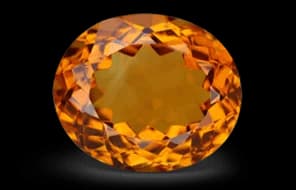
Madeira Citrine
Madeira Citrine is a richly colored citrine prized for its deep orange to reddish-orange hues, bright vitreous luster, and elegant appeal in fine jewelry.
Madeira Citrine is a trade name commonly used for citrine with deep reddish-orange, brownish-orange, or Madeira-wine-like coloration. It is not a separate mineral species or a distinct quartz variety in the scientific sense; it is quartz, SiO₂, with the same fundamental gemological properties as other citrine. Citrine belongs to the quartz mineral group and crystallizes in the trigonal crystal system. It has a Mohs hardness of 7, a refractive index of approximately 1.544–1.553, and a specific gravity around 2.66. Its vitreous luster and good transparency give well-cut stones lively brilliance. The name Madeira Citrine refers to its resemblance to the rich reddish-brown and orange tones associated with Madeira wine. Its color range can include golden orange, honey-orange, reddish orange, and brownish orange. Natural citrine is uncommon, while much of the citrine sold today is produced by heat treatment, commonly by heating suitable amethyst material. The resulting color can range from golden yellow to orange and orangy red. Madeira-like coloration is especially associated with strongly saturated orange and reddish-orange citrine. Brazil is an important source of quartz and citrine, while citrine and related quartz varieties also occur in locations including Bolivia, Madagascar, and Zambia. Madeira Citrine has been appreciated in gemstone markets for its warm color and affordability, and it is frequently fashioned into faceted rings, earrings, pendants, necklaces, bracelets, and statement pieces. Buyers value it for its distinctive color, durability for jewelry use, transparency, and generally accessible price compared with many other colored gemstones. November recognizes citrine as a birthstone, making Madeira Citrine an appealing option for buyers seeking a more saturated interpretation of the traditional November gemstone.
- Mineral Family
- Quartz
- Chemical Formula
- SiO₂
- Mohs Hardness
- 7
- Refractive Index
- 1.544 - 1.553
- Specific Gravity
- 2.66 (+0.03/-0.02)
- Cleavage
- None
- Crystal System
- Trigonal
- Luster
- Vitreous
- Color Range
- Orange, Red, Yellow
When buying Madeira Citrine, evaluate the gemstone as citrine first and then assess the qualities that create its distinctive Madeira appearance. Color is usually the most important visual factor: look for attractive, evenly distributed orange, reddish-orange, amber, or brownish-orange tones with good saturation. Clarity is also important because transparent, eye-clean material can show stronger brilliance, although minor natural inclusions do not automatically make a stone undesirable. Cut should maximize both color and light return. Well-proportioned faceting can make a deeply colored stone appear lively rather than overly dark. Carat weight affects price, but citrine generally remains relatively affordable even in larger sizes, so color and overall beauty often matter more than size alone. Origin can provide useful provenance, but it should not be treated as proof of superior quality. Treatment disclosure is essential. Natural citrine is relatively rare, and much commercial citrine is produced through heat treatment, often from amethyst. Heat-treated citrine is still quartz and should be accurately disclosed rather than presented as untreated natural citrine. Natural Madeira-colored citrine is much less common, so claims of untreated material should be supported by credible laboratory evidence when significant value is involved. Lab-grown or synthetic quartz can have essentially the same chemical composition and physical properties as natural quartz, making laboratory testing important when origin or natural status materially affects the purchase. For expensive stones, consider an independent gemological report identifying the material and any detectable treatment. Authenticity cannot be established reliably from color alone. Compare the seller's photographs, treatment disclosure, return policy, measurements, carat weight, and laboratory documentation. Price is influenced primarily by color quality, clarity, cut, size, treatment status, and overall beauty rather than simply by the Madeira name.
Madeira Citrine is suitable for regular jewelry use because quartz has a Mohs hardness of 7, but it can still scratch or chip under impact. Clean the gemstone with lukewarm water, a soft brush, and mild soap, then rinse and dry with a soft cloth. Avoid abrasive cleaners, harsh chemicals, and sudden temperature changes. Prolonged exposure to intense heat should also be avoided, particularly for treated material, because heat can affect some quartz treatments or inclusions. Store Madeira Citrine separately from harder gemstones such as sapphire and diamond to reduce scratching, ideally in a soft pouch or fabric-lined compartment. Rings should receive extra care because their exposed stones can experience knocks during everyday activities. Remove Madeira Citrine jewelry before strenuous work, sports, or activities where the gemstone could suffer a sharp impact. Periodically inspect the setting to ensure the stone remains secure.
Madeira Citrine is a trade name commonly used for citrine with deep reddish-orange, brownish-orange, or Madeira-wine-like coloration. It is not a separate mineral species or a distinct quartz variety in the scientific sense; it is quartz, SiO₂, with the same fundamental gemological properties as other citrine. Citrine belongs to the quartz mineral group and crystallizes in the trigonal crystal system. It has a Mohs hardness of 7, a refractive index of approximately 1.544–1.553, and a specific gravity around 2.66. Its vitreous luster and good transparency give well-cut stones lively brilliance. The name Madeira Citrine refers to its resemblance to the rich reddish-brown and orange tones associated with Madeira wine. Its color range can include golden orange, honey-orange, reddish orange, and brownish orange. Natural citrine is uncommon, while much of the citrine sold today is produced by heat treatment, commonly by heating suitable amethyst material. The resulting color can range from golden yellow to orange and orangy red. Madeira-like coloration is especially associated with strongly saturated orange and reddish-orange citrine. Brazil is an important source of quartz and citrine, while citrine and related quartz varieties also occur in locations including Bolivia, Madagascar, and Zambia. Madeira Citrine has been appreciated in gemstone markets for its warm color and affordability, and it is frequently fashioned into faceted rings, earrings, pendants, necklaces, bracelets, and statement pieces. Buyers value it for its distinctive color, durability for jewelry use, transparency, and generally accessible price compared with many other colored gemstones. November recognizes citrine as a birthstone, making Madeira Citrine an appealing option for buyers seeking a more saturated interpretation of the traditional November gemstone.
- Mineral Family
- Quartz
- Chemical Formula
- SiO₂
- Mohs Hardness
- 7
- Refractive Index
- 1.544 - 1.553
- Specific Gravity
- 2.66 (+0.03/-0.02)
- Cleavage
- None
- Crystal System
- Trigonal
- Luster
- Vitreous
- Color Range
- Orange, Red, Yellow
When buying Madeira Citrine, evaluate the gemstone as citrine first and then assess the qualities that create its distinctive Madeira appearance. Color is usually the most important visual factor: look for attractive, evenly distributed orange, reddish-orange, amber, or brownish-orange tones with good saturation. Clarity is also important because transparent, eye-clean material can show stronger brilliance, although minor natural inclusions do not automatically make a stone undesirable. Cut should maximize both color and light return. Well-proportioned faceting can make a deeply colored stone appear lively rather than overly dark. Carat weight affects price, but citrine generally remains relatively affordable even in larger sizes, so color and overall beauty often matter more than size alone. Origin can provide useful provenance, but it should not be treated as proof of superior quality. Treatment disclosure is essential. Natural citrine is relatively rare, and much commercial citrine is produced through heat treatment, often from amethyst. Heat-treated citrine is still quartz and should be accurately disclosed rather than presented as untreated natural citrine. Natural Madeira-colored citrine is much less common, so claims of untreated material should be supported by credible laboratory evidence when significant value is involved. Lab-grown or synthetic quartz can have essentially the same chemical composition and physical properties as natural quartz, making laboratory testing important when origin or natural status materially affects the purchase. For expensive stones, consider an independent gemological report identifying the material and any detectable treatment. Authenticity cannot be established reliably from color alone. Compare the seller's photographs, treatment disclosure, return policy, measurements, carat weight, and laboratory documentation. Price is influenced primarily by color quality, clarity, cut, size, treatment status, and overall beauty rather than simply by the Madeira name.
Madeira Citrine is suitable for regular jewelry use because quartz has a Mohs hardness of 7, but it can still scratch or chip under impact. Clean the gemstone with lukewarm water, a soft brush, and mild soap, then rinse and dry with a soft cloth. Avoid abrasive cleaners, harsh chemicals, and sudden temperature changes. Prolonged exposure to intense heat should also be avoided, particularly for treated material, because heat can affect some quartz treatments or inclusions. Store Madeira Citrine separately from harder gemstones such as sapphire and diamond to reduce scratching, ideally in a soft pouch or fabric-lined compartment. Rings should receive extra care because their exposed stones can experience knocks during everyday activities. Remove Madeira Citrine jewelry before strenuous work, sports, or activities where the gemstone could suffer a sharp impact. Periodically inspect the setting to ensure the stone remains secure.
Madeira Citrine for Sale
No gems found
Try broadening your search or adjusting your filters.
Have a gem of your own? List it free - no fees