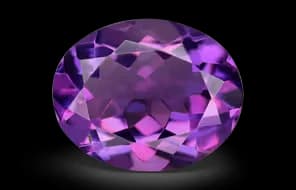
Brazilian Amethyst
Brazilian Amethyst is prized for its beautiful violet color, crystalline clarity and distinctive quartz character, making it a versatile choice for jewelry and collectors.
Brazilian Amethyst is the purple variety of quartz, a widely distributed mineral prized for its attractive color and excellent everyday durability. Brazil is one of the world's historically important sources of amethyst, and the discovery of large Brazilian deposits helped make amethyst much more accessible to the jewelry market. Amethyst is composed of silicon dioxide (SiO₂) and crystallizes in the trigonal crystal system. It has a Mohs hardness of 7, a vitreous luster, a specific gravity of about 2.66 and a refractive index of approximately 1.544–1.553. Its cleavage is absent, although quartz can fracture conchoidally. Brazilian Amethyst ranges from delicate lilac and lavender to saturated violet and purple. Color distribution can be uneven or zoned within individual crystals, and attractive stones may show subtle differences in tone depending on viewing direction. The purple color is associated with color centers involving iron and natural irradiation within the quartz structure. Brazil is particularly famous for large amethyst geodes and crystal-lined cavities, as well as gem-quality material suitable for faceting. Important Brazilian producing regions include Rio Grande do Sul, Minas Gerais and Bahia, although material from different localities can vary considerably in appearance and quality. Amethyst has a long history in jewelry and decorative arts and is the modern birthstone for February. Today, Brazilian Amethyst is fashioned into rings, earrings, pendants, necklaces, bracelets and other jewelry, while larger specimens are collected as mineral and decorative pieces. Buyers value natural Brazilian Amethyst for its appealing purple color, good hardness, broad availability, and the wide variety of cuts and sizes available. Like other quartz, it offers a strong balance between beauty, wearability and accessibility.
- Mineral Family
- Quartz
- Chemical Formula
- SiO₂
- Mohs Hardness
- 7
- Refractive Index
- 1.544 - 1.553
- Specific Gravity
- 2.66
- Cleavage
- None
- Crystal System
- Trigonal
- Luster
- Vitreous
- Color Range
- Purple
When buying Brazilian Amethyst online, evaluate the stone as a combination of color, clarity, cut, carat weight, origin, treatment and overall craftsmanship rather than relying on a grade label alone. Color is one of the most important factors. Look for attractive, well-balanced purple or violet color with good saturation. Very dark material is not automatically more valuable if the color becomes overly closed or reduces the stone's brilliance. Clarity is also important in faceted Brazilian Amethyst. Eye-clean material is desirable for jewelry, while inclusions may be acceptable in larger or collector-oriented stones when they contribute to the character of the specimen. Cut should maximize brightness, color presentation and proportions. Well-executed faceting can make a modestly saturated stone appear lively and attractive. Carat weight matters, but amethyst is relatively abundant, so size alone does not determine value. Origin can add interest and provenance, particularly when a seller can document a Brazilian locality, but Brazilian origin should not automatically be treated as a guarantee of superior quality. Treatments should always be disclosed. Amethyst can be heat treated to alter its color, and heating may produce yellow, orange, brown, colorless or, under some conditions, green material. If you specifically want natural untreated Brazilian Amethyst, request clear treatment information from the seller. Natural and laboratory-grown amethyst should not be confused with imitations. Laboratory-grown quartz can have essentially the same chemical and physical properties as natural quartz, so professional identification may require gemological testing. A reputable seller should clearly state whether the stone is natural, synthetic or an imitation and disclose known treatments. Certification is particularly useful for higher-value stones, unusual specimens or purchases where origin and treatment are important. For authenticity, consider independent laboratory identification rather than relying solely on seller terminology or commercial grades such as AAA, which are not standardized across the trade. Price depends on color quality, clarity, cut, size, treatment, provenance, craftsmanship and market demand. To buy Brazilian Amethyst online with confidence, request detailed photographs, dimensions, carat weight, treatment disclosure and any available laboratory report before purchasing.
Brazilian Amethyst is reasonably durable for everyday jewelry because quartz has a Mohs hardness of 7, but it can still scratch, chip or fracture if handled roughly. Clean the stone with lukewarm water, mild soap and a soft cloth or soft brush. Rinse thoroughly and dry with a clean, lint-free cloth. Avoid sudden temperature changes and prolonged exposure to intense heat, as heat can alter amethyst's color. Prolonged exposure to strong sunlight or ultraviolet radiation can also gradually fade some amethyst, so store valuable pieces away from direct sunlight when not being worn. Avoid harsh chemicals, abrasive cleaners and unnecessary exposure to household cleaning products. For storage, keep Brazilian Amethyst separately from harder gemstones and pieces that could scratch it, ideally in a soft pouch or lined jewelry compartment. Although quartz has no cleavage, strong impacts can still cause fractures or chips, especially around facet edges and pointed corners. Ultrasonic or steam cleaning is best avoided when the stone has significant fractures, inclusions or unknown treatment. For rings and bracelets worn frequently, remove the jewelry during strenuous activities, sports, heavy work and situations where the stone may receive hard knocks.
Brazilian Amethyst is the purple variety of quartz, a widely distributed mineral prized for its attractive color and excellent everyday durability. Brazil is one of the world's historically important sources of amethyst, and the discovery of large Brazilian deposits helped make amethyst much more accessible to the jewelry market. Amethyst is composed of silicon dioxide (SiO₂) and crystallizes in the trigonal crystal system. It has a Mohs hardness of 7, a vitreous luster, a specific gravity of about 2.66 and a refractive index of approximately 1.544–1.553. Its cleavage is absent, although quartz can fracture conchoidally. Brazilian Amethyst ranges from delicate lilac and lavender to saturated violet and purple. Color distribution can be uneven or zoned within individual crystals, and attractive stones may show subtle differences in tone depending on viewing direction. The purple color is associated with color centers involving iron and natural irradiation within the quartz structure. Brazil is particularly famous for large amethyst geodes and crystal-lined cavities, as well as gem-quality material suitable for faceting. Important Brazilian producing regions include Rio Grande do Sul, Minas Gerais and Bahia, although material from different localities can vary considerably in appearance and quality. Amethyst has a long history in jewelry and decorative arts and is the modern birthstone for February. Today, Brazilian Amethyst is fashioned into rings, earrings, pendants, necklaces, bracelets and other jewelry, while larger specimens are collected as mineral and decorative pieces. Buyers value natural Brazilian Amethyst for its appealing purple color, good hardness, broad availability, and the wide variety of cuts and sizes available. Like other quartz, it offers a strong balance between beauty, wearability and accessibility.
- Mineral Family
- Quartz
- Chemical Formula
- SiO₂
- Mohs Hardness
- 7
- Refractive Index
- 1.544 - 1.553
- Specific Gravity
- 2.66
- Cleavage
- None
- Crystal System
- Trigonal
- Luster
- Vitreous
- Color Range
- Purple
When buying Brazilian Amethyst online, evaluate the stone as a combination of color, clarity, cut, carat weight, origin, treatment and overall craftsmanship rather than relying on a grade label alone. Color is one of the most important factors. Look for attractive, well-balanced purple or violet color with good saturation. Very dark material is not automatically more valuable if the color becomes overly closed or reduces the stone's brilliance. Clarity is also important in faceted Brazilian Amethyst. Eye-clean material is desirable for jewelry, while inclusions may be acceptable in larger or collector-oriented stones when they contribute to the character of the specimen. Cut should maximize brightness, color presentation and proportions. Well-executed faceting can make a modestly saturated stone appear lively and attractive. Carat weight matters, but amethyst is relatively abundant, so size alone does not determine value. Origin can add interest and provenance, particularly when a seller can document a Brazilian locality, but Brazilian origin should not automatically be treated as a guarantee of superior quality. Treatments should always be disclosed. Amethyst can be heat treated to alter its color, and heating may produce yellow, orange, brown, colorless or, under some conditions, green material. If you specifically want natural untreated Brazilian Amethyst, request clear treatment information from the seller. Natural and laboratory-grown amethyst should not be confused with imitations. Laboratory-grown quartz can have essentially the same chemical and physical properties as natural quartz, so professional identification may require gemological testing. A reputable seller should clearly state whether the stone is natural, synthetic or an imitation and disclose known treatments. Certification is particularly useful for higher-value stones, unusual specimens or purchases where origin and treatment are important. For authenticity, consider independent laboratory identification rather than relying solely on seller terminology or commercial grades such as AAA, which are not standardized across the trade. Price depends on color quality, clarity, cut, size, treatment, provenance, craftsmanship and market demand. To buy Brazilian Amethyst online with confidence, request detailed photographs, dimensions, carat weight, treatment disclosure and any available laboratory report before purchasing.
Brazilian Amethyst is reasonably durable for everyday jewelry because quartz has a Mohs hardness of 7, but it can still scratch, chip or fracture if handled roughly. Clean the stone with lukewarm water, mild soap and a soft cloth or soft brush. Rinse thoroughly and dry with a clean, lint-free cloth. Avoid sudden temperature changes and prolonged exposure to intense heat, as heat can alter amethyst's color. Prolonged exposure to strong sunlight or ultraviolet radiation can also gradually fade some amethyst, so store valuable pieces away from direct sunlight when not being worn. Avoid harsh chemicals, abrasive cleaners and unnecessary exposure to household cleaning products. For storage, keep Brazilian Amethyst separately from harder gemstones and pieces that could scratch it, ideally in a soft pouch or lined jewelry compartment. Although quartz has no cleavage, strong impacts can still cause fractures or chips, especially around facet edges and pointed corners. Ultrasonic or steam cleaning is best avoided when the stone has significant fractures, inclusions or unknown treatment. For rings and bracelets worn frequently, remove the jewelry during strenuous activities, sports, heavy work and situations where the stone may receive hard knocks.
Brazilian Amethyst for Sale
No gems found
Try broadening your search or adjusting your filters.
Have a gem of your own? List it free - no fees