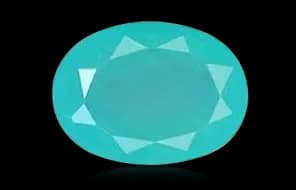
Blue Onyx
Blue Onyx is a distinctive chalcedony material prized for its cool blue tones, banded appearance and polished finish, making it an appealing choice for jewelry and collectors.
Blue Onyx is a trade name used for blue-colored onyx or chalcedony materials rather than a separate mineral species. Onyx belongs to the chalcedony group of microcrystalline silica, with the ideal chemical formula SiO₂. In gemological usage, true onyx is characterized by relatively straight, parallel bands. Blue material may occur naturally as blue chalcedony, while some commercial Blue Onyx is colored or enhanced through treatment, so the exact identity and treatment history should be confirmed when purchasing.
Chalcedony forms when silica-rich fluids deposit microscopic silica in cavities, fractures and other spaces in rocks. Over time, successive layers can create the parallel or layered patterns associated with onyx. Naturally blue chalcedony can owe its color to microscopic inclusions or optical effects such as light scattering, while strongly saturated blue commercial material may be dyed. This distinction is important when comparing natural Blue Onyx with treated material.
Blue Onyx generally has a Mohs hardness of 6.5–7, specific gravity around 2.55–2.70 and a refractive index commonly reported around 1.530–1.543. Its crystal structure is associated with trigonal quartz, although chalcedony is a microcrystalline aggregate rather than a single large quartz crystal. Cleavage is absent, and fracture is typically conchoidal to sub-conchoidal. The surface can appear waxy or dull before polishing and vitreous after a high-quality polish.
Blue shades range from soft blue and blue-gray to deeper denim, slate and navy-like tones. Gray and white banding may add contrast and visual depth. Natural blue chalcedony is documented from localities including Namibia, Malawi, Turkey and the United States, while onyx and chalcedony materials are commercially sourced from several regions worldwide. The name Blue Onyx can also be applied inconsistently in the marketplace, making laboratory identification especially useful for unusual or expensive specimens.
Historically, onyx has been valued as a carving and ornamental material for centuries, appearing in cameos, seals, vessels, decorative objects and jewelry. Today, Blue Onyx and blue chalcedony are fashioned into cabochons, beads, pendants, rings, earrings, bracelets and carved pieces. Its moderate hardness and lack of cleavage make it practical for many jewelry applications, although it remains more vulnerable to scratching than sapphire, ruby or diamond.
Buyers value Blue Onyx primarily for its color, pattern, polish and affordability. Its layered appearance gives each piece a distinctive visual character, while its durability is suitable for carefully worn jewelry. Because the name can describe both naturally colored and treated material, transparency about treatment and identification is an important part of a trustworthy purchase.
- Mineral Family
- Quartz
- Chemical Formula
- SiO₂
- Mohs Hardness
- 6.5 - 7
- Refractive Index
- 1.530 - 1.543
- Specific Gravity
- 2.55 - 2.70
- Cleavage
- None
- Crystal System
- Trigonal
- Luster
- Waxy
- Color Range
- Blue, Gray, White
When buying Blue Onyx gemstone, start with color and pattern. Attractive material typically has pleasing blue or blue-gray tones, balanced banding and an even, well-polished surface. Very intense or unusually uniform blue should prompt a question about dyeing or other treatment rather than automatically being treated as evidence of superior quality.
Clarity is less important than pattern and surface quality because onyx is commonly opaque or only slightly translucent. Look for clean, well-defined banding, a smooth polish and minimal pits, cracks or damaged edges. For cabochons and carvings, symmetry, proportions and workmanship can have a major effect on appearance.
Carat weight is useful for jewelry pricing, but Blue Onyx does not generally command the dramatic per-carat premiums associated with rare transparent gemstones. Larger pieces can be attractive for statement jewelry or carving, while smaller calibrated stones are useful for everyday designs. Cut should be selected according to the material: cabochons, beads, slabs and carvings are common, while conventional faceting is uncommon for opaque onyx.
Origin can add interest and collector value, but it should not be treated as a guarantee of quality. Ask the seller whether the material is naturally colored, dyed, impregnated or otherwise treated. Natural blue chalcedony exists, but much commercial blue material sold under broad trade names may have been enhanced. A treatment disclosure is therefore more important than an unsupported claim of origin.
Natural and laboratory-grown are not equivalent categories for Blue Onyx in the same way they are for many transparent gemstones. Commercial Blue Onyx is primarily natural silica material, sometimes treated to alter its appearance. Synthetic or imitation materials may also occur in the marketplace. For valuable purchases, an independent gemological laboratory report can help establish material identity and detect significant treatments.
When buying Blue Onyx online, request clear photographs in neutral lighting, treatment disclosure, dimensions, weight and return terms. For higher-value pieces, choose a reputable seller and obtain an independent report when appropriate. Price is influenced by color, pattern, size, polish, workmanship, treatment status, provenance and the quality of the finished jewelry. A higher price alone does not prove that a piece is natural or untreated.
Blue Onyx is reasonably durable at 6.5–7 on the Mohs scale, but it can still scratch when stored with harder gemstones or metal jewelry. Clean it with lukewarm water, a small amount of mild soap and a soft cloth or soft brush. Rinse thoroughly and dry with a clean cloth.
Avoid harsh chemicals, abrasive cleaners, prolonged exposure to strong heat and sudden temperature changes. If the stone is dyed or otherwise treated, aggressive cleaning can potentially affect its appearance. Ultrasonic or steam cleaning is best avoided unless a qualified professional has confirmed that the specific material and treatment are suitable.
For everyday wear, Blue Onyx works well in protected settings and jewelry that is not exposed to repeated impact. Rings and bracelets receive more knocks and scratches than pendants or earrings, so remove the jewelry before heavy manual work, sports or activities involving chemicals.
Store Blue Onyx separately in a soft pouch or lined compartment to reduce scratching and contact with harder stones. If you are unsure whether your Blue Onyx has been treated, use gentle soap-and-water cleaning and consult a professional before attempting any stronger cleaning method.
Blue Onyx is a trade name used for blue-colored onyx or chalcedony materials rather than a separate mineral species. Onyx belongs to the chalcedony group of microcrystalline silica, with the ideal chemical formula SiO₂. In gemological usage, true onyx is characterized by relatively straight, parallel bands. Blue material may occur naturally as blue chalcedony, while some commercial Blue Onyx is colored or enhanced through treatment, so the exact identity and treatment history should be confirmed when purchasing.
Chalcedony forms when silica-rich fluids deposit microscopic silica in cavities, fractures and other spaces in rocks. Over time, successive layers can create the parallel or layered patterns associated with onyx. Naturally blue chalcedony can owe its color to microscopic inclusions or optical effects such as light scattering, while strongly saturated blue commercial material may be dyed. This distinction is important when comparing natural Blue Onyx with treated material.
Blue Onyx generally has a Mohs hardness of 6.5–7, specific gravity around 2.55–2.70 and a refractive index commonly reported around 1.530–1.543. Its crystal structure is associated with trigonal quartz, although chalcedony is a microcrystalline aggregate rather than a single large quartz crystal. Cleavage is absent, and fracture is typically conchoidal to sub-conchoidal. The surface can appear waxy or dull before polishing and vitreous after a high-quality polish.
Blue shades range from soft blue and blue-gray to deeper denim, slate and navy-like tones. Gray and white banding may add contrast and visual depth. Natural blue chalcedony is documented from localities including Namibia, Malawi, Turkey and the United States, while onyx and chalcedony materials are commercially sourced from several regions worldwide. The name Blue Onyx can also be applied inconsistently in the marketplace, making laboratory identification especially useful for unusual or expensive specimens.
Historically, onyx has been valued as a carving and ornamental material for centuries, appearing in cameos, seals, vessels, decorative objects and jewelry. Today, Blue Onyx and blue chalcedony are fashioned into cabochons, beads, pendants, rings, earrings, bracelets and carved pieces. Its moderate hardness and lack of cleavage make it practical for many jewelry applications, although it remains more vulnerable to scratching than sapphire, ruby or diamond.
Buyers value Blue Onyx primarily for its color, pattern, polish and affordability. Its layered appearance gives each piece a distinctive visual character, while its durability is suitable for carefully worn jewelry. Because the name can describe both naturally colored and treated material, transparency about treatment and identification is an important part of a trustworthy purchase.
- Mineral Family
- Quartz
- Chemical Formula
- SiO₂
- Mohs Hardness
- 6.5 - 7
- Refractive Index
- 1.530 - 1.543
- Specific Gravity
- 2.55 - 2.70
- Cleavage
- None
- Crystal System
- Trigonal
- Luster
- Waxy
- Color Range
- Blue, Gray, White
When buying Blue Onyx gemstone, start with color and pattern. Attractive material typically has pleasing blue or blue-gray tones, balanced banding and an even, well-polished surface. Very intense or unusually uniform blue should prompt a question about dyeing or other treatment rather than automatically being treated as evidence of superior quality.
Clarity is less important than pattern and surface quality because onyx is commonly opaque or only slightly translucent. Look for clean, well-defined banding, a smooth polish and minimal pits, cracks or damaged edges. For cabochons and carvings, symmetry, proportions and workmanship can have a major effect on appearance.
Carat weight is useful for jewelry pricing, but Blue Onyx does not generally command the dramatic per-carat premiums associated with rare transparent gemstones. Larger pieces can be attractive for statement jewelry or carving, while smaller calibrated stones are useful for everyday designs. Cut should be selected according to the material: cabochons, beads, slabs and carvings are common, while conventional faceting is uncommon for opaque onyx.
Origin can add interest and collector value, but it should not be treated as a guarantee of quality. Ask the seller whether the material is naturally colored, dyed, impregnated or otherwise treated. Natural blue chalcedony exists, but much commercial blue material sold under broad trade names may have been enhanced. A treatment disclosure is therefore more important than an unsupported claim of origin.
Natural and laboratory-grown are not equivalent categories for Blue Onyx in the same way they are for many transparent gemstones. Commercial Blue Onyx is primarily natural silica material, sometimes treated to alter its appearance. Synthetic or imitation materials may also occur in the marketplace. For valuable purchases, an independent gemological laboratory report can help establish material identity and detect significant treatments.
When buying Blue Onyx online, request clear photographs in neutral lighting, treatment disclosure, dimensions, weight and return terms. For higher-value pieces, choose a reputable seller and obtain an independent report when appropriate. Price is influenced by color, pattern, size, polish, workmanship, treatment status, provenance and the quality of the finished jewelry. A higher price alone does not prove that a piece is natural or untreated.
Blue Onyx is reasonably durable at 6.5–7 on the Mohs scale, but it can still scratch when stored with harder gemstones or metal jewelry. Clean it with lukewarm water, a small amount of mild soap and a soft cloth or soft brush. Rinse thoroughly and dry with a clean cloth.
Avoid harsh chemicals, abrasive cleaners, prolonged exposure to strong heat and sudden temperature changes. If the stone is dyed or otherwise treated, aggressive cleaning can potentially affect its appearance. Ultrasonic or steam cleaning is best avoided unless a qualified professional has confirmed that the specific material and treatment are suitable.
For everyday wear, Blue Onyx works well in protected settings and jewelry that is not exposed to repeated impact. Rings and bracelets receive more knocks and scratches than pendants or earrings, so remove the jewelry before heavy manual work, sports or activities involving chemicals.
Store Blue Onyx separately in a soft pouch or lined compartment to reduce scratching and contact with harder stones. If you are unsure whether your Blue Onyx has been treated, use gentle soap-and-water cleaning and consult a professional before attempting any stronger cleaning method.
Blue Onyx for Sale
No gems found
Try broadening your search or adjusting your filters.
Have a gem of your own? List it free - no fees