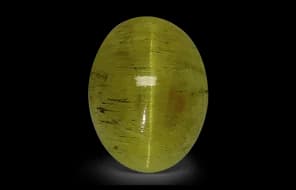
Apatite Cat's Eye
Apatite Cat's Eye is a distinctive variety of apatite prized for its moving cat's-eye band, vivid colors, and collector appeal. Its unusual optical effect makes it a fascinating choice for jewelry.
Apatite Cat's Eye is a chatoyant variety of apatite, a phosphate mineral group best known in gemology for its attractive colors and relatively soft hardness. Apatite commonly occurs as fluorapatite, with a chemical composition represented by Ca5(PO4)3(F,Cl,OH), and crystallizes in the hexagonal system. Gem-quality material may occur in yellow, green, blue, and related shades. The cat's-eye effect, or chatoyancy, appears as a narrow band of reflected light that moves across the surface when the stone is rotated under suitable lighting. In apatite, chatoyancy can be associated with aligned internal features such as fine inclusions or growth channels. Proper orientation and a domed cabochon cut are essential for displaying the effect clearly. Apatite forms in a variety of geological environments, including igneous and metamorphic settings, and gem-quality material is known from several localities around the world. Brazil is particularly notable for attractive blue apatite, including documented blue cat's-eye material, while other apatite occurrences have produced green and yellow chatoyant stones. Unlike chrysoberyl, apatite is relatively soft at about 5 on the Mohs scale, so Apatite Cat's Eye is better suited to occasional-wear jewelry and collector pieces than rings exposed to frequent abrasion. Its vitreous luster, distinctive optical effect, and unusual combination of color and chatoyancy give it strong appeal among gemstone enthusiasts. Buyers value natural Apatite Cat's Eye for its individuality, visible chatoyant effect, attractive body color, and the rarity of well-oriented material that produces a sharp, centered eye.
- Mineral Family
- Apatite
- Chemical Formula
- Ca5(PO4)3(F,Cl,OH)
- Mohs Hardness
- 5
- Refractive Index
- 1.628 - 1.649
- Specific Gravity
- 3.16 - 3.22
- Cleavage
- Poor to indistinct
- Crystal System
- Hexagonal
- Luster
- Vitreous
- Color Range
- Green, Yellow, Blue
When buying Apatite Cat's Eye online, evaluate the stone as a combination of body color, chatoyancy, clarity, cut, size, origin, and condition.
Color: Saturated yellow, green, and blue hues can be attractive, but preference is largely subjective. Color should be evaluated together with the strength and visibility of the cat's-eye effect.
Clarity: Apatite Cat's Eye is expected to contain internal features associated with chatoyancy, so complete transparency is not necessary. However, fractures, cavities, surface-reaching inclusions, or heavily distracting features can reduce durability and visual appeal.
Chatoyancy: A strong, narrow, continuous, and well-centered band is highly desirable. Examine videos or photographs under a focused light source when buying online, because the eye can appear much weaker under diffuse lighting.
Cut: Apatite Cat's Eye is normally fashioned as a cabochon. Correct orientation of the rough and an appropriate dome are important for producing a centered, mobile eye.
Carat: Larger clean-looking stones with attractive color and strong chatoyancy can become increasingly uncommon, but carat weight alone does not determine value.
Origin: Geographic origin can add interest and provenance, but quality characteristics should remain the primary consideration unless a documented origin carries recognized collector significance. Treatments: Ask whether the stone has been treated or enhanced and require disclosure of any treatment that may affect value, durability, or care.
Natural vs lab-grown: Confirm whether the gemstone is natural apatite. Synthetic or laboratory-produced apatite materials exist, so reliable identification is important when natural origin is part of the purchase.
Certification: For valuable stones, an independent gemological report can help confirm identity, natural status, detectable treatments, and relevant gemological characteristics.
Authenticity: Buy from a reputable seller and request clear photographs, videos, weight and dimensions, treatment disclosure, and laboratory documentation when appropriate.
Price: Value depends primarily on color quality, strength and sharpness of chatoyancy, clarity and surface condition, cut quality, size, rarity, origin, treatment status, and overall visual appeal.
A natural Apatite Cat's Eye with a vivid body color and strong, centered eye can command a premium over dull or poorly oriented material.
Apatite Cat's Eye requires more careful handling than many popular jewelry gemstones because its Mohs hardness is around 5. For cleaning, use lukewarm water, a small amount of mild soap, and a soft cloth or brush. Rinse thoroughly and dry with a soft cloth. Avoid ultrasonic and steam cleaners unless a qualified gemologist confirms that the specific stone and any treatments are safe. Store the gemstone separately from harder materials such as quartz, topaz, beryl, sapphire, and diamond to prevent scratches. A fabric-lined compartment or individual soft pouch is ideal. Because apatite can scratch relatively easily, avoid wearing Apatite Cat's Eye rings during sports, household work, gardening, or other activities involving impact or abrasion. Remove jewelry before using harsh chemicals, cleaning products, or exposing it to unnecessary heat. When traveling or storing the stone for long periods, protect the cabochon from knocks and contact with harder gemstones. With sensible care, Apatite Cat's Eye can remain attractive while being best reserved for occasional or protected jewelry wear.
Apatite Cat's Eye is a chatoyant variety of apatite, a phosphate mineral group best known in gemology for its attractive colors and relatively soft hardness. Apatite commonly occurs as fluorapatite, with a chemical composition represented by Ca5(PO4)3(F,Cl,OH), and crystallizes in the hexagonal system. Gem-quality material may occur in yellow, green, blue, and related shades. The cat's-eye effect, or chatoyancy, appears as a narrow band of reflected light that moves across the surface when the stone is rotated under suitable lighting. In apatite, chatoyancy can be associated with aligned internal features such as fine inclusions or growth channels. Proper orientation and a domed cabochon cut are essential for displaying the effect clearly. Apatite forms in a variety of geological environments, including igneous and metamorphic settings, and gem-quality material is known from several localities around the world. Brazil is particularly notable for attractive blue apatite, including documented blue cat's-eye material, while other apatite occurrences have produced green and yellow chatoyant stones. Unlike chrysoberyl, apatite is relatively soft at about 5 on the Mohs scale, so Apatite Cat's Eye is better suited to occasional-wear jewelry and collector pieces than rings exposed to frequent abrasion. Its vitreous luster, distinctive optical effect, and unusual combination of color and chatoyancy give it strong appeal among gemstone enthusiasts. Buyers value natural Apatite Cat's Eye for its individuality, visible chatoyant effect, attractive body color, and the rarity of well-oriented material that produces a sharp, centered eye.
- Mineral Family
- Apatite
- Chemical Formula
- Ca5(PO4)3(F,Cl,OH)
- Mohs Hardness
- 5
- Refractive Index
- 1.628 - 1.649
- Specific Gravity
- 3.16 - 3.22
- Cleavage
- Poor to indistinct
- Crystal System
- Hexagonal
- Luster
- Vitreous
- Color Range
- Green, Yellow, Blue
When buying Apatite Cat's Eye online, evaluate the stone as a combination of body color, chatoyancy, clarity, cut, size, origin, and condition.
Color: Saturated yellow, green, and blue hues can be attractive, but preference is largely subjective. Color should be evaluated together with the strength and visibility of the cat's-eye effect.
Clarity: Apatite Cat's Eye is expected to contain internal features associated with chatoyancy, so complete transparency is not necessary. However, fractures, cavities, surface-reaching inclusions, or heavily distracting features can reduce durability and visual appeal.
Chatoyancy: A strong, narrow, continuous, and well-centered band is highly desirable. Examine videos or photographs under a focused light source when buying online, because the eye can appear much weaker under diffuse lighting.
Cut: Apatite Cat's Eye is normally fashioned as a cabochon. Correct orientation of the rough and an appropriate dome are important for producing a centered, mobile eye.
Carat: Larger clean-looking stones with attractive color and strong chatoyancy can become increasingly uncommon, but carat weight alone does not determine value.
Origin: Geographic origin can add interest and provenance, but quality characteristics should remain the primary consideration unless a documented origin carries recognized collector significance. Treatments: Ask whether the stone has been treated or enhanced and require disclosure of any treatment that may affect value, durability, or care.
Natural vs lab-grown: Confirm whether the gemstone is natural apatite. Synthetic or laboratory-produced apatite materials exist, so reliable identification is important when natural origin is part of the purchase.
Certification: For valuable stones, an independent gemological report can help confirm identity, natural status, detectable treatments, and relevant gemological characteristics.
Authenticity: Buy from a reputable seller and request clear photographs, videos, weight and dimensions, treatment disclosure, and laboratory documentation when appropriate.
Price: Value depends primarily on color quality, strength and sharpness of chatoyancy, clarity and surface condition, cut quality, size, rarity, origin, treatment status, and overall visual appeal.
A natural Apatite Cat's Eye with a vivid body color and strong, centered eye can command a premium over dull or poorly oriented material.
Apatite Cat's Eye requires more careful handling than many popular jewelry gemstones because its Mohs hardness is around 5. For cleaning, use lukewarm water, a small amount of mild soap, and a soft cloth or brush. Rinse thoroughly and dry with a soft cloth. Avoid ultrasonic and steam cleaners unless a qualified gemologist confirms that the specific stone and any treatments are safe. Store the gemstone separately from harder materials such as quartz, topaz, beryl, sapphire, and diamond to prevent scratches. A fabric-lined compartment or individual soft pouch is ideal. Because apatite can scratch relatively easily, avoid wearing Apatite Cat's Eye rings during sports, household work, gardening, or other activities involving impact or abrasion. Remove jewelry before using harsh chemicals, cleaning products, or exposing it to unnecessary heat. When traveling or storing the stone for long periods, protect the cabochon from knocks and contact with harder gemstones. With sensible care, Apatite Cat's Eye can remain attractive while being best reserved for occasional or protected jewelry wear.
Apatite Cat's Eye for Sale
No gems found
Try broadening your search or adjusting your filters.
Have a gem of your own? List it free - no fees