Tsavorite
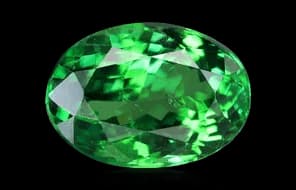
Tsavorite is a rare, vivid green variety of grossular garnet, prized for its lively color, good durability, natural beauty, and exceptional appeal in fine jewelry.
Tsavorite gemstone is the green gem variety of grossular garnet, a member of the garnet mineral group. Its chemical composition is calcium aluminum silicate, Ca3Al2(SiO4)3. Tsavorite has a cubic crystal system, vitreous luster, a Mohs hardness of about 7 to 7.5, and a refractive index typically around 1.737 to 1.770. Its specific gravity generally falls around 3.61 to 3.68. Like other garnets, it has no prominent cleavage, although individual specimens can contain fractures or inclusions.
The finest Tsavorite is valued for saturated green color, ranging from fresh yellowish green to intense pure green and deeper bluish green. Strong color combined with good transparency and lively brilliance is particularly desirable. Unlike emerald, Tsavorite is not a beryllium-containing beryl; it is a grossular garnet, giving the two gems different mineral identities and gemological properties.
Tsavorite forms primarily in metamorphic geological environments under unusual chemical conditions. Important deposits occur in Kenya and Tanzania, with additional material known from Madagascar and other locations. Geological research has linked East African Tsavorite formation with metamorphosed rocks including quartzite, gneiss, schist, calc-silicate rocks, and marble.
The gemstone became internationally recognized in the late 20th century after its discovery in East Africa and subsequent promotion by the jewelry industry. The name Tsavorite refers to the Tsavo region of Kenya. Today, natural Tsavorite is used in rings, earrings, pendants, bracelets and other fine jewelry. Its combination of saturated green color, rarity, and relatively strong durability makes it especially attractive to collectors and buyers seeking an alternative to emerald.
Buyers value Tsavorite because naturally vivid material is uncommon, large fine stones are difficult to source, and the gem is generally sold without routine color or clarity enhancement. Its natural inclusions can provide useful evidence of identity and origin, while exceptional transparency and strong green color can significantly increase desirability. For jewelry intended for regular wear, Tsavorite offers good durability, although it should still be protected from hard impacts.
- Mineral Family
- Garnet
- Chemical Formula
- Ca3Al2(SiO4)3
- Mohs Hardness
- 7 - 7.5
- Refractive Index
- 1.737 - 1.770
- Specific Gravity
- 3.61 - 3.68
- Cleavage
- Indistinct
- Crystal System
- Cubic
- Luster
- Vitreous
- Color Range
- Green
When buying natural Tsavorite online, begin with color. Strong, vivid green with good saturation is generally the most desirable, while overly dark, grayish, or weakly colored material can be less appealing. Color should be evaluated under neutral lighting rather than relying only on photographs.
Clarity is important, but Tsavorite commonly contains natural inclusions. A stone does not need to be perfectly loupe-clean to be valuable. The best balance is strong color and transparency with inclusions that do not significantly affect beauty or durability. Cut should maximize brightness, color distribution and light return. Oval, cushion, round, pear and other well-proportioned cuts can work beautifully, but the quality of execution matters more than the shape itself.
Carat weight has a major influence on value because fine Tsavorite becomes considerably rarer as size increases. Two stones of identical weight can have very different values because color, clarity, cut, origin and overall appearance are not equal. Avoid judging price by carat weight alone.
Origin can add interest and provenance, but it should not replace gemological quality when evaluating a stone. Kenya and Tanzania are historically important sources, while Madagascar has also produced gem-quality Tsavorite. A reputable seller should clearly state whether an origin claim is documented or simply an indication.
Natural Tsavorite is generally untreated. Garnets can rarely be fracture-filled, so any disclosed treatment should be documented and reflected in the care instructions. A laboratory report from a respected independent gemological laboratory can help confirm that a stone is Tsavorite garnet and can provide useful information about treatments or, where determinable, geographic origin.
Be cautious with listings described only as 'green garnet' or 'Tsavorite-like.' Synthetic or imitation materials can look attractive but are not equivalent to natural Tsavorite. For higher-value purchases, request an independent laboratory report, clear photographs, treatment disclosure, carat weight, measurements and return terms. Price should reflect the complete quality profile rather than a marketing grade such as AAA, since there is no universal standardized AAA grading system for garnet.
Tsavorite jewelry is relatively durable, but it is still best treated as a fine gemstone rather than an indestructible stone. Clean it with warm water, mild soap and a soft brush, then rinse and dry it carefully. This is the safest routine cleaning method for garnet.
Ultrasonic cleaning can be acceptable for some garnets, but it should be avoided if the stone has significant fractures or has been fracture-filled. Steam cleaning is not recommended. If a treatment has been disclosed, follow the seller or laboratory's specific care instructions.
For everyday wear, protect Tsavorite from sharp impacts, especially around exposed corners or vulnerable settings. Remove Tsavorite rings before heavy manual work, sports or activities where the gemstone could be struck. Store each piece separately in a soft pouch or lined compartment so it does not rub against harder gemstones such as diamond, ruby or sapphire.
Tsavorite gemstone is the green gem variety of grossular garnet, a member of the garnet mineral group. Its chemical composition is calcium aluminum silicate, Ca3Al2(SiO4)3. Tsavorite has a cubic crystal system, vitreous luster, a Mohs hardness of about 7 to 7.5, and a refractive index typically around 1.737 to 1.770. Its specific gravity generally falls around 3.61 to 3.68. Like other garnets, it has no prominent cleavage, although individual specimens can contain fractures or inclusions.
The finest Tsavorite is valued for saturated green color, ranging from fresh yellowish green to intense pure green and deeper bluish green. Strong color combined with good transparency and lively brilliance is particularly desirable. Unlike emerald, Tsavorite is not a beryllium-containing beryl; it is a grossular garnet, giving the two gems different mineral identities and gemological properties.
Tsavorite forms primarily in metamorphic geological environments under unusual chemical conditions. Important deposits occur in Kenya and Tanzania, with additional material known from Madagascar and other locations. Geological research has linked East African Tsavorite formation with metamorphosed rocks including quartzite, gneiss, schist, calc-silicate rocks, and marble.
The gemstone became internationally recognized in the late 20th century after its discovery in East Africa and subsequent promotion by the jewelry industry. The name Tsavorite refers to the Tsavo region of Kenya. Today, natural Tsavorite is used in rings, earrings, pendants, bracelets and other fine jewelry. Its combination of saturated green color, rarity, and relatively strong durability makes it especially attractive to collectors and buyers seeking an alternative to emerald.
Buyers value Tsavorite because naturally vivid material is uncommon, large fine stones are difficult to source, and the gem is generally sold without routine color or clarity enhancement. Its natural inclusions can provide useful evidence of identity and origin, while exceptional transparency and strong green color can significantly increase desirability. For jewelry intended for regular wear, Tsavorite offers good durability, although it should still be protected from hard impacts.
- Mineral Family
- Garnet
- Chemical Formula
- Ca3Al2(SiO4)3
- Mohs Hardness
- 7 - 7.5
- Refractive Index
- 1.737 - 1.770
- Specific Gravity
- 3.61 - 3.68
- Cleavage
- Indistinct
- Crystal System
- Cubic
- Luster
- Vitreous
- Color Range
- Green
When buying natural Tsavorite online, begin with color. Strong, vivid green with good saturation is generally the most desirable, while overly dark, grayish, or weakly colored material can be less appealing. Color should be evaluated under neutral lighting rather than relying only on photographs.
Clarity is important, but Tsavorite commonly contains natural inclusions. A stone does not need to be perfectly loupe-clean to be valuable. The best balance is strong color and transparency with inclusions that do not significantly affect beauty or durability. Cut should maximize brightness, color distribution and light return. Oval, cushion, round, pear and other well-proportioned cuts can work beautifully, but the quality of execution matters more than the shape itself.
Carat weight has a major influence on value because fine Tsavorite becomes considerably rarer as size increases. Two stones of identical weight can have very different values because color, clarity, cut, origin and overall appearance are not equal. Avoid judging price by carat weight alone.
Origin can add interest and provenance, but it should not replace gemological quality when evaluating a stone. Kenya and Tanzania are historically important sources, while Madagascar has also produced gem-quality Tsavorite. A reputable seller should clearly state whether an origin claim is documented or simply an indication.
Natural Tsavorite is generally untreated. Garnets can rarely be fracture-filled, so any disclosed treatment should be documented and reflected in the care instructions. A laboratory report from a respected independent gemological laboratory can help confirm that a stone is Tsavorite garnet and can provide useful information about treatments or, where determinable, geographic origin.
Be cautious with listings described only as 'green garnet' or 'Tsavorite-like.' Synthetic or imitation materials can look attractive but are not equivalent to natural Tsavorite. For higher-value purchases, request an independent laboratory report, clear photographs, treatment disclosure, carat weight, measurements and return terms. Price should reflect the complete quality profile rather than a marketing grade such as AAA, since there is no universal standardized AAA grading system for garnet.
Tsavorite jewelry is relatively durable, but it is still best treated as a fine gemstone rather than an indestructible stone. Clean it with warm water, mild soap and a soft brush, then rinse and dry it carefully. This is the safest routine cleaning method for garnet.
Ultrasonic cleaning can be acceptable for some garnets, but it should be avoided if the stone has significant fractures or has been fracture-filled. Steam cleaning is not recommended. If a treatment has been disclosed, follow the seller or laboratory's specific care instructions.
For everyday wear, protect Tsavorite from sharp impacts, especially around exposed corners or vulnerable settings. Remove Tsavorite rings before heavy manual work, sports or activities where the gemstone could be struck. Store each piece separately in a soft pouch or lined compartment so it does not rub against harder gemstones such as diamond, ruby or sapphire.
Tsavorite for Sale
No gems found
Try broadening your search or adjusting your filters.
Have a gem of your own? List it free - no fees