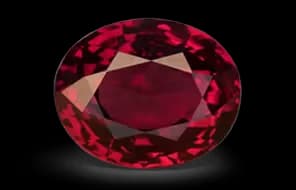
Almandine Garnet
Almandine Garnet is prized for its rich red to reddish-brown color, strong durability, and bright vitreous luster, making it a classic choice for gemstone jewelry.
Almandine Garnet is a species of the garnet mineral group and is one of the most important red garnets used in jewelry. Its chemical composition is iron aluminum silicate, Fe3Al2(SiO4)3, and its iron content is responsible for its characteristic deep red to reddish-brown appearance. Almandine belongs to the pyralspite garnet group and crystallizes in the cubic crystal system. It is isotropic, meaning it does not show birefringence under standard gemological observation. Almandine typically has a Mohs hardness of 7 to 7.5, a refractive index of about 1.785 to 1.830, and a relatively high specific gravity of approximately 4.0 to 4.2. Its luster is usually vitreous and can become resinous on some surfaces. Almandine commonly occurs in deep red, brownish-red, and red-violet hues; very dark material can approach a blackish appearance. The finest transparent material is especially attractive when a well-proportioned cut allows light to return through the stone rather than making it appear overly dark. Almandine forms naturally in a variety of geological environments, particularly metamorphic rocks, where it develops under elevated temperature and pressure. It can also occur in other mineral-bearing geological settings and is widely distributed in gem-producing regions. Garnet has an ancient history in jewelry, with red garnet beads documented in Egypt more than 5,000 years ago. Almandine and almandine-rich garnets have subsequently been found in numerous parts of the world, including Sri Lanka, India, Brazil, Madagascar, Australia, and the United States. Today, Almandine Garnet is used for rings, earrings, pendants, bracelets, and other jewelry, as well as for collectors who appreciate classic red garnet varieties. Buyers value it for its saturated color, good hardness, high brilliance when properly cut, availability in a broad range of sizes, and long-established place in gemstone history.
- Mineral Family
- Garnet
- Chemical Formula
- Fe3Al2(SiO4)3
- Mohs Hardness
- 7 - 7.5
- Refractive Index
- 1.785 - 1.830
- Specific Gravity
- 4.0 - 4.2
- Cleavage
- None
- Crystal System
- Cubic
- Luster
- Vitreous
- Color Range
- Red
When buying Almandine Garnet, start with color. Attractive stones generally show a rich, balanced red or reddish-red body color without becoming so dark that brilliance is lost. Clarity is also important: transparent material with fewer distracting inclusions is generally more desirable, although natural inclusions can help confirm the stone's identity and origin. Cut has a major effect on appearance because strongly saturated Almandine can look overly dark if the proportions or facet arrangement do not return enough light. A well-executed cut should balance face-up color with brightness and scintillation. Carat weight affects price, but value does not increase simply because a stone is larger; color, transparency, cut quality, and overall beauty remain important. Origin can add interest and collector value when it is documented, but locality alone does not guarantee superior quality. Almandine Garnet is generally not known for routine enhancement treatments, so buyers should ask whether any treatment has been applied and whether the treatment is stable. Natural Almandine should be distinguished from other garnet species and from laboratory-grown or synthetic garnet materials. A reputable laboratory report can confirm species, treatment information, and whether the stone is natural when this distinction is important. For expensive or unusual stones, independent certification is a useful safeguard. Authenticity should be evaluated through a combination of professional testing, accurate species identification, seller reputation, and transparent disclosure. Price depends on color quality, clarity, transparency, cut, carat weight, origin, rarity of the material, treatment status, and the quality of the finished jewelry. Before you buy Almandine Garnet online, request clear photographs or videos in neutral lighting, full disclosure of treatments, exact measurements and carat weight, and a gemological report when appropriate.
Almandine Garnet is durable enough for regular jewelry use, but sensible care will help preserve its polish and brilliance. Clean it with warm water, mild soap, and a soft brush, then rinse thoroughly and dry with a soft cloth. Store Almandine jewelry separately from harder gemstones to reduce the risk of scratches, preferably in a fabric-lined compartment or individual pouch. Although its hardness is good, garnet can still chip if it receives a sharp impact, particularly around thin facet junctions or exposed edges. Remove rings and other Almandine jewelry before activities involving heavy impact, abrasive materials, or harsh chemicals. Avoid prolonged exposure to strong chemicals and do not use aggressive cleaning methods unless a qualified jeweler has confirmed that they are appropriate for the specific stone and setting. Ultrasonic or steam cleaning should be approached cautiously, especially when the gemstone contains significant fractures or when the jewelry setting is delicate. For everyday wear, periodic professional inspection of the stone and mounting is recommended.
Almandine Garnet is a species of the garnet mineral group and is one of the most important red garnets used in jewelry. Its chemical composition is iron aluminum silicate, Fe3Al2(SiO4)3, and its iron content is responsible for its characteristic deep red to reddish-brown appearance. Almandine belongs to the pyralspite garnet group and crystallizes in the cubic crystal system. It is isotropic, meaning it does not show birefringence under standard gemological observation. Almandine typically has a Mohs hardness of 7 to 7.5, a refractive index of about 1.785 to 1.830, and a relatively high specific gravity of approximately 4.0 to 4.2. Its luster is usually vitreous and can become resinous on some surfaces. Almandine commonly occurs in deep red, brownish-red, and red-violet hues; very dark material can approach a blackish appearance. The finest transparent material is especially attractive when a well-proportioned cut allows light to return through the stone rather than making it appear overly dark. Almandine forms naturally in a variety of geological environments, particularly metamorphic rocks, where it develops under elevated temperature and pressure. It can also occur in other mineral-bearing geological settings and is widely distributed in gem-producing regions. Garnet has an ancient history in jewelry, with red garnet beads documented in Egypt more than 5,000 years ago. Almandine and almandine-rich garnets have subsequently been found in numerous parts of the world, including Sri Lanka, India, Brazil, Madagascar, Australia, and the United States. Today, Almandine Garnet is used for rings, earrings, pendants, bracelets, and other jewelry, as well as for collectors who appreciate classic red garnet varieties. Buyers value it for its saturated color, good hardness, high brilliance when properly cut, availability in a broad range of sizes, and long-established place in gemstone history.
- Mineral Family
- Garnet
- Chemical Formula
- Fe3Al2(SiO4)3
- Mohs Hardness
- 7 - 7.5
- Refractive Index
- 1.785 - 1.830
- Specific Gravity
- 4.0 - 4.2
- Cleavage
- None
- Crystal System
- Cubic
- Luster
- Vitreous
- Color Range
- Red
When buying Almandine Garnet, start with color. Attractive stones generally show a rich, balanced red or reddish-red body color without becoming so dark that brilliance is lost. Clarity is also important: transparent material with fewer distracting inclusions is generally more desirable, although natural inclusions can help confirm the stone's identity and origin. Cut has a major effect on appearance because strongly saturated Almandine can look overly dark if the proportions or facet arrangement do not return enough light. A well-executed cut should balance face-up color with brightness and scintillation. Carat weight affects price, but value does not increase simply because a stone is larger; color, transparency, cut quality, and overall beauty remain important. Origin can add interest and collector value when it is documented, but locality alone does not guarantee superior quality. Almandine Garnet is generally not known for routine enhancement treatments, so buyers should ask whether any treatment has been applied and whether the treatment is stable. Natural Almandine should be distinguished from other garnet species and from laboratory-grown or synthetic garnet materials. A reputable laboratory report can confirm species, treatment information, and whether the stone is natural when this distinction is important. For expensive or unusual stones, independent certification is a useful safeguard. Authenticity should be evaluated through a combination of professional testing, accurate species identification, seller reputation, and transparent disclosure. Price depends on color quality, clarity, transparency, cut, carat weight, origin, rarity of the material, treatment status, and the quality of the finished jewelry. Before you buy Almandine Garnet online, request clear photographs or videos in neutral lighting, full disclosure of treatments, exact measurements and carat weight, and a gemological report when appropriate.
Almandine Garnet is durable enough for regular jewelry use, but sensible care will help preserve its polish and brilliance. Clean it with warm water, mild soap, and a soft brush, then rinse thoroughly and dry with a soft cloth. Store Almandine jewelry separately from harder gemstones to reduce the risk of scratches, preferably in a fabric-lined compartment or individual pouch. Although its hardness is good, garnet can still chip if it receives a sharp impact, particularly around thin facet junctions or exposed edges. Remove rings and other Almandine jewelry before activities involving heavy impact, abrasive materials, or harsh chemicals. Avoid prolonged exposure to strong chemicals and do not use aggressive cleaning methods unless a qualified jeweler has confirmed that they are appropriate for the specific stone and setting. Ultrasonic or steam cleaning should be approached cautiously, especially when the gemstone contains significant fractures or when the jewelry setting is delicate. For everyday wear, periodic professional inspection of the stone and mounting is recommended.
Almandine Garnet for Sale
No gems found
Try broadening your search or adjusting your filters.
Have a gem of your own? List it free - no fees