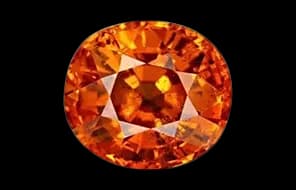
Ceylon Spessartite
Ceylon Spessartite is a vibrant orange to reddish-orange garnet from Sri Lanka, prized for its lively color, brilliance and distinctive gem heritage.
Ceylon Spessartite is the trade name commonly used for natural spessartite garnet associated with Sri Lanka, historically known as Ceylon. Spessartite, also called spessartine, is a manganese-rich member of the garnet group. Its ideal chemical composition is Mn3Al2(SiO4)3, although natural garnets commonly contain some chemical substitution and may occur along a compositional range with other garnet species. Spessartite has a cubic crystal system, vitreous luster, no cleavage, a Mohs hardness of about 7 to 7.5, a refractive index of approximately 1.795-1.815, and a specific gravity generally around 4.12-4.32. Its strong orange coloration is characteristic, while iron and other compositional variations can shift the appearance toward reddish-orange or brownish-orange. Sri Lanka has a long-established gemstone tradition, with important gem-bearing gravels around the Ratnapura region and other parts of the island. Ceylon Spessartite is valued by jewelry buyers and collectors for its warm color, high brilliance and connection to Sri Lanka's renowned gem heritage. It can be fashioned into rings, earrings, pendants and other jewelry, although stones with good clarity and attractive saturated color are especially desirable. As with other natural gemstones, individual inclusions, color zoning, cutting quality and documented origin can have a significant effect on appeal and value.
- Mineral Family
- Garnet
- Chemical Formula
- Mn3Al2(SiO4)3
- Mohs Hardness
- 7 - 7.5
- Refractive Index
- 1.795 - 1.815
- Specific Gravity
- 4.12 - 4.32
- Cleavage
- None
- Crystal System
- Cubic
- Luster
- Vitreous
- Color Range
- Orange, Red
When buying Ceylon Spessartite, start with color. Bright, vivid orange through attractive reddish-orange hues are generally more desirable than overly brown or dull material. Clarity is also important because transparent, eye-clean stones can show excellent brilliance, although natural inclusions are common and should be evaluated rather than automatically treated as defects. Cut has a major influence on performance: a well-proportioned faceted stone should return strong light without excessive windowing or extinction. Carat weight affects price, but size should be considered alongside color, clarity, cut and overall beauty. Origin matters particularly when a stone is marketed specifically as Ceylon or Sri Lankan; a laboratory report is the most reliable way to substantiate geographic origin when origin determination is available. Most natural spessartite is sold without routine enhancement, but buyers should ask whether any treatment has been applied or reported. Synthetic garnet materials exist, so a claim of natural origin should be supported by reputable documentation when value warrants it. For significant purchases, choose an independent gemological laboratory report identifying the material as natural spessartite garnet and, where applicable, stating an origin opinion. Price depends on color quality, transparency, size, cut, treatment status, provenance and certification. Buying from a reputable seller with clear disclosure and return terms is an important part of gemstone authenticity.
Ceylon Spessartite is suitable for many types of jewelry because of its good hardness, but it should still be treated with care. Clean it with lukewarm water, a mild soap and a soft brush or cloth, then rinse and dry thoroughly. Avoid sudden temperature changes, harsh chemicals, abrasive cleaners and prolonged exposure to strong heat. Ultrasonic or steam cleaning should be used only when a qualified gem professional confirms that the individual stone and its condition are suitable. Store the gemstone separately from harder materials to reduce scratching and protect it from impact. Rings worn every day deserve particular care because knocks can damage facet edges or create fractures even in a relatively durable garnet.
Ceylon Spessartite is the trade name commonly used for natural spessartite garnet associated with Sri Lanka, historically known as Ceylon. Spessartite, also called spessartine, is a manganese-rich member of the garnet group. Its ideal chemical composition is Mn3Al2(SiO4)3, although natural garnets commonly contain some chemical substitution and may occur along a compositional range with other garnet species. Spessartite has a cubic crystal system, vitreous luster, no cleavage, a Mohs hardness of about 7 to 7.5, a refractive index of approximately 1.795-1.815, and a specific gravity generally around 4.12-4.32. Its strong orange coloration is characteristic, while iron and other compositional variations can shift the appearance toward reddish-orange or brownish-orange. Sri Lanka has a long-established gemstone tradition, with important gem-bearing gravels around the Ratnapura region and other parts of the island. Ceylon Spessartite is valued by jewelry buyers and collectors for its warm color, high brilliance and connection to Sri Lanka's renowned gem heritage. It can be fashioned into rings, earrings, pendants and other jewelry, although stones with good clarity and attractive saturated color are especially desirable. As with other natural gemstones, individual inclusions, color zoning, cutting quality and documented origin can have a significant effect on appeal and value.
- Mineral Family
- Garnet
- Chemical Formula
- Mn3Al2(SiO4)3
- Mohs Hardness
- 7 - 7.5
- Refractive Index
- 1.795 - 1.815
- Specific Gravity
- 4.12 - 4.32
- Cleavage
- None
- Crystal System
- Cubic
- Luster
- Vitreous
- Color Range
- Orange, Red
When buying Ceylon Spessartite, start with color. Bright, vivid orange through attractive reddish-orange hues are generally more desirable than overly brown or dull material. Clarity is also important because transparent, eye-clean stones can show excellent brilliance, although natural inclusions are common and should be evaluated rather than automatically treated as defects. Cut has a major influence on performance: a well-proportioned faceted stone should return strong light without excessive windowing or extinction. Carat weight affects price, but size should be considered alongside color, clarity, cut and overall beauty. Origin matters particularly when a stone is marketed specifically as Ceylon or Sri Lankan; a laboratory report is the most reliable way to substantiate geographic origin when origin determination is available. Most natural spessartite is sold without routine enhancement, but buyers should ask whether any treatment has been applied or reported. Synthetic garnet materials exist, so a claim of natural origin should be supported by reputable documentation when value warrants it. For significant purchases, choose an independent gemological laboratory report identifying the material as natural spessartite garnet and, where applicable, stating an origin opinion. Price depends on color quality, transparency, size, cut, treatment status, provenance and certification. Buying from a reputable seller with clear disclosure and return terms is an important part of gemstone authenticity.
Ceylon Spessartite is suitable for many types of jewelry because of its good hardness, but it should still be treated with care. Clean it with lukewarm water, a mild soap and a soft brush or cloth, then rinse and dry thoroughly. Avoid sudden temperature changes, harsh chemicals, abrasive cleaners and prolonged exposure to strong heat. Ultrasonic or steam cleaning should be used only when a qualified gem professional confirms that the individual stone and its condition are suitable. Store the gemstone separately from harder materials to reduce scratching and protect it from impact. Rings worn every day deserve particular care because knocks can damage facet edges or create fractures even in a relatively durable garnet.
Ceylon Spessartite for Sale
No gems found
Try broadening your search or adjusting your filters.
Have a gem of your own? List it free - no fees