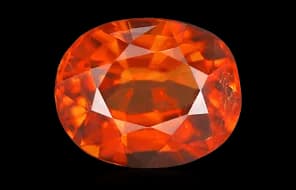
Spessartite
Spessartite is a vivid orange garnet prized for its lively brilliance, warm color and excellent jewelry durability, making it a standout choice for collectors and gem lovers.
Spessartite, also called spessartine, is an orange to reddish-orange gemstone variety of the garnet group. It is a manganese-aluminum garnet with the chemical formula Mn₃Al₂(SiO₄)₃. Its cubic crystal structure, vitreous luster and high refractive index give well-cut stones an exceptionally bright appearance. Spessartite typically measures 7–7.5 on the Mohs hardness scale and has no cleavage, making it well suited to many types of jewelry when protected from severe impact. Its characteristic colors range from yellowish orange and vivid orange to orange-red and red, with fine pure orange material especially sought after. Color is primarily associated with manganese, while iron and compositional variation can influence the appearance. Spessartite forms in several geological environments, including granitic pegmatites, and important gem sources have included Namibia, Nigeria, Tanzania, Mozambique, Madagascar, Brazil and the United States. The historic Little Three mine area near Ramona, California, was an important source of fine spessartite during the 20th century, while vividly orange material from Namibia helped establish the trade name Mandarin garnet. Today, Spessartite jewelry includes rings, earrings, pendants, bracelets and collector-quality loose gems. Buyers value the stone for its energetic orange color, strong brilliance, relative rarity and distinctive identity within the garnet family. As with other natural gemstones, each stone should be assessed individually because color, clarity, origin, treatment status and cut can vary considerably.
- Mineral Family
- Garnet
- Chemical Formula
- Mn₃Al₂(SiO₄)₃
- Mohs Hardness
- 7 - 7.5
- Refractive Index
- 1.789 - 1.820
- Specific Gravity
- 4.12 - 4.18
- Cleavage
- None
- Crystal System
- Cubic
- Luster
- Vitreous
- Color Range
- Orange, Red, Yellow
When buying a natural Spessartite gemstone, begin with color. Bright, saturated orange through orange-red hues are generally the most desirable, while brownish or overly dark stones may be less visually striking. Clarity is also important because transparent, eye-clean Spessartite can be uncommon, particularly in attractive larger sizes. Some inclusions are natural and can help confirm that a stone is genuine, but fractures or inclusions that significantly reduce transparency may affect value and durability. Cut should maximize brilliance, color and face-up appearance; well-proportioned round, oval, cushion and other faceted cuts can perform beautifully. Carat weight matters because fine, clean material becomes more difficult to find as size increases, although price does not rise automatically with size. Origin can add interest and provenance, particularly for material associated with historically important localities, but origin should not outweigh actual gem quality. Spessartite is generally encountered as a natural gemstone, and laboratory-grown material is not a standard equivalent in the fine-gem market; buyers should ask specifically whether a stone is natural, synthetic or an imitation. Treatments are not a defining feature of fine Spessartite, but treatment disclosure should always be requested rather than assumed. For expensive stones, an independent gemological report can verify species, natural status and any detectable treatments. When you buy Spessartite online, review high-resolution photographs or video in neutral lighting, request exact carat weight and dimensions, confirm return terms, and purchase from a seller that provides clear disclosure. Price is primarily influenced by color, clarity, transparency, cut, size, provenance, treatment status and overall beauty rather than by carat weight alone.
Spessartite is durable enough for regular jewelry use, but it should still be protected from hard impacts because garnets have fair to good toughness. Clean Spessartite with warm water, mild soap and a soft brush, then rinse and dry with a soft cloth. GIA notes that warm soapy water is safe for garnets, while steam cleaning is not recommended; ultrasonic cleaning is generally suitable except when the stone has significant fractures or certain durability concerns. Store Spessartite separately from harder gemstones to reduce scratching, ideally in a soft pouch or individual jewelry compartment. Remove rings and other exposed jewelry before activities involving heavy impact, abrasive materials or harsh chemicals. Avoid hydrofluoric acid and unnecessary exposure to strong chemicals. If a stone has undergone a treatment such as fracture filling, follow the specific care instructions supplied by the seller or laboratory. Periodically inspect the setting of a Spessartite ring or pendant to make sure the gemstone remains secure.
Spessartite, also called spessartine, is an orange to reddish-orange gemstone variety of the garnet group. It is a manganese-aluminum garnet with the chemical formula Mn₃Al₂(SiO₄)₃. Its cubic crystal structure, vitreous luster and high refractive index give well-cut stones an exceptionally bright appearance. Spessartite typically measures 7–7.5 on the Mohs hardness scale and has no cleavage, making it well suited to many types of jewelry when protected from severe impact. Its characteristic colors range from yellowish orange and vivid orange to orange-red and red, with fine pure orange material especially sought after. Color is primarily associated with manganese, while iron and compositional variation can influence the appearance. Spessartite forms in several geological environments, including granitic pegmatites, and important gem sources have included Namibia, Nigeria, Tanzania, Mozambique, Madagascar, Brazil and the United States. The historic Little Three mine area near Ramona, California, was an important source of fine spessartite during the 20th century, while vividly orange material from Namibia helped establish the trade name Mandarin garnet. Today, Spessartite jewelry includes rings, earrings, pendants, bracelets and collector-quality loose gems. Buyers value the stone for its energetic orange color, strong brilliance, relative rarity and distinctive identity within the garnet family. As with other natural gemstones, each stone should be assessed individually because color, clarity, origin, treatment status and cut can vary considerably.
- Mineral Family
- Garnet
- Chemical Formula
- Mn₃Al₂(SiO₄)₃
- Mohs Hardness
- 7 - 7.5
- Refractive Index
- 1.789 - 1.820
- Specific Gravity
- 4.12 - 4.18
- Cleavage
- None
- Crystal System
- Cubic
- Luster
- Vitreous
- Color Range
- Orange, Red, Yellow
When buying a natural Spessartite gemstone, begin with color. Bright, saturated orange through orange-red hues are generally the most desirable, while brownish or overly dark stones may be less visually striking. Clarity is also important because transparent, eye-clean Spessartite can be uncommon, particularly in attractive larger sizes. Some inclusions are natural and can help confirm that a stone is genuine, but fractures or inclusions that significantly reduce transparency may affect value and durability. Cut should maximize brilliance, color and face-up appearance; well-proportioned round, oval, cushion and other faceted cuts can perform beautifully. Carat weight matters because fine, clean material becomes more difficult to find as size increases, although price does not rise automatically with size. Origin can add interest and provenance, particularly for material associated with historically important localities, but origin should not outweigh actual gem quality. Spessartite is generally encountered as a natural gemstone, and laboratory-grown material is not a standard equivalent in the fine-gem market; buyers should ask specifically whether a stone is natural, synthetic or an imitation. Treatments are not a defining feature of fine Spessartite, but treatment disclosure should always be requested rather than assumed. For expensive stones, an independent gemological report can verify species, natural status and any detectable treatments. When you buy Spessartite online, review high-resolution photographs or video in neutral lighting, request exact carat weight and dimensions, confirm return terms, and purchase from a seller that provides clear disclosure. Price is primarily influenced by color, clarity, transparency, cut, size, provenance, treatment status and overall beauty rather than by carat weight alone.
Spessartite is durable enough for regular jewelry use, but it should still be protected from hard impacts because garnets have fair to good toughness. Clean Spessartite with warm water, mild soap and a soft brush, then rinse and dry with a soft cloth. GIA notes that warm soapy water is safe for garnets, while steam cleaning is not recommended; ultrasonic cleaning is generally suitable except when the stone has significant fractures or certain durability concerns. Store Spessartite separately from harder gemstones to reduce scratching, ideally in a soft pouch or individual jewelry compartment. Remove rings and other exposed jewelry before activities involving heavy impact, abrasive materials or harsh chemicals. Avoid hydrofluoric acid and unnecessary exposure to strong chemicals. If a stone has undergone a treatment such as fracture filling, follow the specific care instructions supplied by the seller or laboratory. Periodically inspect the setting of a Spessartite ring or pendant to make sure the gemstone remains secure.
Spessartite for Sale
No gems found
Try broadening your search or adjusting your filters.
Have a gem of your own? List it free - no fees