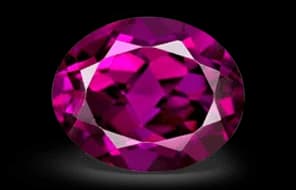
Purple Garnet
Purple Garnet is a rare garnet prized for its rich purple to purplish-red color, vitreous luster, strong brilliance, and exceptional appeal among collectors and jewelry buyers.
Purple Garnet is a trade and descriptive name used for rare purple garnets, including the pyrope-almandine material documented from Manica Province, Mozambique. GIA identified this material as a pyrope-almandine garnet, commonly classified within the rhodolite garnet range. Its composition is a solid solution rather than a single pure garnet end member, with studied Mozambique material containing approximately 48.8-59.5% pyrope, 37.9-47.6% almandine, 2.0-3.5% grossular, and 0.5-0.6% spessartine. The general formula is therefore best represented as (Mg,Fe)3Al2(SiO4)3 rather than the generic X3Y2(SiO4)3 formula. GIA reported a refractive index of 1.767 ± 0.003 and specific gravity of 3.87 ± 0.02 for the documented Mozambique material. Purple Garnet has a cubic crystal system, no cleavage, and a vitreous luster, with a typical hardness of about 7-7.5 on the Mohs scale. The purple appearance results from the interaction of iron and other minor elements within the garnet structure. Some purple garnets can also show attractive color behavior under different lighting conditions, although the exact effect varies by material. The Mozambique material became known in the international gem market in 2016, with the documented deposit located in Manica Province. Purple garnet varieties and related color-change garnets have also been documented from other parts of Africa and elsewhere, so origin should not be assumed from color alone. Today, Purple Garnet is used for rings, earrings, pendants, bracelets, and collector gemstones. Its combination of rarity, saturated color, brilliance, and relatively good durability makes it attractive for jewelry, while unusual color and provenance can make fine examples particularly interesting to collectors. Buyers value natural Purple Garnet primarily for its distinctive color, transparency, cut quality, size, rarity, and reliable laboratory identification.
- Mineral Family
- Garnet
- Chemical Formula
- (Mg,Fe)3Al2(SiO4)3
- Mohs Hardness
- 7 - 7.5
- Refractive Index
- 1.764 - 1.770
- Specific Gravity
- 3.85 - 3.89
- Cleavage
- None
- Crystal System
- Cubic
- Luster
- Vitreous
- Color Range
- Purple, Red, Pink
When buying Purple Garnet online, start with color. Fine stones generally have an attractive, well-saturated purple or purplish-red bodycolor without excessive brown or gray influence. Some stones may display red, pink, or other secondary tones depending on the material and lighting. Clarity is also important because garnets can contain natural inclusions. Rather than requiring absolute flawlessness, look for inclusions that do not significantly reduce transparency, brilliance, or durability. Cut has a major effect on appearance because well-proportioned facets can maximize the high luster and brilliance expected from garnet. Common shapes include round, oval, cushion, pear, and other faceted designs. Carat weight matters because fine material in larger sizes can be considerably rarer, but size should always be evaluated together with color, clarity, cut, and transparency. Origin can add interest and value when it is documented, particularly for material from known deposits, but origin should be established by a qualified laboratory rather than inferred from appearance. Purple Garnet is generally sold as natural garnet material, and there is no need to assume that every purple garnet has the same treatment history. Ask the seller to disclose any known treatment or enhancement and request laboratory documentation when the stone is valuable or represented as particularly rare. Natural garnet should not be confused with laboratory-grown garnet simulants or unrelated purple gemstones such as amethyst. A reputable independent gemological report can confirm the gemstone identity and, where offered, document treatment and origin. For authenticity, compare the stone with the laboratory report, verify the report number directly with the issuing laboratory, and buy from a seller who provides clear photographs, accurate measurements, treatment disclosure, and a transparent return policy. Price is influenced by color quality, clarity, transparency, cut, carat weight, rarity, origin when verified, treatment status, and certification. There is no single fixed price per carat for Purple Garnet, so unusually low prices for supposedly rare, fine material deserve careful scrutiny.
Purple Garnet is reasonably durable for jewelry, with a Mohs hardness of about 7-7.5 and no cleavage. For routine cleaning, use lukewarm water, mild soap, and a soft brush, then rinse and dry with a soft cloth. Avoid harsh chemicals, abrasive cleaners, and sudden temperature changes. Because individual garnets can contain inclusions or fractures, ultrasonic and steam cleaning are best avoided unless a qualified jeweler has assessed the stone and confirmed that the specific gem is suitable. For everyday wear, rings deserve more care than earrings or pendants because they receive more knocks and abrasion. Remove Purple Garnet jewelry before heavy physical work, sports, gardening, or activities where the stone may be struck. Store each gemstone or jewelry piece separately in a soft pouch or lined compartment to prevent scratches and contact damage. Periodically check prongs and settings on rings and other mounted jewelry, particularly if the piece is worn frequently.
Purple Garnet is a trade and descriptive name used for rare purple garnets, including the pyrope-almandine material documented from Manica Province, Mozambique. GIA identified this material as a pyrope-almandine garnet, commonly classified within the rhodolite garnet range. Its composition is a solid solution rather than a single pure garnet end member, with studied Mozambique material containing approximately 48.8-59.5% pyrope, 37.9-47.6% almandine, 2.0-3.5% grossular, and 0.5-0.6% spessartine. The general formula is therefore best represented as (Mg,Fe)3Al2(SiO4)3 rather than the generic X3Y2(SiO4)3 formula. GIA reported a refractive index of 1.767 ± 0.003 and specific gravity of 3.87 ± 0.02 for the documented Mozambique material. Purple Garnet has a cubic crystal system, no cleavage, and a vitreous luster, with a typical hardness of about 7-7.5 on the Mohs scale. The purple appearance results from the interaction of iron and other minor elements within the garnet structure. Some purple garnets can also show attractive color behavior under different lighting conditions, although the exact effect varies by material. The Mozambique material became known in the international gem market in 2016, with the documented deposit located in Manica Province. Purple garnet varieties and related color-change garnets have also been documented from other parts of Africa and elsewhere, so origin should not be assumed from color alone. Today, Purple Garnet is used for rings, earrings, pendants, bracelets, and collector gemstones. Its combination of rarity, saturated color, brilliance, and relatively good durability makes it attractive for jewelry, while unusual color and provenance can make fine examples particularly interesting to collectors. Buyers value natural Purple Garnet primarily for its distinctive color, transparency, cut quality, size, rarity, and reliable laboratory identification.
- Mineral Family
- Garnet
- Chemical Formula
- (Mg,Fe)3Al2(SiO4)3
- Mohs Hardness
- 7 - 7.5
- Refractive Index
- 1.764 - 1.770
- Specific Gravity
- 3.85 - 3.89
- Cleavage
- None
- Crystal System
- Cubic
- Luster
- Vitreous
- Color Range
- Purple, Red, Pink
When buying Purple Garnet online, start with color. Fine stones generally have an attractive, well-saturated purple or purplish-red bodycolor without excessive brown or gray influence. Some stones may display red, pink, or other secondary tones depending on the material and lighting. Clarity is also important because garnets can contain natural inclusions. Rather than requiring absolute flawlessness, look for inclusions that do not significantly reduce transparency, brilliance, or durability. Cut has a major effect on appearance because well-proportioned facets can maximize the high luster and brilliance expected from garnet. Common shapes include round, oval, cushion, pear, and other faceted designs. Carat weight matters because fine material in larger sizes can be considerably rarer, but size should always be evaluated together with color, clarity, cut, and transparency. Origin can add interest and value when it is documented, particularly for material from known deposits, but origin should be established by a qualified laboratory rather than inferred from appearance. Purple Garnet is generally sold as natural garnet material, and there is no need to assume that every purple garnet has the same treatment history. Ask the seller to disclose any known treatment or enhancement and request laboratory documentation when the stone is valuable or represented as particularly rare. Natural garnet should not be confused with laboratory-grown garnet simulants or unrelated purple gemstones such as amethyst. A reputable independent gemological report can confirm the gemstone identity and, where offered, document treatment and origin. For authenticity, compare the stone with the laboratory report, verify the report number directly with the issuing laboratory, and buy from a seller who provides clear photographs, accurate measurements, treatment disclosure, and a transparent return policy. Price is influenced by color quality, clarity, transparency, cut, carat weight, rarity, origin when verified, treatment status, and certification. There is no single fixed price per carat for Purple Garnet, so unusually low prices for supposedly rare, fine material deserve careful scrutiny.
Purple Garnet is reasonably durable for jewelry, with a Mohs hardness of about 7-7.5 and no cleavage. For routine cleaning, use lukewarm water, mild soap, and a soft brush, then rinse and dry with a soft cloth. Avoid harsh chemicals, abrasive cleaners, and sudden temperature changes. Because individual garnets can contain inclusions or fractures, ultrasonic and steam cleaning are best avoided unless a qualified jeweler has assessed the stone and confirmed that the specific gem is suitable. For everyday wear, rings deserve more care than earrings or pendants because they receive more knocks and abrasion. Remove Purple Garnet jewelry before heavy physical work, sports, gardening, or activities where the stone may be struck. Store each gemstone or jewelry piece separately in a soft pouch or lined compartment to prevent scratches and contact damage. Periodically check prongs and settings on rings and other mounted jewelry, particularly if the piece is worn frequently.
Purple Garnet for Sale
No gems found
Try broadening your search or adjusting your filters.
Have a gem of your own? List it free - no fees