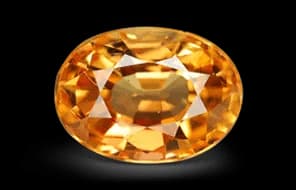
Mandarin Garnet
Mandarin Garnet is prized for its exceptionally vivid orange color, high brilliance and distinctive character. This rare spessartine garnet brings warm color and refined appeal to fine jewelry.
Mandarin Garnet is the trade name commonly used for exceptionally vivid orange spessartine garnet, a manganese-rich member of the garnet group. Spessartine has the ideal chemical formula Mn3Al2(SiO4)3, although natural gem material commonly contains some chemical variation through mixing with other garnet components. Manganese is an important contributor to the characteristic orange color.
The gemstone belongs to the cubic garnet crystal system and is singly refractive. Its refractive index is typically around 1.780-1.810, while specific gravity varies with composition and locality. Spessartine has a Mohs hardness of about 6.5-7.5 and a vitreous luster. It has no cleavage and commonly shows a sub-conchoidal fracture. These properties give well-cut Mandarin Garnet good brilliance and make it suitable for many types of jewelry, although it still deserves protection from hard impact and abrasive wear.
The most famous Mandarin Garnet material came from northwestern Namibia, where vivid orange spessartine was discovered in the early 1990s. Important spessartine sources have also included Nigeria, Madagascar, Tanzania, Brazil, Sri Lanka, Pakistan and the United States. The Little Three mining area near Ramona, California, is historically important for fine orange spessartine, while Nigerian and Tanzanian material has also produced attractive orange stones. Origin should be documented rather than assumed from color alone.
Mandarin Garnet forms through geological processes that produce manganese-rich spessartine, commonly in granitic pegmatites and related geological environments. The exact chemistry and geological setting influence color, clarity, size and overall appearance. Exceptionally saturated orange color with strong brightness is particularly sought after, while brown or overly dark modifiers can reduce visual appeal.
Mandarin Garnet has a relatively short modern history compared with historic garnet varieties, but its distinctive color quickly established it as a desirable collector and jewelry gemstone. Today it is especially popular in rings, earrings, pendants and statement pieces where its intense orange color can take center stage. It pairs particularly well with yellow gold, rose gold, white metals and diamond accents.
Buyers value Mandarin Garnet primarily for its color, brilliance, rarity of fine material and individuality. Unlike mass-market orange gemstones, fine Mandarin Garnet can display a remarkably pure and energetic orange appearance. Because there is no universal AAA or similar grading system for garnet, buyers should judge the actual stone and rely on independent gemological documentation when origin, treatment or authenticity is important.
- Mineral Family
- Garnet
- Chemical Formula
- Mn3Al2(SiO4)3
- Mohs Hardness
- 6.5 - 7.5
- Refractive Index
- 1.780 - 1.810
- Specific Gravity
- 4.04 - 4.32
- Cleavage
- None
- Crystal System
- Cubic
- Luster
- Vitreous
- Color Range
- Orange, Pink
When buying Mandarin Garnet online, begin with color. The most desirable material generally shows a vivid, saturated orange with strong brightness and minimal distracting brown or gray modifiers. A lively orange appearance under neutral lighting is more useful than heavily edited photographs. Ask for daylight and indoor images or videos when possible.
Clarity is also important, but Mandarin Garnet should not automatically be judged by the same clarity expectations used for diamonds. Fine stones can contain natural inclusions, and the effect of those inclusions on transparency, brilliance and durability matters more than simply counting them. Eye-clean or highly transparent stones can command a premium when combined with exceptional color.
Cut has a major influence on appearance. Well-proportioned faceting can maximize the high refractive index and return of light, while poor cutting can make even strongly colored rough appear dark or lifeless. Check symmetry, facet alignment, polish, windowing and whether the stone performs well when viewed from different angles.
Carat weight affects value, but size alone does not determine quality. Large, attractive Mandarin Garnets with excellent color and clarity can become substantially more valuable because fine material in larger sizes is less common. Compare stones by color, clarity, cut and overall visual quality rather than price per carat alone.
Origin can influence collector interest and price, particularly when a stone is represented as material from a historically significant locality such as Namibia. However, origin should not be inferred simply from appearance. If origin is important to your purchase, request a reputable laboratory report that specifically addresses geographic origin where possible.
Treatment should always be disclosed. Most garnets are not routinely treated, although garnets can rarely be fracture-filled. Do not assume that a stone described as natural is automatically untreated. Ask the seller whether any treatment, filling, coating or enhancement has been performed and have valuable stones independently examined when necessary.
Natural and laboratory-grown terminology should also be clear. A natural Mandarin Garnet should have a geological origin and should not be represented as synthetic material. If a seller describes a stone as lab-grown, synthetic or laboratory-created, request clear documentation identifying what material it is and how it was produced.
Certification is especially useful for higher-value Mandarin Garnet. An independent gemological report can help confirm the gemstone identity and may document detectable treatments or, where the laboratory offers the service and sufficient evidence exists, geographic origin. A certificate should be checked against the laboratory's database when possible.
Authenticity cannot be established reliably from color photographs alone. For an expensive purchase, prioritize transparent sellers, detailed photographs, accurate weight and dimensions, treatment disclosure, return policies and independent laboratory documentation. Price depends on color saturation, brightness, clarity, cut quality, size, origin documentation, treatment status and overall rarity. Avoid using generic online price ranges as a substitute for evaluating the individual stone.
Mandarin Garnet is reasonably durable for jewelry, but its hardness and toughness do not make it immune to scratching, abrasion or impact. Rings can receive more wear than earrings and pendants, so a Mandarin Garnet ring should be protected from hard knocks and removed before activities such as gardening, sports, heavy manual work or household tasks that could damage the stone.
For routine cleaning, use lukewarm water, mild soap and a soft brush. Rinse carefully and dry with a soft lint-free cloth. Avoid harsh chemicals and unnecessary exposure to extreme heat. Steam cleaning is not recommended for garnet, and ultrasonic cleaning should be avoided when the stone has significant fractures or has been fracture-filled.
Store Mandarin Garnet jewelry separately from harder gemstones such as diamond, ruby and sapphire to reduce scratching. A soft pouch or individual jewelry compartment is ideal. Avoid allowing pieces to rub against one another during storage.
If a stone has been fracture-filled or has another disclosed treatment, follow the care instructions provided by the treating laboratory or jeweler. When purchasing an expensive Mandarin Garnet, keeping the laboratory report and treatment information with the jewelry record is a useful long-term practice.
Mandarin Garnet is the trade name commonly used for exceptionally vivid orange spessartine garnet, a manganese-rich member of the garnet group. Spessartine has the ideal chemical formula Mn3Al2(SiO4)3, although natural gem material commonly contains some chemical variation through mixing with other garnet components. Manganese is an important contributor to the characteristic orange color.
The gemstone belongs to the cubic garnet crystal system and is singly refractive. Its refractive index is typically around 1.780-1.810, while specific gravity varies with composition and locality. Spessartine has a Mohs hardness of about 6.5-7.5 and a vitreous luster. It has no cleavage and commonly shows a sub-conchoidal fracture. These properties give well-cut Mandarin Garnet good brilliance and make it suitable for many types of jewelry, although it still deserves protection from hard impact and abrasive wear.
The most famous Mandarin Garnet material came from northwestern Namibia, where vivid orange spessartine was discovered in the early 1990s. Important spessartine sources have also included Nigeria, Madagascar, Tanzania, Brazil, Sri Lanka, Pakistan and the United States. The Little Three mining area near Ramona, California, is historically important for fine orange spessartine, while Nigerian and Tanzanian material has also produced attractive orange stones. Origin should be documented rather than assumed from color alone.
Mandarin Garnet forms through geological processes that produce manganese-rich spessartine, commonly in granitic pegmatites and related geological environments. The exact chemistry and geological setting influence color, clarity, size and overall appearance. Exceptionally saturated orange color with strong brightness is particularly sought after, while brown or overly dark modifiers can reduce visual appeal.
Mandarin Garnet has a relatively short modern history compared with historic garnet varieties, but its distinctive color quickly established it as a desirable collector and jewelry gemstone. Today it is especially popular in rings, earrings, pendants and statement pieces where its intense orange color can take center stage. It pairs particularly well with yellow gold, rose gold, white metals and diamond accents.
Buyers value Mandarin Garnet primarily for its color, brilliance, rarity of fine material and individuality. Unlike mass-market orange gemstones, fine Mandarin Garnet can display a remarkably pure and energetic orange appearance. Because there is no universal AAA or similar grading system for garnet, buyers should judge the actual stone and rely on independent gemological documentation when origin, treatment or authenticity is important.
- Mineral Family
- Garnet
- Chemical Formula
- Mn3Al2(SiO4)3
- Mohs Hardness
- 6.5 - 7.5
- Refractive Index
- 1.780 - 1.810
- Specific Gravity
- 4.04 - 4.32
- Cleavage
- None
- Crystal System
- Cubic
- Luster
- Vitreous
- Color Range
- Orange, Pink
When buying Mandarin Garnet online, begin with color. The most desirable material generally shows a vivid, saturated orange with strong brightness and minimal distracting brown or gray modifiers. A lively orange appearance under neutral lighting is more useful than heavily edited photographs. Ask for daylight and indoor images or videos when possible.
Clarity is also important, but Mandarin Garnet should not automatically be judged by the same clarity expectations used for diamonds. Fine stones can contain natural inclusions, and the effect of those inclusions on transparency, brilliance and durability matters more than simply counting them. Eye-clean or highly transparent stones can command a premium when combined with exceptional color.
Cut has a major influence on appearance. Well-proportioned faceting can maximize the high refractive index and return of light, while poor cutting can make even strongly colored rough appear dark or lifeless. Check symmetry, facet alignment, polish, windowing and whether the stone performs well when viewed from different angles.
Carat weight affects value, but size alone does not determine quality. Large, attractive Mandarin Garnets with excellent color and clarity can become substantially more valuable because fine material in larger sizes is less common. Compare stones by color, clarity, cut and overall visual quality rather than price per carat alone.
Origin can influence collector interest and price, particularly when a stone is represented as material from a historically significant locality such as Namibia. However, origin should not be inferred simply from appearance. If origin is important to your purchase, request a reputable laboratory report that specifically addresses geographic origin where possible.
Treatment should always be disclosed. Most garnets are not routinely treated, although garnets can rarely be fracture-filled. Do not assume that a stone described as natural is automatically untreated. Ask the seller whether any treatment, filling, coating or enhancement has been performed and have valuable stones independently examined when necessary.
Natural and laboratory-grown terminology should also be clear. A natural Mandarin Garnet should have a geological origin and should not be represented as synthetic material. If a seller describes a stone as lab-grown, synthetic or laboratory-created, request clear documentation identifying what material it is and how it was produced.
Certification is especially useful for higher-value Mandarin Garnet. An independent gemological report can help confirm the gemstone identity and may document detectable treatments or, where the laboratory offers the service and sufficient evidence exists, geographic origin. A certificate should be checked against the laboratory's database when possible.
Authenticity cannot be established reliably from color photographs alone. For an expensive purchase, prioritize transparent sellers, detailed photographs, accurate weight and dimensions, treatment disclosure, return policies and independent laboratory documentation. Price depends on color saturation, brightness, clarity, cut quality, size, origin documentation, treatment status and overall rarity. Avoid using generic online price ranges as a substitute for evaluating the individual stone.
Mandarin Garnet is reasonably durable for jewelry, but its hardness and toughness do not make it immune to scratching, abrasion or impact. Rings can receive more wear than earrings and pendants, so a Mandarin Garnet ring should be protected from hard knocks and removed before activities such as gardening, sports, heavy manual work or household tasks that could damage the stone.
For routine cleaning, use lukewarm water, mild soap and a soft brush. Rinse carefully and dry with a soft lint-free cloth. Avoid harsh chemicals and unnecessary exposure to extreme heat. Steam cleaning is not recommended for garnet, and ultrasonic cleaning should be avoided when the stone has significant fractures or has been fracture-filled.
Store Mandarin Garnet jewelry separately from harder gemstones such as diamond, ruby and sapphire to reduce scratching. A soft pouch or individual jewelry compartment is ideal. Avoid allowing pieces to rub against one another during storage.
If a stone has been fracture-filled or has another disclosed treatment, follow the care instructions provided by the treating laboratory or jeweler. When purchasing an expensive Mandarin Garnet, keeping the laboratory report and treatment information with the jewelry record is a useful long-term practice.
Mandarin Garnet for Sale
No gems found
Try broadening your search or adjusting your filters.
Have a gem of your own? List it free - no fees