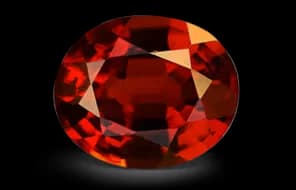
Hessonite
Hessonite is a warm, distinctive garnet prized for its honey, cinnamon and orange-brown colors, characteristic inner glow and durable appeal in jewelry.
Hessonite is the gem variety of grossular garnet, a member of the garnet mineral group. Its chemical formula is Ca₃Al₂(SiO₄)₃, and its cubic crystal structure gives it the isotropic optical character typical of garnets. Hessonite generally measures 6.5 to 7 on the Mohs scale, has a refractive index around 1.74-1.768, a specific gravity of approximately 3.62-3.67, no observed cleavage and a vitreous to resinous luster. Its color is its defining feature, ranging from warm yellow and orange through cinnamon, reddish brown and deeper brown tones. Many attractive stones display a distinctive soft, swirling or heat-wave appearance caused by their internal granular structure. Hessonite has a long history as a gemstone, particularly in Sri Lanka, where gem gravels around Ratnapura have produced notable material. It also occurs in other localities, including India, Italy and parts of East Africa. The name cinnamon stone is commonly associated with its characteristic warm coloration. Today, natural Hessonite is used in rings, pendants, earrings, bracelets and collector-quality gemstone pieces. Buyers value it for its unusual color, strong visual character, relative durability and the individuality created by its internal texture. Unlike some garnets that are prized primarily for vivid red or green colors, Hessonite offers a distinctive palette of honey, cinnamon and orange-brown shades that works particularly well in warm-toned jewelry.
- Mineral Family
- Garnet
- Chemical Formula
- Ca₃Al₂(SiO₄)₃
- Mohs Hardness
- 6.5 - 7
- Refractive Index
- 1.74 - 1.768
- Specific Gravity
- 3.62 - 3.67
- Cleavage
- None observed
- Crystal System
- Cubic
- Luster
- Vitreous
- Color Range
- Orange, Yellow, Red
When buying Hessonite gemstone, begin with color. Attractive stones typically show pleasing honey, cinnamon, orange or reddish-brown tones with good saturation and an appealing overall appearance. Clarity should be evaluated in context: Hessonite commonly contains internal features and may show a characteristic roiled or heat-wave appearance, so absolute flawlessness is not necessary for a beautiful stone. Cut should maximize color, brilliance and face-up appearance while preserving good proportions and avoiding excessive windowing. Oval, cushion and other shapes can all work well depending on the jewelry design. Carat weight affects price, but larger size alone does not guarantee higher value. Origin can influence desirability, especially when a documented locality has a strong reputation, but origin should not replace evaluation of the individual stone. Hessonite is generally sold as a natural gemstone rather than a routinely treated gem, but any disclosed treatment should be considered when comparing stones. Laboratory-grown or synthetic material should be clearly identified as such rather than represented as natural Hessonite. For significant purchases, request an independent gemological report that identifies the material as natural Hessonite or grossular garnet and records relevant treatments where applicable. A reliable seller should provide clear photographs, accurate measurements, weight, treatment disclosure and a return policy. Authenticity is best established through professional gemological testing rather than appearance alone. Price depends mainly on color quality, transparency, clarity, cut, carat weight, origin documentation, treatment status and overall visual appeal. Comparing stones by these factors is more useful than relying on a simple price-per-carat rule.
Hessonite is suitable for many types of jewelry, but its 6.5-7 Mohs hardness means it should be protected from hard knocks and abrasive contact. For routine cleaning, use lukewarm water, a small amount of mild soap and a soft brush or cloth. Rinse thoroughly and dry with a soft, lint-free cloth. Avoid harsh chemicals, abrasive cleaners and prolonged exposure to high heat unless a qualified professional has confirmed that the specific stone and setting can tolerate them. Store Hessonite jewelry separately from harder gemstones to reduce scratching, preferably in a soft pouch or a lined compartment. Remove rings and bracelets before activities involving impact, heavy work or abrasive surfaces. Periodic inspection of the stone and its setting can help identify loose prongs, chips or other damage before it becomes more serious. For valuable or particularly included stones, professional cleaning advice is preferable to aggressive home cleaning methods.
Hessonite is the gem variety of grossular garnet, a member of the garnet mineral group. Its chemical formula is Ca₃Al₂(SiO₄)₃, and its cubic crystal structure gives it the isotropic optical character typical of garnets. Hessonite generally measures 6.5 to 7 on the Mohs scale, has a refractive index around 1.74-1.768, a specific gravity of approximately 3.62-3.67, no observed cleavage and a vitreous to resinous luster. Its color is its defining feature, ranging from warm yellow and orange through cinnamon, reddish brown and deeper brown tones. Many attractive stones display a distinctive soft, swirling or heat-wave appearance caused by their internal granular structure. Hessonite has a long history as a gemstone, particularly in Sri Lanka, where gem gravels around Ratnapura have produced notable material. It also occurs in other localities, including India, Italy and parts of East Africa. The name cinnamon stone is commonly associated with its characteristic warm coloration. Today, natural Hessonite is used in rings, pendants, earrings, bracelets and collector-quality gemstone pieces. Buyers value it for its unusual color, strong visual character, relative durability and the individuality created by its internal texture. Unlike some garnets that are prized primarily for vivid red or green colors, Hessonite offers a distinctive palette of honey, cinnamon and orange-brown shades that works particularly well in warm-toned jewelry.
- Mineral Family
- Garnet
- Chemical Formula
- Ca₃Al₂(SiO₄)₃
- Mohs Hardness
- 6.5 - 7
- Refractive Index
- 1.74 - 1.768
- Specific Gravity
- 3.62 - 3.67
- Cleavage
- None observed
- Crystal System
- Cubic
- Luster
- Vitreous
- Color Range
- Orange, Yellow, Red
When buying Hessonite gemstone, begin with color. Attractive stones typically show pleasing honey, cinnamon, orange or reddish-brown tones with good saturation and an appealing overall appearance. Clarity should be evaluated in context: Hessonite commonly contains internal features and may show a characteristic roiled or heat-wave appearance, so absolute flawlessness is not necessary for a beautiful stone. Cut should maximize color, brilliance and face-up appearance while preserving good proportions and avoiding excessive windowing. Oval, cushion and other shapes can all work well depending on the jewelry design. Carat weight affects price, but larger size alone does not guarantee higher value. Origin can influence desirability, especially when a documented locality has a strong reputation, but origin should not replace evaluation of the individual stone. Hessonite is generally sold as a natural gemstone rather than a routinely treated gem, but any disclosed treatment should be considered when comparing stones. Laboratory-grown or synthetic material should be clearly identified as such rather than represented as natural Hessonite. For significant purchases, request an independent gemological report that identifies the material as natural Hessonite or grossular garnet and records relevant treatments where applicable. A reliable seller should provide clear photographs, accurate measurements, weight, treatment disclosure and a return policy. Authenticity is best established through professional gemological testing rather than appearance alone. Price depends mainly on color quality, transparency, clarity, cut, carat weight, origin documentation, treatment status and overall visual appeal. Comparing stones by these factors is more useful than relying on a simple price-per-carat rule.
Hessonite is suitable for many types of jewelry, but its 6.5-7 Mohs hardness means it should be protected from hard knocks and abrasive contact. For routine cleaning, use lukewarm water, a small amount of mild soap and a soft brush or cloth. Rinse thoroughly and dry with a soft, lint-free cloth. Avoid harsh chemicals, abrasive cleaners and prolonged exposure to high heat unless a qualified professional has confirmed that the specific stone and setting can tolerate them. Store Hessonite jewelry separately from harder gemstones to reduce scratching, preferably in a soft pouch or a lined compartment. Remove rings and bracelets before activities involving impact, heavy work or abrasive surfaces. Periodic inspection of the stone and its setting can help identify loose prongs, chips or other damage before it becomes more serious. For valuable or particularly included stones, professional cleaning advice is preferable to aggressive home cleaning methods.
Hessonite for Sale
No gems found
Try broadening your search or adjusting your filters.
Have a gem of your own? List it free - no fees