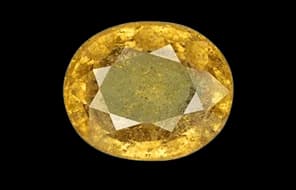
Gomutra Gomed
Gomutra Gomed is a warm, distinctive hessonite garnet known for its honey, orange-brown to cinnamon hues, vitreous luster, and naturally lively internal character.
Gomutra Gomed is a trade name commonly used for a color appearance of hessonite, the orange to brown variety of grossular garnet. Grossular belongs to the garnet mineral group and has the chemical formula Ca3Al2(SiO4)3. Hessonite forms in calcium-rich metamorphic environments, where geological heat and pressure allow garnet crystals to develop. Its characteristic warm coloration can range from yellow-orange and honey tones to orange-brown and cinnamon shades. The name Gomutra refers to a traditional color description rather than a separate mineral species.
Hessonite has a cubic crystal system, no cleavage, a Mohs hardness of approximately 6.5-7.5, a refractive index generally around 1.73-1.76, and a specific gravity of about 3.57-3.73. Its luster is typically vitreous to resinous. Many hessonites show a distinctive internal 'roiled' or heat-wave appearance caused by inclusions and growth features; this can be an identifying characteristic rather than a defect. GIA records, including documented Sri Lankan hessonite, show the characteristic orange-red color, vitreous luster, and internal growth structures associated with this garnet variety.
Hessonite has a long history as a gem material, with Sri Lanka being an important traditional source. Gem-quality material is also found in other garnet-producing regions. Today, Gomutra Gomed and other hessonite garnets are used in rings, pendants, earrings, bracelets, and collector's pieces. Buyers value attractive hessonite for its distinctive cinnamon-to-orange color, strong brilliance when well cut, natural inclusions, and individuality. Because garnet is a mineral group rather than a single gemstone species, laboratory identification is useful when confirming the exact garnet variety.
- Mineral Family
- Garnet
- Chemical Formula
- Ca3Al2(SiO4)3
- Mohs Hardness
- 6.5 - 7.5
- Refractive Index
- 1.73 - 1.76
- Specific Gravity
- 3.57 - 3.73
- Cleavage
- None
- Crystal System
- Cubic
- Luster
- Vitreous
- Color Range
- Orange, Yellow, Red
When buying Gomutra Gomed, begin with color. Attractive stones typically show a pleasing, even orange, honey, cinnamon, or orange-brown body color with good saturation. Color preference is subjective, but lively, well-balanced tones generally have greater visual appeal. Clarity should be assessed in context: hessonite commonly contains internal features, including the characteristic roiled appearance, and a completely inclusion-free appearance is not necessary for a beautiful stone.
Cut has a major effect on appearance. Look for symmetrical proportions, good polish, strong light return, and a cut that distributes color attractively. Carat weight should be considered together with face-up dimensions because garnet varieties can have relatively high specific gravity. Origin can add interest and provenance, but it should not automatically be treated as a guarantee of quality or value.
Ask whether the stone is natural and whether any treatment has been applied. Hessonite is generally encountered as a natural gemstone, but treatments, fracture filling, or other enhancements should be disclosed when present. Synthetic or imitation material can also be offered under misleading descriptions, so laboratory identification is the safest way to establish identity when the stone is valuable or the description is uncertain.
For higher-value Gomutra Gomed, request an independent gemological certificate that states the gemstone identity, natural or synthetic status, and any detected treatments. Authenticity should be assessed through gemological testing rather than color or appearance alone. Price depends on color quality, transparency, clarity, cut, carat weight, origin, treatment status, craftsmanship, and market demand. Avoid choosing a stone solely because it is described with a traditional name; confirm that the material is actually hessonite garnet.
Clean Gomutra Gomed with warm water, mild soap, and a soft brush or cloth. Rinse thoroughly and dry with a soft, lint-free cloth. Because hessonite has a hardness of about 6.5-7.5 and lacks cleavage, it is reasonably suitable for jewelry, but it can still be scratched or damaged by harder materials.
For everyday wear, rings deserve more care because they receive more impacts than pendants or earrings. Remove Gomutra Gomed jewelry before strenuous activities, household work, or situations where the stone may experience sharp knocks. Avoid harsh chemicals, abrasive cleaners, sudden temperature changes, and prolonged exposure to damaging cleaning methods unless a qualified jeweler confirms they are appropriate for the specific stone and treatment status.
Store the gemstone separately from harder gems such as diamond, sapphire, and ruby to reduce scratching. A soft pouch or individual jewelry compartment is ideal. If the stone has been treated or fracture-filled, follow the care instructions supplied by the seller or gemological laboratory.
Gomutra Gomed is a trade name commonly used for a color appearance of hessonite, the orange to brown variety of grossular garnet. Grossular belongs to the garnet mineral group and has the chemical formula Ca3Al2(SiO4)3. Hessonite forms in calcium-rich metamorphic environments, where geological heat and pressure allow garnet crystals to develop. Its characteristic warm coloration can range from yellow-orange and honey tones to orange-brown and cinnamon shades. The name Gomutra refers to a traditional color description rather than a separate mineral species.
Hessonite has a cubic crystal system, no cleavage, a Mohs hardness of approximately 6.5-7.5, a refractive index generally around 1.73-1.76, and a specific gravity of about 3.57-3.73. Its luster is typically vitreous to resinous. Many hessonites show a distinctive internal 'roiled' or heat-wave appearance caused by inclusions and growth features; this can be an identifying characteristic rather than a defect. GIA records, including documented Sri Lankan hessonite, show the characteristic orange-red color, vitreous luster, and internal growth structures associated with this garnet variety.
Hessonite has a long history as a gem material, with Sri Lanka being an important traditional source. Gem-quality material is also found in other garnet-producing regions. Today, Gomutra Gomed and other hessonite garnets are used in rings, pendants, earrings, bracelets, and collector's pieces. Buyers value attractive hessonite for its distinctive cinnamon-to-orange color, strong brilliance when well cut, natural inclusions, and individuality. Because garnet is a mineral group rather than a single gemstone species, laboratory identification is useful when confirming the exact garnet variety.
- Mineral Family
- Garnet
- Chemical Formula
- Ca3Al2(SiO4)3
- Mohs Hardness
- 6.5 - 7.5
- Refractive Index
- 1.73 - 1.76
- Specific Gravity
- 3.57 - 3.73
- Cleavage
- None
- Crystal System
- Cubic
- Luster
- Vitreous
- Color Range
- Orange, Yellow, Red
When buying Gomutra Gomed, begin with color. Attractive stones typically show a pleasing, even orange, honey, cinnamon, or orange-brown body color with good saturation. Color preference is subjective, but lively, well-balanced tones generally have greater visual appeal. Clarity should be assessed in context: hessonite commonly contains internal features, including the characteristic roiled appearance, and a completely inclusion-free appearance is not necessary for a beautiful stone.
Cut has a major effect on appearance. Look for symmetrical proportions, good polish, strong light return, and a cut that distributes color attractively. Carat weight should be considered together with face-up dimensions because garnet varieties can have relatively high specific gravity. Origin can add interest and provenance, but it should not automatically be treated as a guarantee of quality or value.
Ask whether the stone is natural and whether any treatment has been applied. Hessonite is generally encountered as a natural gemstone, but treatments, fracture filling, or other enhancements should be disclosed when present. Synthetic or imitation material can also be offered under misleading descriptions, so laboratory identification is the safest way to establish identity when the stone is valuable or the description is uncertain.
For higher-value Gomutra Gomed, request an independent gemological certificate that states the gemstone identity, natural or synthetic status, and any detected treatments. Authenticity should be assessed through gemological testing rather than color or appearance alone. Price depends on color quality, transparency, clarity, cut, carat weight, origin, treatment status, craftsmanship, and market demand. Avoid choosing a stone solely because it is described with a traditional name; confirm that the material is actually hessonite garnet.
Clean Gomutra Gomed with warm water, mild soap, and a soft brush or cloth. Rinse thoroughly and dry with a soft, lint-free cloth. Because hessonite has a hardness of about 6.5-7.5 and lacks cleavage, it is reasonably suitable for jewelry, but it can still be scratched or damaged by harder materials.
For everyday wear, rings deserve more care because they receive more impacts than pendants or earrings. Remove Gomutra Gomed jewelry before strenuous activities, household work, or situations where the stone may experience sharp knocks. Avoid harsh chemicals, abrasive cleaners, sudden temperature changes, and prolonged exposure to damaging cleaning methods unless a qualified jeweler confirms they are appropriate for the specific stone and treatment status.
Store the gemstone separately from harder gems such as diamond, sapphire, and ruby to reduce scratching. A soft pouch or individual jewelry compartment is ideal. If the stone has been treated or fracture-filled, follow the care instructions supplied by the seller or gemological laboratory.
Gomutra Gomed for Sale
No gems found
Try broadening your search or adjusting your filters.
Have a gem of your own? List it free - no fees