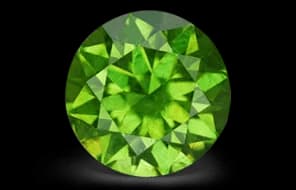
Demantoid Garnet
Demantoid Garnet is a rare green andradite garnet prized for exceptional brilliance, vivid color and remarkable rainbow-like fire.
Demantoid Garnet is one of the rarest and most distinctive members of the garnet family. It is the green variety of andradite garnet and is especially admired for its high refractive index, strong dispersion and lively flashes of spectral color. Its name reflects its diamond-like brilliance.
As an andradite garnet, Demantoid has the chemical composition Ca3Fe2(SiO4)3 and crystallizes in the cubic crystal system. It has a vitreous luster, no cleavage and a Mohs hardness of about 6.5 to 7, making it suitable for carefully selected fine jewelry. Its refractive index is typically around 1.81 to 1.89, while specific gravity is approximately 3.81 to 3.88.
Demantoid is usually green to yellowish green. Fine stones can show vivid, saturated green colors, while lighter yellow-green examples are also encountered. Color is influenced by the chemistry of the stone, including iron and, in many demantoids, chromium. The combination of intense color and exceptional dispersion gives well-cut stones an unusually lively appearance.
One of the most famous features of natural Demantoid Garnet is the so-called horsetail inclusion: radiating fibrous inclusions that can occur in some stones. These inclusions are particularly associated with demantoid from certain localities and are highly valued by collectors, although their presence does not by itself prove Russian origin. Horsetails have also been documented in demantoid from Italy and Iran.
Demantoid was first identified in Russia's Ural Mountains in the nineteenth century, establishing Russian demantoid as an important historic material. Later deposits were identified in other parts of the world, including Namibia, Madagascar, Italy, Iran and Mexico. Russian material remains especially sought after by collectors, but origin should be established through appropriate gemological evidence rather than assumed from appearance alone.
Today, Demantoid Garnet is used in rings, earrings, pendants, bracelets and collector jewelry. Because of its moderate hardness and natural inclusions, protective settings are sensible for rings intended for frequent wear. It is particularly appealing to buyers who want a green gemstone with more visible dispersion and fire than many other garnets.
Collectors value Demantoid Garnet for its rarity, distinctive green color, strong optical performance, interesting inclusions and historic Russian connection. For buyers, the most important consideration is not simply the word 'demantoid' but the individual stone's color, transparency, cut, inclusion character, provenance and laboratory identification.
- Mineral Family
- Garnet
- Chemical Formula
- Ca3Fe2(SiO4)3
- Mohs Hardness
- 6.5 - 7
- Refractive Index
- 1.81 - 1.89
- Specific Gravity
- 3.81 - 3.88
- Cleavage
- None
- Crystal System
- Cubic
- Luster
- Vitreous
- Color Range
- Green, Yellow
When buying Demantoid Garnet, begin with color. Saturated green and attractive yellowish-green stones can be highly desirable, but the best choice depends on the balance of hue, tone, saturation and overall appearance. A bright stone with strong visual life is generally more appealing than one that appears overly dark.
Clarity deserves special attention because Demantoid is valued for transparency, brilliance and fire. Natural inclusions are common, and some can add collector interest. Horsetail inclusions can be especially desirable, but they should be assessed under magnification rather than treated as an automatic guarantee of origin.
Cut has a major effect on Demantoid Garnet's appearance. Well-proportioned faceting can maximize brilliance and dispersion, producing the colorful flashes for which the gem is famous. Examine symmetry, polish, windowing, extinction and the relationship between color and brightness rather than judging the stone by shape alone.
Carat weight is another important price factor. Fine large Demantoids are uncommon, so exceptional stones can become substantially more valuable as size increases. However, carat weight should never be considered separately from color, clarity, cut and rarity.
Origin can influence collector interest and price, particularly for historically important Russian material. Nevertheless, origin should be supported by a reputable laboratory report when it is an important part of the purchase. A horsetail inclusion does not automatically establish Russian origin because similar inclusions occur in demantoid from other localities.
Demantoid is not normally associated with extensive routine treatment, so buyers should ask specifically whether a stone has undergone any treatment or enhancement. Natural and untreated material can command particular interest when supported by documentation. Lab-created demantoid is not a major mainstream category; synthetic garnets such as YAG and GGG are different materials and should not be represented as demantoid.
For a significant purchase, an independent gemological laboratory report can help confirm that the stone is natural demantoid and document relevant characteristics. Buyers should check the report number, issuing laboratory, species and variety description, measurements, weight and any stated treatments. Clear photographs, return policies and transparent disclosure from the seller are also important authenticity safeguards.
Price depends on a combination of color, clarity, cut quality, carat weight, origin, inclusion character, treatment status, rarity and market demand. There is no universal standardized 'AAA' grading system for garnet, so buyers should evaluate the actual stone and supporting documentation rather than relying on seller-created grade labels.
Demantoid Garnet can be cared for safely with warm water, mild soap and a soft brush or cloth. Rinse thoroughly after cleaning and dry with a soft, lint-free cloth. This gentle method is preferable to aggressive cleaning products.
Because Demantoid has a Mohs hardness of about 6.5 to 7 and may contain natural inclusions or fractures, avoid hard knocks and prolonged abrasion. Rings worn every day deserve particular care because they are more exposed to impact than earrings or pendants.
Avoid harsh chemicals, abrasive cleaners and sudden temperature changes. When possible, remove Demantoid jewelry before strenuous activities, household cleaning, gardening or situations where the stone could receive a sharp impact.
Store each piece separately in a soft pouch or lined jewelry compartment. Keeping Demantoid away from harder gemstones such as diamond and sapphire helps prevent scratches. For valuable or heavily included stones, professional inspection and cleaning can be worthwhile.
Demantoid Garnet is one of the rarest and most distinctive members of the garnet family. It is the green variety of andradite garnet and is especially admired for its high refractive index, strong dispersion and lively flashes of spectral color. Its name reflects its diamond-like brilliance.
As an andradite garnet, Demantoid has the chemical composition Ca3Fe2(SiO4)3 and crystallizes in the cubic crystal system. It has a vitreous luster, no cleavage and a Mohs hardness of about 6.5 to 7, making it suitable for carefully selected fine jewelry. Its refractive index is typically around 1.81 to 1.89, while specific gravity is approximately 3.81 to 3.88.
Demantoid is usually green to yellowish green. Fine stones can show vivid, saturated green colors, while lighter yellow-green examples are also encountered. Color is influenced by the chemistry of the stone, including iron and, in many demantoids, chromium. The combination of intense color and exceptional dispersion gives well-cut stones an unusually lively appearance.
One of the most famous features of natural Demantoid Garnet is the so-called horsetail inclusion: radiating fibrous inclusions that can occur in some stones. These inclusions are particularly associated with demantoid from certain localities and are highly valued by collectors, although their presence does not by itself prove Russian origin. Horsetails have also been documented in demantoid from Italy and Iran.
Demantoid was first identified in Russia's Ural Mountains in the nineteenth century, establishing Russian demantoid as an important historic material. Later deposits were identified in other parts of the world, including Namibia, Madagascar, Italy, Iran and Mexico. Russian material remains especially sought after by collectors, but origin should be established through appropriate gemological evidence rather than assumed from appearance alone.
Today, Demantoid Garnet is used in rings, earrings, pendants, bracelets and collector jewelry. Because of its moderate hardness and natural inclusions, protective settings are sensible for rings intended for frequent wear. It is particularly appealing to buyers who want a green gemstone with more visible dispersion and fire than many other garnets.
Collectors value Demantoid Garnet for its rarity, distinctive green color, strong optical performance, interesting inclusions and historic Russian connection. For buyers, the most important consideration is not simply the word 'demantoid' but the individual stone's color, transparency, cut, inclusion character, provenance and laboratory identification.
- Mineral Family
- Garnet
- Chemical Formula
- Ca3Fe2(SiO4)3
- Mohs Hardness
- 6.5 - 7
- Refractive Index
- 1.81 - 1.89
- Specific Gravity
- 3.81 - 3.88
- Cleavage
- None
- Crystal System
- Cubic
- Luster
- Vitreous
- Color Range
- Green, Yellow
When buying Demantoid Garnet, begin with color. Saturated green and attractive yellowish-green stones can be highly desirable, but the best choice depends on the balance of hue, tone, saturation and overall appearance. A bright stone with strong visual life is generally more appealing than one that appears overly dark.
Clarity deserves special attention because Demantoid is valued for transparency, brilliance and fire. Natural inclusions are common, and some can add collector interest. Horsetail inclusions can be especially desirable, but they should be assessed under magnification rather than treated as an automatic guarantee of origin.
Cut has a major effect on Demantoid Garnet's appearance. Well-proportioned faceting can maximize brilliance and dispersion, producing the colorful flashes for which the gem is famous. Examine symmetry, polish, windowing, extinction and the relationship between color and brightness rather than judging the stone by shape alone.
Carat weight is another important price factor. Fine large Demantoids are uncommon, so exceptional stones can become substantially more valuable as size increases. However, carat weight should never be considered separately from color, clarity, cut and rarity.
Origin can influence collector interest and price, particularly for historically important Russian material. Nevertheless, origin should be supported by a reputable laboratory report when it is an important part of the purchase. A horsetail inclusion does not automatically establish Russian origin because similar inclusions occur in demantoid from other localities.
Demantoid is not normally associated with extensive routine treatment, so buyers should ask specifically whether a stone has undergone any treatment or enhancement. Natural and untreated material can command particular interest when supported by documentation. Lab-created demantoid is not a major mainstream category; synthetic garnets such as YAG and GGG are different materials and should not be represented as demantoid.
For a significant purchase, an independent gemological laboratory report can help confirm that the stone is natural demantoid and document relevant characteristics. Buyers should check the report number, issuing laboratory, species and variety description, measurements, weight and any stated treatments. Clear photographs, return policies and transparent disclosure from the seller are also important authenticity safeguards.
Price depends on a combination of color, clarity, cut quality, carat weight, origin, inclusion character, treatment status, rarity and market demand. There is no universal standardized 'AAA' grading system for garnet, so buyers should evaluate the actual stone and supporting documentation rather than relying on seller-created grade labels.
Demantoid Garnet can be cared for safely with warm water, mild soap and a soft brush or cloth. Rinse thoroughly after cleaning and dry with a soft, lint-free cloth. This gentle method is preferable to aggressive cleaning products.
Because Demantoid has a Mohs hardness of about 6.5 to 7 and may contain natural inclusions or fractures, avoid hard knocks and prolonged abrasion. Rings worn every day deserve particular care because they are more exposed to impact than earrings or pendants.
Avoid harsh chemicals, abrasive cleaners and sudden temperature changes. When possible, remove Demantoid jewelry before strenuous activities, household cleaning, gardening or situations where the stone could receive a sharp impact.
Store each piece separately in a soft pouch or lined jewelry compartment. Keeping Demantoid away from harder gemstones such as diamond and sapphire helps prevent scratches. For valuable or heavily included stones, professional inspection and cleaning can be worthwhile.
Demantoid Garnet for Sale
No gems found
Try broadening your search or adjusting your filters.
Have a gem of your own? List it free - no fees