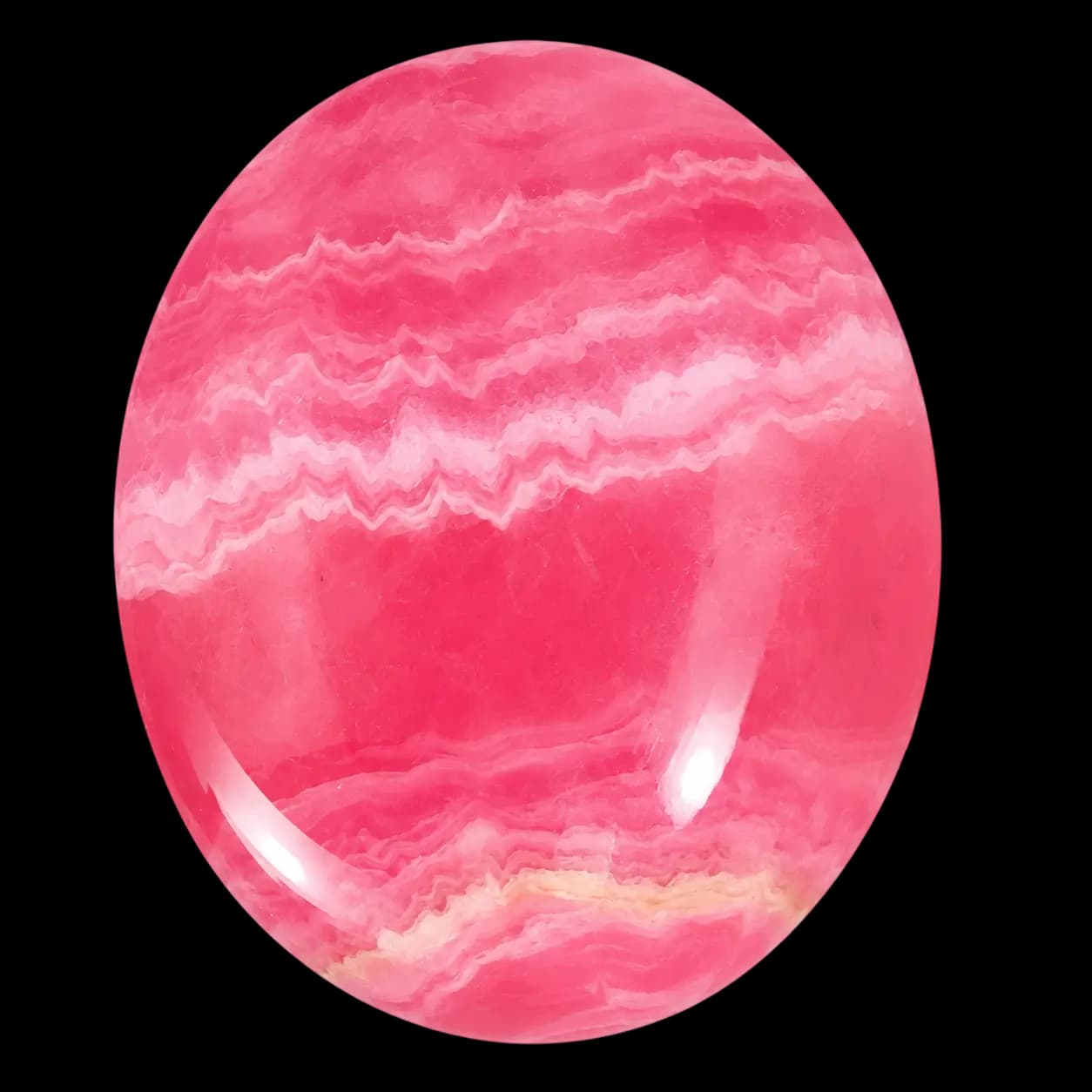
Rhodochrosite
Rhodochrosite is a captivating pink to rose-red gemstone admired for its unique banding, vibrant color, and collectible beauty. Its delicate appearance makes it a distinctive choice for jewelry and mineral collectors.
Rhodochrosite is a manganese carbonate gemstone belonging to the calcite mineral group. Its name comes from the Greek words meaning “rose-colored,” reflecting its characteristic pink and red hues.
The gemstone forms through mineral deposits in hydrothermal veins and manganese-rich environments. Its chemical composition is manganese carbonate (MnCO3), and it crystallizes in the trigonal crystal system. Rhodochrosite has a Mohs hardness of 3.5-4, making it a relatively soft gemstone that requires careful handling.
Natural Rhodochrosite is best known for shades of pink, rose-red, orange, and reddish-brown, often displaying attractive white banding or patterns caused by mineral growth. Transparent crystals are rare, while banded varieties are more commonly used as cabochons and ornamental stones.
Important sources of Rhodochrosite include Argentina, Peru, South Africa, Romania, and the United States. The famous Sweet Home Mine in Colorado, USA, produced exceptional red rhodochrosite crystals that are highly valued by collectors. Argentina is also renowned for its beautifully patterned banded Rhodochrosite specimens.
Throughout history, Rhodochrosite has been appreciated as both a mineral specimen and a decorative gemstone. Today, Rhodochrosite jewelry such as rings, pendants, earrings, and bracelets is valued for its distinctive appearance and rarity. Buyers appreciate natural Rhodochrosite for its unusual color patterns, individuality, and collector appeal.
- Mineral Family
- Carbonate
- Chemical Formula
- MnCO3
- Mohs Hardness
- 3.5 - 4
- Refractive Index
- 1.597 to 1.820
- Specific Gravity
- 3.45 - 3.70
- Cleavage
- Perfect rhombohedral cleavage
- Crystal System
- Trigonal
- Luster
- Vitreous
- Color Range
- Pink, Red, Orange, White
When buying Rhodochrosite gemstone, several factors influence quality and value.
Color: The most desirable Rhodochrosite displays vivid pink to intense rose-red colors with attractive saturation. Strong, even colors generally increase value.
Clarity: Most Rhodochrosite used in jewelry is opaque to translucent. Fine transparent crystals are rare and highly collectible. Attractive white banding and patterns can add to the gemstone's appeal.
Cut: Due to its softness, Rhodochrosite is commonly cut as cabochons rather than faceted stones. Skilled cutting highlights its natural patterns and color.
Carat: Larger Rhodochrosite specimens with excellent color, patterns, or transparency are uncommon and may command higher prices.
Origin: Geographic origin can influence collector interest. Specimens from notable locations such as the Sweet Home Mine in Colorado or Argentine deposits are especially appreciated.
Treatments: Natural Rhodochrosite is generally valued without enhancements. Buyers should ask whether any treatments or stabilization methods have been applied.
Natural vs Lab-Grown: Natural Rhodochrosite is preferred by collectors because of its unique formation patterns and geological history. Synthetic alternatives are uncommon compared with many other gemstones.
Certification: A reputable gemological certificate can confirm gemstone identity, characteristics, and any disclosed treatments. When buying Rhodochrosite online, choose sellers who provide accurate descriptions and authenticity information.
Rhodochrosite requires gentle care because of its low hardness and perfect cleavage. Clean your Rhodochrosite jewelry using lukewarm water, mild soap, and a soft cloth. Avoid ultrasonic cleaners, steam cleaners, and harsh chemicals that may damage the gemstone.
Store Rhodochrosite separately from harder gemstones such as diamonds, sapphires, and quartz to prevent scratches. Keep pieces in a soft pouch or lined jewelry box.
Because of its softness, Rhodochrosite jewelry is best suited for earrings, pendants, and occasional-wear rings. Remove Rhodochrosite jewelry before activities that may expose it to impact, chemicals, or abrasion.
Rhodochrosite is a manganese carbonate gemstone belonging to the calcite mineral group. Its name comes from the Greek words meaning “rose-colored,” reflecting its characteristic pink and red hues.
The gemstone forms through mineral deposits in hydrothermal veins and manganese-rich environments. Its chemical composition is manganese carbonate (MnCO3), and it crystallizes in the trigonal crystal system. Rhodochrosite has a Mohs hardness of 3.5-4, making it a relatively soft gemstone that requires careful handling.
Natural Rhodochrosite is best known for shades of pink, rose-red, orange, and reddish-brown, often displaying attractive white banding or patterns caused by mineral growth. Transparent crystals are rare, while banded varieties are more commonly used as cabochons and ornamental stones.
Important sources of Rhodochrosite include Argentina, Peru, South Africa, Romania, and the United States. The famous Sweet Home Mine in Colorado, USA, produced exceptional red rhodochrosite crystals that are highly valued by collectors. Argentina is also renowned for its beautifully patterned banded Rhodochrosite specimens.
Throughout history, Rhodochrosite has been appreciated as both a mineral specimen and a decorative gemstone. Today, Rhodochrosite jewelry such as rings, pendants, earrings, and bracelets is valued for its distinctive appearance and rarity. Buyers appreciate natural Rhodochrosite for its unusual color patterns, individuality, and collector appeal.
- Mineral Family
- Carbonate
- Chemical Formula
- MnCO3
- Mohs Hardness
- 3.5 - 4
- Refractive Index
- 1.597 to 1.820
- Specific Gravity
- 3.45 - 3.70
- Cleavage
- Perfect rhombohedral cleavage
- Crystal System
- Trigonal
- Luster
- Vitreous
- Color Range
- Pink, Red, Orange, White
When buying Rhodochrosite gemstone, several factors influence quality and value.
Color: The most desirable Rhodochrosite displays vivid pink to intense rose-red colors with attractive saturation. Strong, even colors generally increase value.
Clarity: Most Rhodochrosite used in jewelry is opaque to translucent. Fine transparent crystals are rare and highly collectible. Attractive white banding and patterns can add to the gemstone's appeal.
Cut: Due to its softness, Rhodochrosite is commonly cut as cabochons rather than faceted stones. Skilled cutting highlights its natural patterns and color.
Carat: Larger Rhodochrosite specimens with excellent color, patterns, or transparency are uncommon and may command higher prices.
Origin: Geographic origin can influence collector interest. Specimens from notable locations such as the Sweet Home Mine in Colorado or Argentine deposits are especially appreciated.
Treatments: Natural Rhodochrosite is generally valued without enhancements. Buyers should ask whether any treatments or stabilization methods have been applied.
Natural vs Lab-Grown: Natural Rhodochrosite is preferred by collectors because of its unique formation patterns and geological history. Synthetic alternatives are uncommon compared with many other gemstones.
Certification: A reputable gemological certificate can confirm gemstone identity, characteristics, and any disclosed treatments. When buying Rhodochrosite online, choose sellers who provide accurate descriptions and authenticity information.
Rhodochrosite requires gentle care because of its low hardness and perfect cleavage. Clean your Rhodochrosite jewelry using lukewarm water, mild soap, and a soft cloth. Avoid ultrasonic cleaners, steam cleaners, and harsh chemicals that may damage the gemstone.
Store Rhodochrosite separately from harder gemstones such as diamonds, sapphires, and quartz to prevent scratches. Keep pieces in a soft pouch or lined jewelry box.
Because of its softness, Rhodochrosite jewelry is best suited for earrings, pendants, and occasional-wear rings. Remove Rhodochrosite jewelry before activities that may expose it to impact, chemicals, or abrasion.
Rhodochrosite for Sale
No gems found
Try broadening your search or adjusting your filters.
Have a gem of your own? List it free - no fees