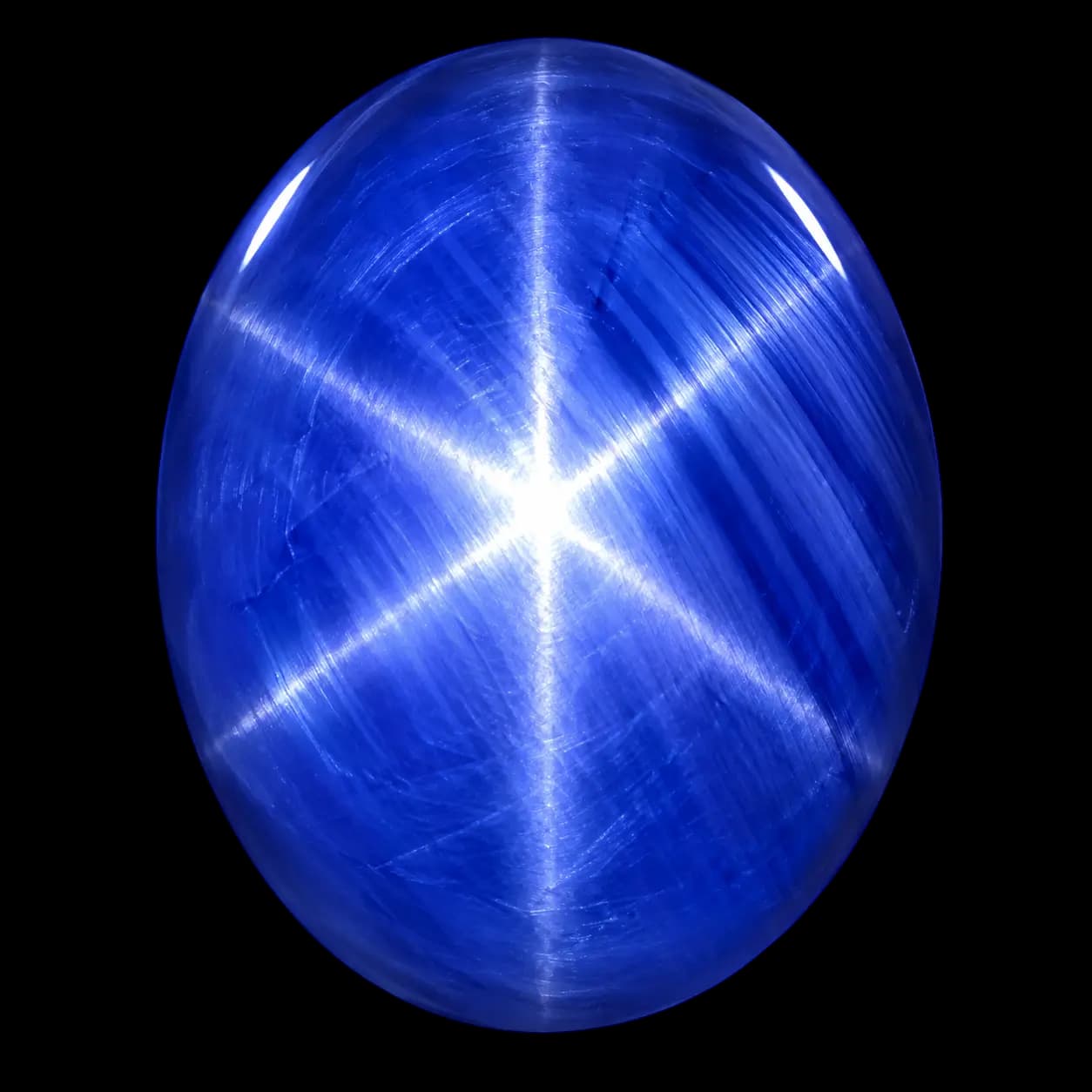
Blue Star Sapphire
Blue Star Sapphire is a rare variety of sapphire known for its captivating asterism, creating a distinctive star-like reflection across its surface. Its deep blue color, durability, and unique optical beauty make it highly valued by collectors and jewelry enthusiasts.
Blue Star Sapphire is a variety of corundum, the same mineral family as traditional sapphire and ruby. Its chemical composition is aluminum oxide with trace elements that create its characteristic blue color. The gemstone forms deep within the Earth under high-pressure geological conditions and is found in regions including Sri Lanka, Thailand, Myanmar, Madagascar, and other sapphire-producing areas.
The defining feature of Blue Star Sapphire is asterism, an optical phenomenon that produces a six-rayed star pattern when the stone is cut as a cabochon. This effect is caused by microscopic rutile inclusions, often called silk, that reflect light in a star-like formation. The visibility and sharpness of the star greatly influence the gemstone’s value.
With a Mohs hardness of 9, sapphire is one of the hardest natural gemstones after diamond, making Blue Star Sapphire suitable for rings, pendants, earrings, and other fine jewelry. It has a vitreous luster and excellent durability, although it should still be protected from strong impacts.
Collectors appreciate Blue Star Sapphire for its rarity, natural optical effect, and individuality. Each stone displays a unique combination of color, transparency, and star formation, making it a distinctive choice among colored gemstones.
- Mineral Family
- Corundum
- Chemical Formula
- Al₂O₃
- Mohs Hardness
- 9
- Refractive Index
- 1.760 - 1.770
- Specific Gravity
- 3.95 - 4.03
- Cleavage
- None
- Crystal System
- Trigonal
- Luster
- Vitreous
- Color Range
- Blue, Gray, Black
When buying Blue Star Sapphire, evaluate color, clarity, cut, carat weight, origin, and treatment history.
Color is one of the most important factors. Premium stones usually display a rich, evenly distributed blue color with good saturation. The star effect should be centered, sharp, and clearly visible under light.
Clarity in star sapphires differs from transparent sapphires because rutile inclusions create the asterism. A balanced amount of silk is desirable, while excessive inclusions may reduce transparency and value.
The cabochon cut is essential because it reveals the star effect. A well-shaped dome allows the star to appear clearly and enhances the gemstone’s visual appeal.
Natural Blue Star Sapphire is more valuable than synthetic alternatives, especially when it has strong color, a sharp star, and minimal treatment. Buyers should request gemological certification confirming authenticity and any treatments applied.
Pricing depends on quality, size, origin, color intensity, and the strength of the star effect. Buying from reputable gemstone sellers and reviewing certification helps ensure a secure purchase.
Blue Star Sapphire is durable enough for regular jewelry use but should be handled with care. Clean the gemstone using warm water, mild soap, and a soft brush to remove dirt.
Avoid harsh chemicals, sudden temperature changes, and abrasive materials that may damage the surface. Ultrasonic and steam cleaners should be used cautiously, especially if the gemstone has fractures or treatments.
Store Blue Star Sapphire separately from softer gemstones to prevent scratches. Regular professional inspections are recommended for mounted jewelry to check settings and maintain long-term beauty.
Blue Star Sapphire is a variety of corundum, the same mineral family as traditional sapphire and ruby. Its chemical composition is aluminum oxide with trace elements that create its characteristic blue color. The gemstone forms deep within the Earth under high-pressure geological conditions and is found in regions including Sri Lanka, Thailand, Myanmar, Madagascar, and other sapphire-producing areas.
The defining feature of Blue Star Sapphire is asterism, an optical phenomenon that produces a six-rayed star pattern when the stone is cut as a cabochon. This effect is caused by microscopic rutile inclusions, often called silk, that reflect light in a star-like formation. The visibility and sharpness of the star greatly influence the gemstone’s value.
With a Mohs hardness of 9, sapphire is one of the hardest natural gemstones after diamond, making Blue Star Sapphire suitable for rings, pendants, earrings, and other fine jewelry. It has a vitreous luster and excellent durability, although it should still be protected from strong impacts.
Collectors appreciate Blue Star Sapphire for its rarity, natural optical effect, and individuality. Each stone displays a unique combination of color, transparency, and star formation, making it a distinctive choice among colored gemstones.
- Mineral Family
- Corundum
- Chemical Formula
- Al₂O₃
- Mohs Hardness
- 9
- Refractive Index
- 1.760 - 1.770
- Specific Gravity
- 3.95 - 4.03
- Cleavage
- None
- Crystal System
- Trigonal
- Luster
- Vitreous
- Color Range
- Blue, Gray, Black
When buying Blue Star Sapphire, evaluate color, clarity, cut, carat weight, origin, and treatment history.
Color is one of the most important factors. Premium stones usually display a rich, evenly distributed blue color with good saturation. The star effect should be centered, sharp, and clearly visible under light.
Clarity in star sapphires differs from transparent sapphires because rutile inclusions create the asterism. A balanced amount of silk is desirable, while excessive inclusions may reduce transparency and value.
The cabochon cut is essential because it reveals the star effect. A well-shaped dome allows the star to appear clearly and enhances the gemstone’s visual appeal.
Natural Blue Star Sapphire is more valuable than synthetic alternatives, especially when it has strong color, a sharp star, and minimal treatment. Buyers should request gemological certification confirming authenticity and any treatments applied.
Pricing depends on quality, size, origin, color intensity, and the strength of the star effect. Buying from reputable gemstone sellers and reviewing certification helps ensure a secure purchase.
Blue Star Sapphire is durable enough for regular jewelry use but should be handled with care. Clean the gemstone using warm water, mild soap, and a soft brush to remove dirt.
Avoid harsh chemicals, sudden temperature changes, and abrasive materials that may damage the surface. Ultrasonic and steam cleaners should be used cautiously, especially if the gemstone has fractures or treatments.
Store Blue Star Sapphire separately from softer gemstones to prevent scratches. Regular professional inspections are recommended for mounted jewelry to check settings and maintain long-term beauty.
Blue Star Sapphire for Sale
No gems found
Try broadening your search or adjusting your filters.
Have a gem of your own? List it free - no fees