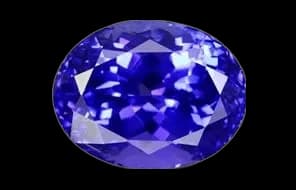
Tanzanite
Tanzanite is a rare blue-to-violet gemstone prized for its vivid color, striking pleochroism and remarkable origin from northern Tanzania.
Tanzanite is the blue to violet variety of the mineral zoisite and is one of the most distinctive modern colored gemstones. It is found commercially in only one known location: the Merelani Hills of northern Tanzania, near Mount Kilimanjaro. The first crystals were identified in the 1960s, and the name Tanzanite was introduced during its international promotion by Tiffany & Co. in the late 1960s. Today, its restricted geographic source and exceptional color make it highly sought after by jewelry buyers and collectors. Tanzanite has the chemical formula Ca₂Al₃(SiO₄)₃(OH), a monoclinic crystal system, vitreous luster, a Mohs hardness of 6-7, a specific gravity of approximately 3.35, and a refractive index of 1.691-1.700. Its most characteristic optical feature is strong pleochroism: a Tanzanite crystal can display different blue, violet and other hues depending on the viewing direction. Fine faceted stones commonly show rich blue, violet-blue or bluish-violet colors, with deeply saturated violet-blue and blue-violet material generally commanding the greatest interest. Most Tanzanite sold in the jewelry market is heat treated. Natural rough is commonly brownish before treatment, while controlled heating can produce the blue-to-violet colors associated with fine Tanzanite. The treatment is considered stable, but buyers should always have treatment information disclosed. Tanzanite became a December birthstone and is also associated with the 24th wedding anniversary. It is especially attractive in rings, earrings, pendants and other fine jewelry, although its moderate hardness and cleavage make protective settings and sensible wear important. Tanzanite is valued not only for its beauty but also for its single commercial source, strong pleochroism, high clarity potential and limited availability.
- Mineral Family
- Zoisite
- Chemical Formula
- Ca₂Al₃(SiO₄)₃(OH)
- Mohs Hardness
- 6 - 7
- Refractive Index
- 1.691 - 1.700
- Specific Gravity
- 3.35
- Cleavage
- Perfect in one direction
- Crystal System
- Monoclinic
- Luster
- Vitreous
- Color Range
- Blue, Purple
When buying a natural Tanzanite gemstone, evaluate color, clarity, cut, carat weight, origin, treatment and documentation together. Color is usually the most important visual consideration. Deep, saturated blue-violet and violet-blue hues are among the most desirable, while very pale stones are generally less valuable. Because Tanzanite is strongly pleochroic, the orientation of the rough during cutting can influence whether blue, violet or other pleochroic tones dominate the finished gem. Clarity is also important: many attractive Tanzanites are relatively clean to the unaided eye, while obvious inclusions or fractures can reduce beauty and durability. Cut should maximize both brilliance and the most attractive pleochroic color without creating excessive windowing or sacrificing symmetry. Carat weight affects price, and larger stones can display stronger color saturation; however, size alone does not determine quality. Origin is particularly significant because Tanzanite is commercially mined only in the Merelani Hills of Tanzania. Treatment should always be disclosed. Most blue Tanzanite on the market has been heat treated, commonly starting from brownish zoisite, and heat treatment does not automatically make a Tanzanite undesirable. Natural versus lab-grown should also be clearly identified. Buyers should understand that natural Tanzanite and synthetic or imitation materials are different categories, and a reputable independent gemological report can help establish identity and disclose relevant treatment information. When you buy Tanzanite online, look for clear photographs, accurate measurements, carat weight, treatment disclosure, return terms and a trustworthy laboratory report for valuable stones. Price is influenced by the combination of color saturation, hue, clarity, cut quality, carat weight, treatment disclosure, provenance and overall rarity rather than by a single characteristic.
Tanzanite requires thoughtful care because its Mohs hardness of 6-7 and cleavage make it more vulnerable to scratching, chipping and damage than harder gemstones such as sapphire. Clean Tanzanite jewelry with lukewarm water, mild soap and a soft cloth or very soft brush. Ultrasonic and steam cleaners are not recommended. Avoid sudden temperature changes, very high heat, harsh chemicals and activities that could expose the gemstone to impact. Apply perfume, hairspray and cosmetics before putting on Tanzanite jewelry. For everyday wear, earrings and pendants are generally safer choices than rings because they receive less impact. If wearing a Tanzanite ring, choose a protective setting and remove it before sports, heavy work, gardening or other activities where the stone could be struck. Store Tanzanite separately in a soft pouch or fabric-lined compartment so it does not come into contact with harder gemstones or jewelry. Periodic professional inspection is recommended for valuable Tanzanite jewelry, particularly when the stone is mounted in a ring.
Tanzanite is the blue to violet variety of the mineral zoisite and is one of the most distinctive modern colored gemstones. It is found commercially in only one known location: the Merelani Hills of northern Tanzania, near Mount Kilimanjaro. The first crystals were identified in the 1960s, and the name Tanzanite was introduced during its international promotion by Tiffany & Co. in the late 1960s. Today, its restricted geographic source and exceptional color make it highly sought after by jewelry buyers and collectors. Tanzanite has the chemical formula Ca₂Al₃(SiO₄)₃(OH), a monoclinic crystal system, vitreous luster, a Mohs hardness of 6-7, a specific gravity of approximately 3.35, and a refractive index of 1.691-1.700. Its most characteristic optical feature is strong pleochroism: a Tanzanite crystal can display different blue, violet and other hues depending on the viewing direction. Fine faceted stones commonly show rich blue, violet-blue or bluish-violet colors, with deeply saturated violet-blue and blue-violet material generally commanding the greatest interest. Most Tanzanite sold in the jewelry market is heat treated. Natural rough is commonly brownish before treatment, while controlled heating can produce the blue-to-violet colors associated with fine Tanzanite. The treatment is considered stable, but buyers should always have treatment information disclosed. Tanzanite became a December birthstone and is also associated with the 24th wedding anniversary. It is especially attractive in rings, earrings, pendants and other fine jewelry, although its moderate hardness and cleavage make protective settings and sensible wear important. Tanzanite is valued not only for its beauty but also for its single commercial source, strong pleochroism, high clarity potential and limited availability.
- Mineral Family
- Zoisite
- Chemical Formula
- Ca₂Al₃(SiO₄)₃(OH)
- Mohs Hardness
- 6 - 7
- Refractive Index
- 1.691 - 1.700
- Specific Gravity
- 3.35
- Cleavage
- Perfect in one direction
- Crystal System
- Monoclinic
- Luster
- Vitreous
- Color Range
- Blue, Purple
When buying a natural Tanzanite gemstone, evaluate color, clarity, cut, carat weight, origin, treatment and documentation together. Color is usually the most important visual consideration. Deep, saturated blue-violet and violet-blue hues are among the most desirable, while very pale stones are generally less valuable. Because Tanzanite is strongly pleochroic, the orientation of the rough during cutting can influence whether blue, violet or other pleochroic tones dominate the finished gem. Clarity is also important: many attractive Tanzanites are relatively clean to the unaided eye, while obvious inclusions or fractures can reduce beauty and durability. Cut should maximize both brilliance and the most attractive pleochroic color without creating excessive windowing or sacrificing symmetry. Carat weight affects price, and larger stones can display stronger color saturation; however, size alone does not determine quality. Origin is particularly significant because Tanzanite is commercially mined only in the Merelani Hills of Tanzania. Treatment should always be disclosed. Most blue Tanzanite on the market has been heat treated, commonly starting from brownish zoisite, and heat treatment does not automatically make a Tanzanite undesirable. Natural versus lab-grown should also be clearly identified. Buyers should understand that natural Tanzanite and synthetic or imitation materials are different categories, and a reputable independent gemological report can help establish identity and disclose relevant treatment information. When you buy Tanzanite online, look for clear photographs, accurate measurements, carat weight, treatment disclosure, return terms and a trustworthy laboratory report for valuable stones. Price is influenced by the combination of color saturation, hue, clarity, cut quality, carat weight, treatment disclosure, provenance and overall rarity rather than by a single characteristic.
Tanzanite requires thoughtful care because its Mohs hardness of 6-7 and cleavage make it more vulnerable to scratching, chipping and damage than harder gemstones such as sapphire. Clean Tanzanite jewelry with lukewarm water, mild soap and a soft cloth or very soft brush. Ultrasonic and steam cleaners are not recommended. Avoid sudden temperature changes, very high heat, harsh chemicals and activities that could expose the gemstone to impact. Apply perfume, hairspray and cosmetics before putting on Tanzanite jewelry. For everyday wear, earrings and pendants are generally safer choices than rings because they receive less impact. If wearing a Tanzanite ring, choose a protective setting and remove it before sports, heavy work, gardening or other activities where the stone could be struck. Store Tanzanite separately in a soft pouch or fabric-lined compartment so it does not come into contact with harder gemstones or jewelry. Periodic professional inspection is recommended for valuable Tanzanite jewelry, particularly when the stone is mounted in a ring.
Tanzanite for Sale
No gems found
Try broadening your search or adjusting your filters.
Have a gem of your own? List it free - no fees