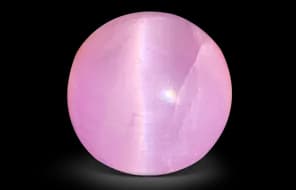
Cats Eye Kunzite
Cat's Eye Kunzite is a rare chatoyant variety of kunzite, prized for its delicate pink-to-violet color and distinctive moving band of light.
Cat's Eye Kunzite is the chatoyant form of kunzite, the pink-to-violet gem variety of spodumene. Its chemical formula is LiAlSi2O6, and it belongs to the monoclinic crystal system. Kunzite typically has a vitreous luster, a Mohs hardness of 6.5 to 7, a refractive index of 1.660 to 1.676, and a specific gravity of about 3.18. Its perfect cleavage in two directions makes it comparatively fragile despite its respectable hardness. Kunzite was recognized as a distinct gemstone variety around 1902 and was named after gemologist George Frederick Kunz. Important historical material came from Pala in California, while gem-quality spodumene has also been found in Brazil, Afghanistan, Madagascar and other pegmatite regions. The cat's-eye phenomenon, known as chatoyancy, occurs when parallel needle-like or fibrous inclusions reflect light into a narrow band across a properly oriented cabochon. This phenomenon is uncommon in kunzite and can make a specimen particularly collectible. Cat's Eye Kunzite generally occurs in pink, lilac and violet shades, with pleochroism causing the apparent color to vary as the stone is viewed from different directions. Kunzite is commonly fashioned as large faceted gems, while chatoyant material is normally shaped as cabochons to display the eye. Notable kunzite specimens have been produced in very large sizes, although exceptional size alone does not establish chatoyancy. Buyers value natural Cat's Eye Kunzite for its unusual optical effect, attractive color, rarity and individuality. Because the term cat's-eye can also refer to chrysoberyl by default, a gemstone marketed specifically as Cat's Eye Kunzite should be identified as kunzite with chatoyancy rather than simply 'cat's-eye'.
- Mineral Family
- Spodumene
- Chemical Formula
- LiAlSi2O6
- Mohs Hardness
- 6.5 - 7
- Refractive Index
- 1.660 - 1.676
- Specific Gravity
- 3.18
- Cleavage
- Perfect in two directions
- Crystal System
- Monoclinic
- Luster
- Vitreous
- Color Range
- Pink, Purple
When buying Cat's Eye Kunzite, evaluate the color, clarity, chatoyancy, cut, carat weight, origin and treatment history together. Color is an important factor in kunzite, with stronger and more attractive pink or violet tones generally commanding greater interest. For chatoyant material, the eye is especially important: look for a bright, sharp and continuous band that moves clearly across the domed surface when the stone is rotated under a focused light source. A centered eye with good contrast is generally more desirable than a weak or diffuse effect. Clarity also matters, although the aligned inclusions responsible for chatoyancy are expected in this material. The cabochon should be correctly oriented to maximize the optical effect and should have a smooth, well-proportioned dome. Larger kunzite is relatively common compared with many other fine gemstones, but genuinely attractive chatoyant material is much less common, so rarity and optical quality can have a strong influence on price. Origin may add provenance interest, but it should not automatically be treated as a guarantee of superior quality. Kunzite can be irradiated and heated to alter or improve color, and some treated colors may fade with prolonged exposure to strong light or heat. Ask the seller to disclose all known treatments. Natural and laboratory-grown material should be clearly distinguished; do not assume that an attractive stone is natural without appropriate identification. For valuable Cat's Eye Kunzite, an independent laboratory report can confirm the gemstone identity, natural or laboratory-grown status and detectable treatments. Look for consistent gemological documentation, accurate weight and measurements, clear photographs of the moving eye, and a reputable seller. Price is influenced by color quality, strength and sharpness of chatoyancy, clarity, cut, size, provenance and treatment status.
Clean Cat's Eye Kunzite with lukewarm water, mild soap and a soft cloth or soft brush. Rinse carefully and dry with a clean cloth. Because kunzite has perfect cleavage and can be damaged by impact or sudden temperature changes, avoid ultrasonic and steam cleaners. Remove kunzite jewelry before activities involving knocks, pressure or harsh chemicals. Prolonged exposure to intense heat or bright light can affect the color of some kunzite, particularly treated material, so store it away from direct sunlight and strong heat sources. Keep it separately from harder gemstones to prevent scratches, ideally in a soft-lined compartment or individual pouch. For everyday jewelry, pendants and earrings are generally more suitable than rings because they receive less impact.
Cat's Eye Kunzite is the chatoyant form of kunzite, the pink-to-violet gem variety of spodumene. Its chemical formula is LiAlSi2O6, and it belongs to the monoclinic crystal system. Kunzite typically has a vitreous luster, a Mohs hardness of 6.5 to 7, a refractive index of 1.660 to 1.676, and a specific gravity of about 3.18. Its perfect cleavage in two directions makes it comparatively fragile despite its respectable hardness. Kunzite was recognized as a distinct gemstone variety around 1902 and was named after gemologist George Frederick Kunz. Important historical material came from Pala in California, while gem-quality spodumene has also been found in Brazil, Afghanistan, Madagascar and other pegmatite regions. The cat's-eye phenomenon, known as chatoyancy, occurs when parallel needle-like or fibrous inclusions reflect light into a narrow band across a properly oriented cabochon. This phenomenon is uncommon in kunzite and can make a specimen particularly collectible. Cat's Eye Kunzite generally occurs in pink, lilac and violet shades, with pleochroism causing the apparent color to vary as the stone is viewed from different directions. Kunzite is commonly fashioned as large faceted gems, while chatoyant material is normally shaped as cabochons to display the eye. Notable kunzite specimens have been produced in very large sizes, although exceptional size alone does not establish chatoyancy. Buyers value natural Cat's Eye Kunzite for its unusual optical effect, attractive color, rarity and individuality. Because the term cat's-eye can also refer to chrysoberyl by default, a gemstone marketed specifically as Cat's Eye Kunzite should be identified as kunzite with chatoyancy rather than simply 'cat's-eye'.
- Mineral Family
- Spodumene
- Chemical Formula
- LiAlSi2O6
- Mohs Hardness
- 6.5 - 7
- Refractive Index
- 1.660 - 1.676
- Specific Gravity
- 3.18
- Cleavage
- Perfect in two directions
- Crystal System
- Monoclinic
- Luster
- Vitreous
- Color Range
- Pink, Purple
When buying Cat's Eye Kunzite, evaluate the color, clarity, chatoyancy, cut, carat weight, origin and treatment history together. Color is an important factor in kunzite, with stronger and more attractive pink or violet tones generally commanding greater interest. For chatoyant material, the eye is especially important: look for a bright, sharp and continuous band that moves clearly across the domed surface when the stone is rotated under a focused light source. A centered eye with good contrast is generally more desirable than a weak or diffuse effect. Clarity also matters, although the aligned inclusions responsible for chatoyancy are expected in this material. The cabochon should be correctly oriented to maximize the optical effect and should have a smooth, well-proportioned dome. Larger kunzite is relatively common compared with many other fine gemstones, but genuinely attractive chatoyant material is much less common, so rarity and optical quality can have a strong influence on price. Origin may add provenance interest, but it should not automatically be treated as a guarantee of superior quality. Kunzite can be irradiated and heated to alter or improve color, and some treated colors may fade with prolonged exposure to strong light or heat. Ask the seller to disclose all known treatments. Natural and laboratory-grown material should be clearly distinguished; do not assume that an attractive stone is natural without appropriate identification. For valuable Cat's Eye Kunzite, an independent laboratory report can confirm the gemstone identity, natural or laboratory-grown status and detectable treatments. Look for consistent gemological documentation, accurate weight and measurements, clear photographs of the moving eye, and a reputable seller. Price is influenced by color quality, strength and sharpness of chatoyancy, clarity, cut, size, provenance and treatment status.
Clean Cat's Eye Kunzite with lukewarm water, mild soap and a soft cloth or soft brush. Rinse carefully and dry with a clean cloth. Because kunzite has perfect cleavage and can be damaged by impact or sudden temperature changes, avoid ultrasonic and steam cleaners. Remove kunzite jewelry before activities involving knocks, pressure or harsh chemicals. Prolonged exposure to intense heat or bright light can affect the color of some kunzite, particularly treated material, so store it away from direct sunlight and strong heat sources. Keep it separately from harder gemstones to prevent scratches, ideally in a soft-lined compartment or individual pouch. For everyday jewelry, pendants and earrings are generally more suitable than rings because they receive less impact.
Cats Eye Kunzite for Sale
No gems found
Try broadening your search or adjusting your filters.
Have a gem of your own? List it free - no fees