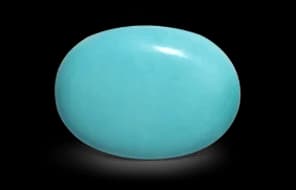
Turquoise
Turquoise is an iconic opaque gemstone prized for its vivid blue to green color, distinctive matrix patterns, rich history, and expressive appeal in jewelry.
Turquoise is a naturally occurring, opaque to occasionally translucent phosphate mineral recognized for its distinctive blue, blue-green, and green colors. It belongs to the turquoise mineral group and has the ideal chemical formula CuAl6(PO4)4(OH)8 / 4H2O. Its triclinic crystal system is rarely expressed as visible crystals because gem-quality turquoise commonly occurs as massive, granular, vein-like, or nodular material. Turquoise forms as a secondary mineral, commonly through the action of mineral-rich groundwater in arid environments and in association with copper-bearing geological systems. Copper contributes strongly to its characteristic blue coloration, while iron substitutions can shift the color toward green. Turquoise typically has a Mohs hardness of 5-6, a specific gravity of about 2.60-2.80, and a refractive index of approximately 1.610-1.650. Its luster can range from waxy and resinous to sub-vitreous, depending on texture and quality. The most recognized colors include vivid blue, sky blue, blue-green, and green. Some material contains natural matrix, consisting of remnants of the host rock, which can appear as dark veins or web-like patterns. Clean, evenly colored turquoise is often highly sought after, while spiderweb matrix can also be desirable among collectors depending on its character and provenance. Turquoise has one of the longest histories of gemstone use, with archaeological evidence of its use extending back thousands of years. Ancient Egypt, Persia, China, Mesoamerica, and Indigenous cultures of North America all incorporated turquoise into ornaments, carvings, ceremonial objects, and jewelry. Important historical and commercial sources include Iran, the southwestern United States, China, Mexico, and other regions with suitable arid geological environments. Today, natural turquoise gemstone material is commonly fashioned into cabochons, beads, carvings, inlays, pendants, earrings, bracelets, and statement rings. Because turquoise is opaque, cabochon cutting is especially common and allows its color and matrix patterns to remain the visual focus. Buyers value turquoise for its unmistakable color, natural variation, historical importance, and ability to give jewelry a distinctive character that differs from transparent faceted gemstones.
- Mineral Family
- Turquoise
- Chemical Formula
- CuAl6(PO4)4(OH)8 / 4H2O
- Mohs Hardness
- 5 - 6
- Refractive Index
- 1.610 - 1.650
- Specific Gravity
- 2.60 - 2.80
- Cleavage
- Perfect
- Crystal System
- Triclinic
- Luster
- Waxy
- Color Range
- Blue, Green
When buying Turquoise online, evaluate the stone as a combination of color, texture, matrix, craftsmanship, treatment status, and provenance rather than relying on color alone. Color: Vivid, evenly distributed blue is traditionally among the most prized appearances, although attractive blue-green and green turquoise can also be valuable. Color preference is subjective, and market value depends on quality and provenance. Clarity and texture: Turquoise is generally opaque. A fine, compact texture with a smooth, even appearance is often desirable. Natural matrix may be present as veins or patches of the host rock; it does not automatically indicate poor quality, and attractive spiderweb matrix can be highly collectible. Cut: Turquoise is most commonly fashioned as cabochons, beads, carvings, or inlays because its opaque nature and moderate hardness are well suited to polished forms rather than conventional faceting. Look for symmetrical cutting, a smooth polish, and a shape appropriate for the intended jewelry design. Carat: Larger pieces of fine-quality turquoise with consistent color and texture can be scarce, so size can influence value. For turquoise, dimensions, weight, quality, and usable material are often considered together. Origin: Iran has a long historical association with high-quality turquoise, while material from the southwestern United States, China, Mexico, and other localities can also be important to collectors and jewelry buyers. Origin should be supported by credible documentation when it is presented as a value factor. Treatments: Turquoise may be stabilized with resins or other substances to improve durability and handling characteristics. Other treatments can alter color or appearance. Ask whether the stone is natural, stabilized, dyed, reconstituted, or otherwise treated. Natural and lab-grown: Natural turquoise occurs in nature. Laboratory-created turquoise-like materials and imitation products may also be encountered, so sellers should clearly disclose what is being offered. Certification: A reputable gemological report can help document identity and disclose detectable treatments, particularly for higher-value material. Authenticity: Do not rely only on color or photographs. Ask for treatment disclosure, origin claims where relevant, clear product specifications, and an independent report for significant purchases. Price factors: Value is influenced by color, texture, matrix pattern, size, craftsmanship, treatment status, rarity, provenance, and market demand. Before you buy Turquoise online, compare these factors together and choose a seller that provides transparent descriptions and appropriate documentation.
Turquoise jewelry requires more care than many harder gemstones because its Mohs hardness is only 5-6 and the material can be porous. Cleaning: Gently wipe turquoise with a soft, slightly damp cloth. If necessary, use a small amount of mild soapy water, then wipe away residue and dry thoroughly. Avoid prolonged soaking. Storage: Keep turquoise jewelry in a soft pouch or separate compartment so it does not rub against harder gemstones or metal edges. Everyday wear: Turquoise can be enjoyed in jewelry, but rings and bracelets receive more impact and abrasion than pendants or earrings. Consider protective settings and remove turquoise jewelry during activities where it may be scratched or knocked. Avoid: Ultrasonic and steam cleaners, harsh chemicals, strong solvents, prolonged heat, and unnecessary exposure to cosmetics, perfumes, oils, and household cleaning products. Treated or stabilized turquoise may have additional care requirements, so follow the seller's or laboratory's specific recommendations when available.
Turquoise is a naturally occurring, opaque to occasionally translucent phosphate mineral recognized for its distinctive blue, blue-green, and green colors. It belongs to the turquoise mineral group and has the ideal chemical formula CuAl6(PO4)4(OH)8 / 4H2O. Its triclinic crystal system is rarely expressed as visible crystals because gem-quality turquoise commonly occurs as massive, granular, vein-like, or nodular material. Turquoise forms as a secondary mineral, commonly through the action of mineral-rich groundwater in arid environments and in association with copper-bearing geological systems. Copper contributes strongly to its characteristic blue coloration, while iron substitutions can shift the color toward green. Turquoise typically has a Mohs hardness of 5-6, a specific gravity of about 2.60-2.80, and a refractive index of approximately 1.610-1.650. Its luster can range from waxy and resinous to sub-vitreous, depending on texture and quality. The most recognized colors include vivid blue, sky blue, blue-green, and green. Some material contains natural matrix, consisting of remnants of the host rock, which can appear as dark veins or web-like patterns. Clean, evenly colored turquoise is often highly sought after, while spiderweb matrix can also be desirable among collectors depending on its character and provenance. Turquoise has one of the longest histories of gemstone use, with archaeological evidence of its use extending back thousands of years. Ancient Egypt, Persia, China, Mesoamerica, and Indigenous cultures of North America all incorporated turquoise into ornaments, carvings, ceremonial objects, and jewelry. Important historical and commercial sources include Iran, the southwestern United States, China, Mexico, and other regions with suitable arid geological environments. Today, natural turquoise gemstone material is commonly fashioned into cabochons, beads, carvings, inlays, pendants, earrings, bracelets, and statement rings. Because turquoise is opaque, cabochon cutting is especially common and allows its color and matrix patterns to remain the visual focus. Buyers value turquoise for its unmistakable color, natural variation, historical importance, and ability to give jewelry a distinctive character that differs from transparent faceted gemstones.
- Mineral Family
- Turquoise
- Chemical Formula
- CuAl6(PO4)4(OH)8 / 4H2O
- Mohs Hardness
- 5 - 6
- Refractive Index
- 1.610 - 1.650
- Specific Gravity
- 2.60 - 2.80
- Cleavage
- Perfect
- Crystal System
- Triclinic
- Luster
- Waxy
- Color Range
- Blue, Green
When buying Turquoise online, evaluate the stone as a combination of color, texture, matrix, craftsmanship, treatment status, and provenance rather than relying on color alone. Color: Vivid, evenly distributed blue is traditionally among the most prized appearances, although attractive blue-green and green turquoise can also be valuable. Color preference is subjective, and market value depends on quality and provenance. Clarity and texture: Turquoise is generally opaque. A fine, compact texture with a smooth, even appearance is often desirable. Natural matrix may be present as veins or patches of the host rock; it does not automatically indicate poor quality, and attractive spiderweb matrix can be highly collectible. Cut: Turquoise is most commonly fashioned as cabochons, beads, carvings, or inlays because its opaque nature and moderate hardness are well suited to polished forms rather than conventional faceting. Look for symmetrical cutting, a smooth polish, and a shape appropriate for the intended jewelry design. Carat: Larger pieces of fine-quality turquoise with consistent color and texture can be scarce, so size can influence value. For turquoise, dimensions, weight, quality, and usable material are often considered together. Origin: Iran has a long historical association with high-quality turquoise, while material from the southwestern United States, China, Mexico, and other localities can also be important to collectors and jewelry buyers. Origin should be supported by credible documentation when it is presented as a value factor. Treatments: Turquoise may be stabilized with resins or other substances to improve durability and handling characteristics. Other treatments can alter color or appearance. Ask whether the stone is natural, stabilized, dyed, reconstituted, or otherwise treated. Natural and lab-grown: Natural turquoise occurs in nature. Laboratory-created turquoise-like materials and imitation products may also be encountered, so sellers should clearly disclose what is being offered. Certification: A reputable gemological report can help document identity and disclose detectable treatments, particularly for higher-value material. Authenticity: Do not rely only on color or photographs. Ask for treatment disclosure, origin claims where relevant, clear product specifications, and an independent report for significant purchases. Price factors: Value is influenced by color, texture, matrix pattern, size, craftsmanship, treatment status, rarity, provenance, and market demand. Before you buy Turquoise online, compare these factors together and choose a seller that provides transparent descriptions and appropriate documentation.
Turquoise jewelry requires more care than many harder gemstones because its Mohs hardness is only 5-6 and the material can be porous. Cleaning: Gently wipe turquoise with a soft, slightly damp cloth. If necessary, use a small amount of mild soapy water, then wipe away residue and dry thoroughly. Avoid prolonged soaking. Storage: Keep turquoise jewelry in a soft pouch or separate compartment so it does not rub against harder gemstones or metal edges. Everyday wear: Turquoise can be enjoyed in jewelry, but rings and bracelets receive more impact and abrasion than pendants or earrings. Consider protective settings and remove turquoise jewelry during activities where it may be scratched or knocked. Avoid: Ultrasonic and steam cleaners, harsh chemicals, strong solvents, prolonged heat, and unnecessary exposure to cosmetics, perfumes, oils, and household cleaning products. Treated or stabilized turquoise may have additional care requirements, so follow the seller's or laboratory's specific recommendations when available.
Turquoise for Sale
No gems found
Try broadening your search or adjusting your filters.
Have a gem of your own? List it free - no fees